A Trucker’s Guide to Railroad Crossing Safety and ENS Signs
Learn how truck drivers can safely navigate railroad crossings, avoid collisions, and use ENS signs to stop trains in emergencies.
by Jennifer DeAngelis, Operation Lifesaver Inc.
September 18, 2025
Truck drivers should know the safe way to cross railroad tracks — and how to find emergency information if needed.
HDT Graphic
5 min to read
More than nine times a week, a tractor-trailer and a train collide, and there are many more near-hits than collisions. Every three hours in the U.S., a person or vehicle is hit by a train. Trains can take a mile or more to stop (to put it in perspective, that’s about 18 football fields).
Ad Loading...
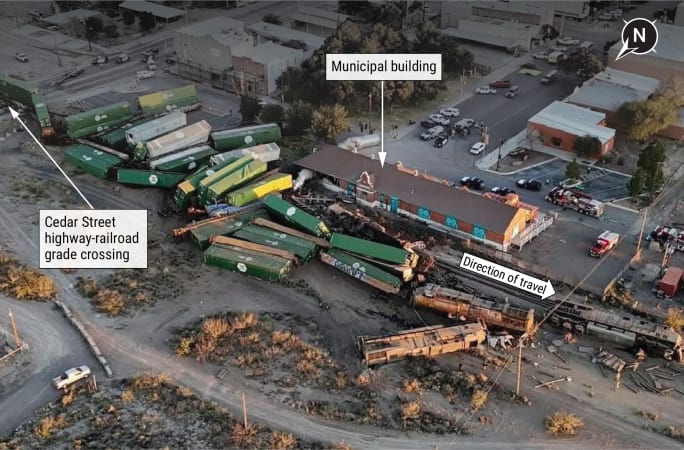
In December 2024, for instance, in Pecos, Texas, a tractor-trailer pulling an oversize load got stuck on a grade crossing. The collision derailed the four head-end locomotives and first 11 railcars, killing two on the train. The load, a demethanizer tower, was 12 feet wide, 116 feet long, and 91,000 pounds.
Professional drivers have critical decisions to make at every turn. With over 140,000 miles of track across the country and over 200,000 locations where roadways cross railroad tracks, it’s imperative that drivers know what to do when they see railroad signs and signals.
Ad Loading...
Over 60% of vehicle-train collisions occur at crossings with active warnings (lights and/or gates).
How Truck Drivers Can Safely Cross Railroad Tracks
According to a document from the Federal Railroad Administration, the American Trucking Associations, and Operations Lifesaver Inc., as you approach a grade crossing:
Never ignore flashing lights, whistles, closing gates, or stop signs.
Slow down, look in both directions, and test your brakes.
Be certain you don't see a train.
Roll down windows; turn off fans and radios; listen for warning whistles.
If a stop is needed, stop no closer than 15 feet and no farther than 50 feet from the tracks.
Never enter a crossing unless you have enough space to fully clear the tracks.
If the gate comes down after you have started across, keep moving! Drive through the gate even if it means breaking the gate — the gate is designed to break.
Understanding the ENS Sign
What if, despite taking the appropriate precautions, it’s not enough? Or if you see other emergencies at a railroad crossing?
There's an App for That!
The Federal Railroad Administration has a free Rail Crossing Locator Mobile App, downloadable from the Apple App store and the Google Play store. The app pulls data from the FRA highway-rail grade crossing database, and lets you map information on crossing locations right from your mobile device. The tool allows you to locate crossings by USDOT Crossing ID, address or geo-location. The crossing information includes the specific ENS emergency number for the location.
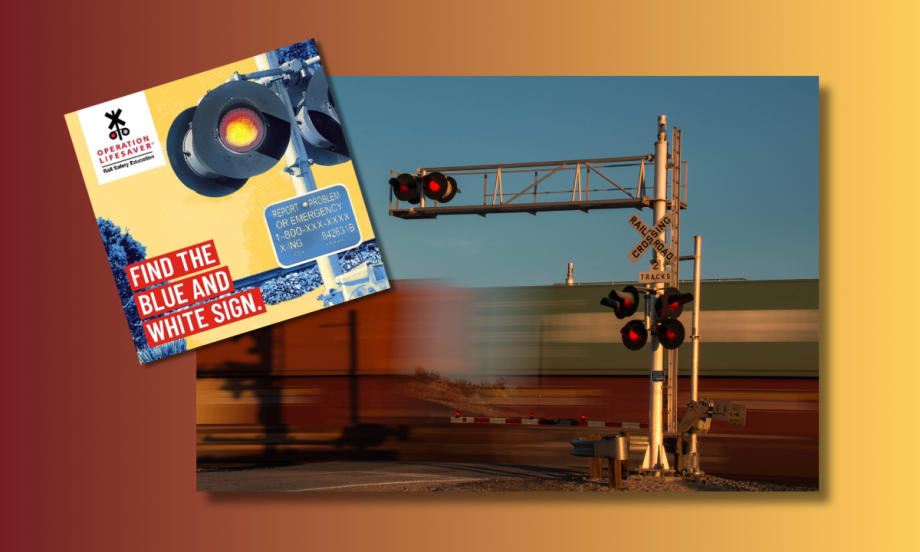
Emergencies on or around railroad tracks and trains demand swift action. Truckers and professional drivers can play a critical role in preventing rail-related incidents by knowing how to use the Blue and White Emergency Notification System (ENS) sign.
Ad Loading...
These rectangular blue and white signs display a unique phone number and specific crossing ID number, allowing direct communication with the railroad.
Calling the number on this sign is the quickest way to stop rail traffic in an emergency.
When multiple tracks are present, ENS signs may differ on either side of the road, so it is crucial to safely locate and use the correct one.
If a vehicle is stuck or stalled on the tracks, debris is spotted, or any other hazard arises, calling the number on the ENS sign can alert the railroad to stop oncoming trains and help prevent incidents.
What to Do in an Emergency
If your vehicle stalls or gets stuck on the tracks, exit immediately and move to a safe location away from the tracks — even if you don’t see a train.
From a safe distance, locate the ENS sign, call the number and provide the crossing ID. No sign? Call 911.
If you see someone stuck or stalled on the tracks or any other hazard, safely locate the ENS sign, call the number and share the crossing ID. No sign? Call 911.
Dispatchers should be aware of ENS signs, how and why to use them and to request this info from drivers.
Ad Loading...
The National Transportation Safety Board investigated a train-truck crash in December 2024.
Source: NTSB
Safety Tips for Railroad Crossings
If you see tracks, you should always think train. Always assume railroad tracks are active and always expect a train on any track, at any time, in either direction. Multiple tracks means multiple trains.
Know about the blue and white ENS signs and how to use them.
Avoid parking or stopping on tracks. Trains overhang the tracks, move faster than they appear, and are quieter than expected. By the time an engineer sees something on the tracks, it’s too late.
If your vehicle won’t fit, don’t commit. Trains are wider than tracks. Make sure there is enough room on the other side for the back of your vehicle (and cargo) to completely clear the tracks.
Track heights vary. If you drive a low-clearance vehicle, be aware of raised crossings.
Once you begin crossing the tracks, do not hesitate. Cross without stopping.
If stuck or stalled on the tracks, evacuate immediately and call the number on the blue and white ENS sign. Give the crossing identification number so the railroad knows your location.
Know the law. Trucks carrying hazardous materials are required to stop at all crossings unless there is an exempt sign posted at the crossing.
Free OLI Rail Safety Resources
Operation Lifesaver Inc. (OLI), a national rail safety education nonprofit, works every day across the U.S. to #STOPTrackTragedies through education and public awareness campaigns through programs in 47 states and Washington, D.C.
OLI offers a variety of free materials educating truckers and professional drivers about the importance of making safe choices around tracks and trains. That includes in-person and virtual safety trainings, brochures, posters, public service announcements, online video games, and more.
Consider requesting free rail safety education presentations for your company. OLI has trained volunteers across the nation that can offer free customized in-person and virtual rail safety presentations tailored to any audience, including truckers. Sign up at oli.org/request-presentation
OLI’s Pro-Driver eLearning provides professional truck drivers with crucial info to safely navigate highway-rail grade crossings. Drivers just need to log on and complete the program.
Ad Loading...
See Tracks? Think Train Week is Sept. 15-21, 2025.
About the Author: Jennifer DeAngelis is director of communications and marketing for Operation Lifesaver Inc. HDT Editor & Associate Publisher Deborah Lockridge contributed to this article.
Carriers whose updates were due on or after June 1 have more time, while FMCSA works to stabilize its new registration system and warns of phishing sites impersonating its new carrier registration system, Motus.
ZF is expanding its North American commercial-vehicle presence with new transmission applications, electrification, trailer technology and autonomous-driving systems.
Fleets have more visibility into truck health, safety events, and driver activity than ever. The next challenge is turning all that information into useful guidance for the person who has to decide what to do next.
Could Tesla’s camera-only autonomous driving technology work on an 80,000-pound Semi? In this commentary, HDT's Deborah Lockridge takes a look at Tesla, Cybercab, and how autonomous trucks see the road.
The U.S. Department of Transportation issued a new automated-vehicle strategy that outlines plans for driverless-truck regulations, cross-state freight corridors, and federal safety standards.
New York City is expanding intelligent speed assistance and pedestrian-alert systems across its municipal fleet, moving the technologies from pilot programs into vehicle procurement and retrofit requirements.
Federal regulators also are targeting more than 160 additional training providers and launching a nationwide audit of third-party CDL skills testers as part of a broader crackdown on trucking fraud.
Two pilot programs could eventually reshape hours-of-service rules, giving truck drivers options to pause their 14-hour clock or use longer split sleeper rest periods.
Hundreds of thousands of pets travel in truck cabs. A new safety guide from Volvo Trucks and the Center for Pet Safety offers practical advice for truck drivers who bring dogs and cats along for the ride.