




Related: Submit Your Ideas for the 2016 Fleet Safety Conference
A Safety Director Offers Steps to Success
A fleet safety director offers tips on how to successfully promote safety within a fleet.
by Mitzi Hartman
December 2, 2015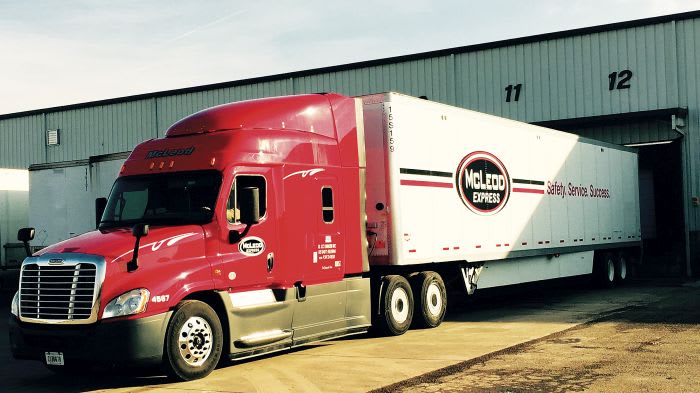
Hartman does not hesitate to tell drivers that they are the most important part of McLeod’s business at the beginning of each orientation and througout their employment. Photo: McLeod Express
5 min to read
Hartman does not hesitate to tell drivers that they are the most important part of McLeod’s business at the beginning of each orientation and througout their employment. Photo: McLeod Express
We need to identify ways to help promote safety in our fleets. First, we need drivers to understand how important they are to our success. Then we need to look at ways to add valuable time to our schedules by training others what we know, while expanding safety knowledge throughout our company. We need to take our new-found time and analyze data to find areas that need attention. Then we need to implement solutions. Lastly, we need to revisit the data to make sure we have made the impact we expected.
We all know drivers are the most important piece of our business. After all, they pay our salaries. I do not hesitate to tell them that at the beginning of each orientation and remind them during their employment whenever I have the chance.
I also take the time to explain that our customers pay their salaries. Therefore, we rely on them to treat the customer with the same respect and professionalism they deserve and should expect from us. Drivers are more likely to care about themselves, their jobs, and operating safely if we show them we appreciate their efforts toward safety and service.
The best way to show them is not just through pay targeted toward safety and service, but also through communication. One-on-one, in-person conversation goes a long way in showing drivers how much they mean to your business. It shows them we listen, we care, and they are not just another body in a truck.
Taking this a step further, we should know our drivers by name. I don’t know how many times I have had a driver say, “I can’t believe you remembered me.” Other ways to help drivers care about their job and safety is to have an open door policy, ask them for suggestions, keep them informed of what is going on, recognize their accomplishments (big or small), establish good competitions (such as best fuel mileage or a weight loss program), and provide attainable incentive programs. Some of these things cost very little money but make a huge difference.
Second, we need to make sure that every department realizes that safety is our number one priority. We expect safety to be part of their dialogue when speaking to our drivers. We want our drivers to go home safely to their families. Explain that injuries can be serious, accidents can be fatal, and catastrophic events are hard to recover from physically, emotionally, and financially.
We all have a responsibility to promote safety in the workplace. Arranging safety training and education for our non-driving employees is just as important as initial, recurring and remedial training for our drivers.
We believe hands-on training is much more effective than “video only” training. And having a feedback system that measures comprehension is important. Whether it is with short tests or even open discussion where participation is mandatory, we need to be sure drivers and employees understood the training content.
Having solid policies and procedures in place is key. They must be written, and employees should sign a receipt or acknowledgement of receiving them. We must follow them and be consistent. That shows drivers fairness in application and helps to dispel the concern that the company plays favorites. We should review these manuals, policies, documentation on a scheduled basis. If updates are made, acknowledgements should be signed again, with updates listed and dated. Communicate any new policies well to avoid misunderstandings later.
As safety managers, the first thing we must examine before we start delving into how we can make really effective safety programs that produce positive results is … ourselves. Without applying the appropriate needed time toward our safety programs, we are just spinning our wheels and gaining zero ground. We can travel many miles in a day with our “busy-ness” and still be going backwards. We need to think smarter, not harder. We are full of knowledge through our experiences, things we’ve learned at seminars, through an audit, reading regulations, and so on. The only way to increase our value is by teaching others what we know. We make our employees more valuable while increasing our own value to the organization.
Think about ways you can mainstream some job duties — cross train. We say we don’t have time to train, but in reality we don’t have time to make a difference if we don’t train. Measuring our success is done by analyzing data. If we don’t have time to analyze data, we have no clue where we are at or if we are even making a difference.
We often want to “talk” our way into getting upper management buy in. Talk is cheap. Safety programs aren’t … up front. We must do our homework and be able to show the likelihood of return on investment on new programs or equipment. Be able to explain the expected impact of the program and what results you hope to achieve. When compiling data, make sure it is accurate. Compare data with previous performance. Show both improvements and deficiencies. We need to know where our problems lie, so we can fix them.
Once issues are found, determine a solution, whether it be a safety campaign, technology, training, short term incentive plan, etc. Communicate the solution effectively via newsletters, memos, or meetings. Report the outcome. Did our solution work? If so, great. If not, go to plan B and try again.
Mitzi Hartman started working in the trucking industry in 1988 as a dispatcher. For the last 20 years she has been at McLeod Express in Decatur, Ill., where she has been director of safety since 2007.
This is a recap of a presentation she gave at this year’s Fleet Safety Conference put on by HDT and sister Bobit Business Media publications. Hartman is a Certified Director of Safety, a Smith System Driver Trainer, has spoken publicly for the Illinois Trucking Association, and is on the ITA’s Safety & Maintenance Council.
Subscribe to Our Newsletter
More Safety & Compliance

FMCSA Pauses Biennial-Update Enforcement Amid Motus Transition
Carriers whose updates were due on or after June 1 have more time, while FMCSA works to stabilize its new registration system and warns of phishing sites impersonating its new carrier registration system, Motus.
Read More →
ZF Expands Commercial Vehicle Push in North America
ZF is expanding its North American commercial-vehicle presence with new transmission applications, electrification, trailer technology and autonomous-driving systems.
Read More →
Truck Drivers Need More Than Another Alert
Fleets have more visibility into truck health, safety events, and driver activity than ever. The next challenge is turning all that information into useful guidance for the person who has to decide what to do next.
Read More →
Tesla Wants a Self-Driving Semi. Are Cameras Enough?
Could Tesla’s camera-only autonomous driving technology work on an 80,000-pound Semi? In this commentary, HDT's Deborah Lockridge takes a look at Tesla, Cybercab, and how autonomous trucks see the road.
Read More →
What DOT’s Automated Vehicle Strategy Means for Trucking
The U.S. Department of Transportation issued a new automated-vehicle strategy that outlines plans for driverless-truck regulations, cross-state freight corridors, and federal safety standards.
Read More →
NYC Expands Speed, Pedestrian Safety Tech Across Fleet
New York City is expanding intelligent speed assistance and pedestrian-alert systems across its municipal fleet, moving the technologies from pilot programs into vehicle procurement and retrofit requirements.
Read More →
FMCSA Removes 110 Truck Driver Training Schools from Certified ELDT List
Federal regulators also are targeting more than 160 additional training providers and launching a nationwide audit of third-party CDL skills testers as part of a broader crackdown on trucking fraud.
Read More →
Beyond DOT Compliance: What Makes a Trucking Fleet Truly Safe?
A trucking fleet can follow every rule and still make unsafe decisions. The real test comes when safety conflicts with freight, productivity, or cost.
Read More →
Hours of Service Pilot Programs: FMCSA Readies for 2027 Rollout
Two pilot programs could eventually reshape hours-of-service rules, giving truck drivers options to pause their 14-hour clock or use longer split sleeper rest periods.
Read More →
New Guide Offers Pet Safety Tips for Truck Drivers
Hundreds of thousands of pets travel in truck cabs. A new safety guide from Volvo Trucks and the Center for Pet Safety offers practical advice for truck drivers who bring dogs and cats along for the ride.
Read More →