




You also might like: What Happens When FMCSA Comes to Audit Your Driver Logs?
5 Things Fleets Need to Know About FMCSA Off-Site Audits
Is an off-site safety audit in your future? The COVID-19 pandemic was a game-changer for off-site compliance reviews. FMCSA off-site audits increased by 400% in 2020 and are on track to nearly double in 2021.
by Brandon Wiseman, Trucksafe Consulting
July 14, 2021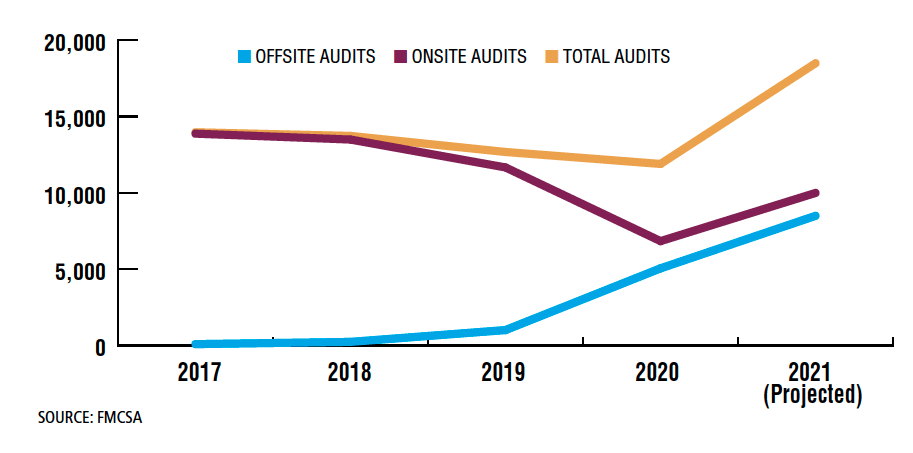
As the offsite review process became more streamlined and reliable, FMCSA slowly began to ramp them up. Then came COVID-19.
HDT graphic. Source: FMCSA via Trucksafe Consulting
8 min to read
If COVID-19 has taught us anything, it’s how to adapt. Prior to the pandemic, approximately 17% of U.S. employees worked from their homes five or more days per week, a number that skyrocketed to nearly 50% during the pandemic. Many employers and workers who swore working remotely was not a viable solution quickly changed their tune. Some organizations have even permanently transitioned to a remote workforce.
The pandemic posed just as much of a challenge to government agencies. Some shut down completely, and those that didn’t had to find new ways to effectively function. That was and continues to be the case with the Federal Motor Carrier Safety Administration, the federal agency charged with regulating the nation’s nearly 600,000 registered motor carriers.
One of the primary ways the FMCSA enforces its highway safety regulations is through compliance reviews. These historically have been on-site audits of a motor carrier’s records, including those pertaining to insurance, driver qualification, hours-of-service, drug/alcohol testing, and more. Depending on the size of the carrier, these audits could last weeks on end, and frequently result in the issuance of one of three safety ratings: satisfactory, conditional, or unsatisfactory.
As federal agencies go, the FMCSA is a relatively small one, so getting out to physically audit any significant number of motor carriers each year has always been a struggle. This has led the agency to develop systems and processes — namely its Compliance, Safety, Accountability or CSA, program — to prioritize carriers for enforcement based primarily on their roadside inspection performance. Carriers with a higher frequency of roadside violations than their peers are more likely to be targeted for an audit.
Even with this prioritization system in place, the agency lacks the resources to conduct onsite audits of any significant number of carriers each year. For this reason, it has experimented with so-called off-site or desk audits over the past few years. The primary benefit of these reviews, of course, is they allow the agency’s investigators to review documents from their own offices, cutting down the time and expense of traveling to and from a carrier’s terminal, and relying, instead, on the electronic transfer of documents.
Prior to the pandemic, the agency typically reserved these off-site reviews for less intensive circumstances, such as new entrant safety audits and focused reviews — those involving a lower volume of paperwork. However, as the off-site review process became more streamlined and reliable, the agency slowly began to ramp them up. And then came COVID-19 — a complete game-changer for off-site reviews.
1. FMCSA’s Use of Offsite Audits is Increasing
FMCSA off-site audits increased by 400% in 2020 and are on track to nearly double in 2021.
From 2017 to 2018, the agency conducted only 329 off-site audits, compared to more than 27,000 on-site reviews over that same period. This meant off-site audits accounted for only 1.2% of the total number of audits conducted during those years.
As the agency worked to ramp up these reviews pre-pandemic, the number of off-site reviews grew to 1,013 in 2019, or nearly 8% of the total audits conducted that year.
In 2020 — the start of COVID-19 — the number grew by just under 400% to 5,058 and accounted for just over 45% of the total audits conducted last year. To be sure, this rapid growth was mostly out of necessity, with travel restrictions and business closures hampering the agency’s efforts to conduct onsite reviews. But that’s not the end of the story.
According to FMCSA data, the agency has already conducted close to 3,500 off-site reviews as of the end of May 2021, as compared to approximately 4,000 on-site reviews over that same period. At this pace, the agency’s investigators are on track to perform nearly 8,500 off-site audits by the end of the year, a 68% increase year-over-year and a whopping increase of nearly 2500% from 2017!
With the pandemic-forced ramp-up serving as a proof of concept, off-site audits appear to be the new norm. Not only do they consume fewer resources, but they also allow the FMCSA to expand its enforcement reach—a goal the agency has been striving to achieve for years.
So, what does this mean for regulated carriers?
2. More Audits Mean More Safety Fitness Determinations
Safety fitness determinations (more commonly known as safety ratings) come in three varieties: satisfactory, conditional, and unsatisfactory. According to the FMCSA’s safety rating methodology, a satisfactory rating means a carrier has “in place and functioning adequate safety management controls,” which are “appropriate for the size and type of operation of the particular motor carrier.”
A conditional rating means the carrier lacks adequate safety management controls, which could lead to significant violations and accidents. And an unsatisfactory rating means the carrier’s lack of effective safety management controls has led to significant violations and/or accidents.
Carriers that get unsatisfactory ratings are prohibited from operating commercial motor vehicles in interstate or intrastate commerce — a death blow for their businesses. Carriers that receive conditional ratings can continue to operate while they work to improve, but they may very well see a hike in their insurance premium or a loss of business from customers not willing to accept the risk of working with a conditionally rated carrier.
Although the FMCSA has toyed with the idea of assigning safety ratings to carriers based in part on their CSA scores, this approach has never gained much traction. Currently, only carriers that have been through comprehensive compliance reviews have a safety rating. And because most regulated carriers have not yet been audited, most carriers operating in the U.S. are currently unrated.
As the FMCSA continues to broaden its enforcement reach through off-site audits, the number of carriers that are assigned a safety rating is bound to rise. We haven’t seen this play out quite yet, as the number of safety fitness determinations dipped in 2020 and is on a similar trajectory for 2021. Why is that? It’s likely because the agency’s off-site audits have traditionally been more focused in scope, and focused audits have not historically led to the assignment of a safety rating. That said, as the agency becomes more comfortable with and confident in its off-site audits, it seems inevitable those audits will result in safety ratings.
Indeed, earlier this month, the FMCSA published a final rule, which, although largely devoted to technical amendments to its safety regulations, included provisions that clear the way for the agency to rely more heavily on comprehensive off-site audits.
“The amendments, [by] removing the word ‘on-site’ from the definitions of Compliance review and Roadability review in § 385.3, recognize the technological advances that allow FMCSA to perform the same investigative functions remotely in some cases that it could perform previously only by in-person reviews of the motor carrier's files.” See 86 Fed. Reg. 35,633 (July 7, 2021).
3. Off-site Audits Can Lure Carriers into a False Sense of Security
Carriers that have been through both off-site and on-site FMCSA audits will usually tell you they prefer off-site audits. This is because, historically, off-site audits have been less intrusive and more casual than their on-site counterparts. And because off-site audits have been more focused in nature, often involving smaller sample sizes and rarely resulting in the issuance of safety ratings, the stakes haven’t been as high.
But now that FMCSA has paved the way for more comprehensive off-site reviews, carriers need to be more cautious when selected for such a review. When there’s no one with a badge sitting in your conference room reviewing records, it’s tempting to think of these reviews as more of an irritant than anything, but it’s imperative you keep your guard up. Nowadays, off-site audits can just as quickly go sideways as an on-site review, leading to less-than-satisfactory ratings and civil penalties.
4. Carriers with Electronic Recordkeeping Have an Advantage
One of the biggest benefits of off-site audits to both the FMCSA and carriers is the paperwork reduction. I’ve sat through many onsite audits where the volume of paperwork was unbelievable — stacks of driver qualification files and hours-of-service records literally filling entire offices.
But off-site audits present a new challenge for carriers that have yet to transition to electronic recordkeeping. In off-site audits, the FMCSA requires carriers to upload records through their Safety Measurement System account. This means that if you maintain the requested records in hardcopy, you will first have to digitize them to transfer them to the investigator. That may not be a tall task for certain records, but could be unmanageable for others (such as driver qualification files).
5. The Time to Prepare is Now
As the FMCSA continues to rely more heavily on off-site audits, carriers need to adapt to this changing landscape. Now is a great time to take stock of your safety program, asking whether your records are complete and suitable to transfer to the FMCSA in the event you are selected for an audit.
It’s also important you have a detailed plan in place for such an occasion. Who will be the primary point of contact? Which internal team members will need to be involved? How quickly can you gather and produce the requested records?
One thing’s for sure, you do not want to be caught off guard when the FMCSA comes knocking — the stakes are too high!
Brandon Wiseman is a partner with Childress Law, PLLC, and president of Trucksafe Consulting, a provider of innovative DOT safety consulting services, resources, and training content. This article was authored and edited according to HDT editorial standards and style to provide useful information to our readers.
Subscribe to Our Newsletter
More Safety & Compliance

FMCSA Pauses Biennial-Update Enforcement Amid Motus Transition
Carriers whose updates were due on or after June 1 have more time, while FMCSA works to stabilize its new registration system and warns of phishing sites impersonating its new carrier registration system, Motus.
Read More →
ZF Expands Commercial Vehicle Push in North America
ZF is expanding its North American commercial-vehicle presence with new transmission applications, electrification, trailer technology and autonomous-driving systems.
Read More →
Truck Drivers Need More Than Another Alert
Fleets have more visibility into truck health, safety events, and driver activity than ever. The next challenge is turning all that information into useful guidance for the person who has to decide what to do next.
Read More →
Tesla Wants a Self-Driving Semi. Are Cameras Enough?
Could Tesla’s camera-only autonomous driving technology work on an 80,000-pound Semi? In this commentary, HDT's Deborah Lockridge takes a look at Tesla, Cybercab, and how autonomous trucks see the road.
Read More →
What DOT’s Automated Vehicle Strategy Means for Trucking
The U.S. Department of Transportation issued a new automated-vehicle strategy that outlines plans for driverless-truck regulations, cross-state freight corridors, and federal safety standards.
Read More →
NYC Expands Speed, Pedestrian Safety Tech Across Fleet
New York City is expanding intelligent speed assistance and pedestrian-alert systems across its municipal fleet, moving the technologies from pilot programs into vehicle procurement and retrofit requirements.
Read More →
FMCSA Removes 110 Truck Driver Training Schools from Certified ELDT List
Federal regulators also are targeting more than 160 additional training providers and launching a nationwide audit of third-party CDL skills testers as part of a broader crackdown on trucking fraud.
Read More →
Beyond DOT Compliance: What Makes a Trucking Fleet Truly Safe?
A trucking fleet can follow every rule and still make unsafe decisions. The real test comes when safety conflicts with freight, productivity, or cost.
Read More →
Hours of Service Pilot Programs: FMCSA Readies for 2027 Rollout
Two pilot programs could eventually reshape hours-of-service rules, giving truck drivers options to pause their 14-hour clock or use longer split sleeper rest periods.
Read More →
New Guide Offers Pet Safety Tips for Truck Drivers
Hundreds of thousands of pets travel in truck cabs. A new safety guide from Volvo Trucks and the Center for Pet Safety offers practical advice for truck drivers who bring dogs and cats along for the ride.
Read More →