




5 Must-Have Tools for Your Tire Shop
Changing truck tires isn't rocket science. Since tire service isn't cheap, it's not uncommon to find smaller fleets and even some bigger ones doing their own tire maintenance. But safety needs to be the priority in any shop.

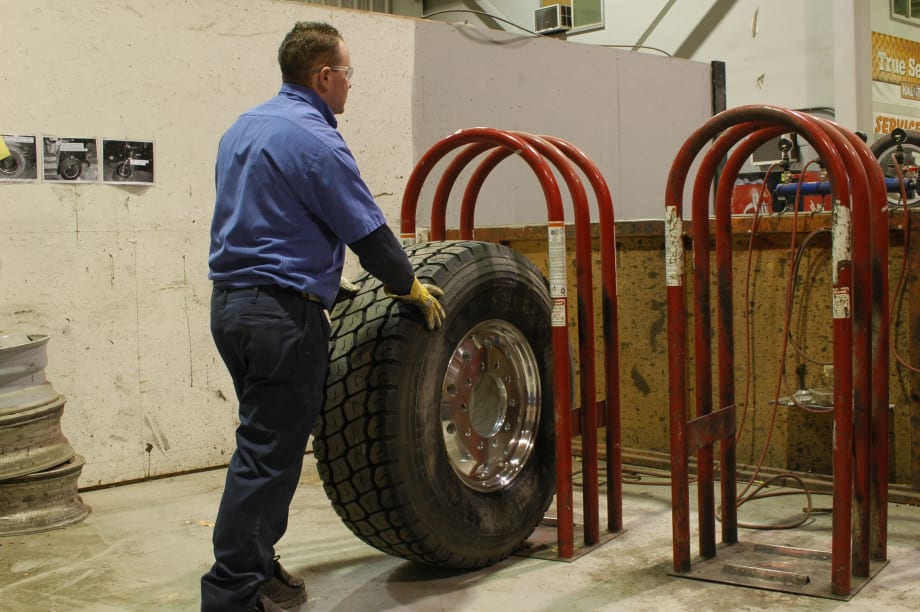

Changing truck tires isn't rocket science. It's a skill diligent technicians can get proficient on in a few days. Since tire service isn't cheap -- because the good shops invest in the training and tools needed for the job -- it's not uncommon to find smaller fleets, and even some of the bigger ones, doing their own tire maintenance.
Larger fleets might well have a tire bay and a fully equipped shop with a few trained and certified technicians on staff, while smaller fleets may be tempted to make do with available space, manpower and tools.
While there are Occupational Safety & Health Administration regulations and procedures for mounting and installing heavy truck tires, sometimes a few critical tools might be absent from the tool crib. When it comes to tire installation, there's no room for make-dos or this-will-do-in-a-pinch tools.
Todd Labbe, the "Metro Manager" of a Wingfoot Commercial Tire outlet in Brunswick, Ohio, says safety has to be the first priority in any shop -- in his case, even before customer service.
"It can be dangerous job, and that's why we have all the OSHA programs in place as well as a number of our own, developed by Goodyear and the Tire Industry Association," he says. "We have a number of zero-tolerance items on our safety check lists that carry immediate dismissal warnings. On top of that we have all the proper tools and equipment, and we use them they way they were intended."
Here's a short list of five tools you must have before you begin mounting and installing you own tires.
1) Tire Cage
Tire cages are mandated by OSHA. Any tire inflated off the vehicle must be inflated inside a safety cage. Their purpose is to protect the operator from rapidly deflating (exploding) tires. Prior and unseen damage, improper mounting or other reasons can cause such a rapid deflation, and you don't want to be anywhere nearby when it happens. The bottom line is a tire cage is designed to contain the blast to some extent, and to absorb some of the energy from the rapid discharge of air from the tire and wheel assembly.
Tire cages should never be bolted to the floor or placed near a wall. They must be inspected before every use. Any cracks, corrosion or damage will reduce the cage's effectiveness at restraining an exploding tire.
It's cheap and easy to lean a tire against the wall while inflating it, but as you'll see in a video from tire cage manufacturer Branick Industries, it's not a recommend practice -- in fact, it's prohibited. If you're mounting and demounting your own tires, you need to invest in a tire cage. If I were a technician, I would never even think of inflating a tire outside a cage. Check out the video, you'll see why.
2) Remote Inflation System

Having a tire technician standing beside a tire holding the air chuck to the valve stem defeats the purpose of the cage. Using a remote inflation system with a pressure-limiting regulator, a remote shut off and a clip on air chuck keeps the technician out of harm's way.
The installation in the photo has a manifold allowing several tires to be inflated simultaneously. The tech can still see what's going on, but from a safe distance. There is of course an OSHA recommended procedure for doing this, which we'll cover in a subsequent story.
The bottom line is, keep the technicians away from the inflating tire to prevent injuries from potentially exploding tires. It's not a complex installation, and it can fit onto an existing shop air system. For a small investment, you'll be keeping your tire technicians safe and complying with OSHA regulations.
3) Tire Bead Seating Tool
A heavy truck tire that has been properly mounted with the recommended lubricant on the tire bead and wheel bead seats will usually seat properly as the first burst of air comes through the valve -- but not always. It's permissible under OSHA to put enough pressure in the tire to seat it and hold in on the wheel before placing it in the inflation cage; usually no more than 20 psi.
If the bead fails to seat, there's always Plan B, which does not include the use of engine starting fluid. A bead seating tool, such as the Cheetah CH-5 Tire Bead Seater, puts a large volume of air into the tire quickly pushing the bead up onto the seats, thus seating it first time every time. Such tools are good to have in the tool crib, lest your technicians be tempted to try pyrotechnics to seat ornery tires. [PAGEBREAK]
4) Torque Wrench

Who hasn't seen a tire guy whaling away on wheel lug nuts with a big 1-inch impact wrench? Sure, it gets the nut on tight, but how tight is anybody's guess.
Too tight and it can stretch the stud and damage the nut. Not tight enough and the nut could easily come off, along with the other nine nuts and your wheel. Nobody wants a wheel-off incident, but a surprising number of small operators court disaster everyday by not using the proper tool to install truck wheels, namely, a calibrated torque wrench.
The Technology & Maintenance Council of the American Trucking Associations, the Tire and Rim Association, and several other groups have specific torque requirements for wheel fastening hardware. You can't even get into the ballpark with a conventional impact wrench. Impact wrenches are fine for running the nuts onto the studs and getting the wheel centered on the hub pilots, but that's as far as their usefulness goes. The final couple of turns on the nut should be made with a calibrated torque wrench.
5) The Instructions
Many males have this thing about instructions. Here, a good case can be made for making sure your tire technician -- who in some really small fleets may also be the dispatcher and recruiter -- has been trained and certified in truck tire and wheel installation. In fact, it's required under regulation. As a fleet owner, you'll be under the microscope if the company is involved in a wheel-related failure, so training certificates and proper policy and procedures manuals are vital.
These are available from TMC, OSHA, the Rubber Manufacturers Association and other organizations as well as private sector suppliers such as J.J. Keller & Associates.
Because it's relatively easy to get a tire off and back onto a truck, doing it yourself can seem like an easy to save a few bucks on a professional service call. But don't kid yourself. Having the right tools is just the beginning.
Tooling a shop and certifying technicians for tire work can be an expensive undertaking. Couple that with the difficulty finding trained technicians, as well as the liability inherent with tire service, it's easier to see why many fleets opt to outsource their tire work.
Southeastern Freight Lines' tire manager, Harold Black, says his technicians do no repairs or tire breakdown work -- it's all outsourced.
"Our technicians are responsible only for airing up tires that are not flat, for conducting inspections, and removing and installing tires on vehicles," Black says. "We have a policy requiring any tire that is less than 80-percent inflated -- for us, this is 80 PSI -- to be removed from the vehicle and sent to our vendor for inspection, evaluation and possible repair."
Black says his technicians will do only the odd bead-seating job in the shop, but he still has to have all the prescribed safety equipment.
Just remember before you start, there's a reason the pros charge real money for the service. You can do it yourself, but make sure you have the right tools before you start.
More Maintenance
What Three Fleets Are Doing Differently When Buying Truck Parts in 2026
With freight improving but costs still climbing, fleet maintenance executives explain how they're balancing price, quality, and supplier relationships.
Read More →
Paccar Recalls 2027 Trucks Built This Summer for Possible Electrical Problem
The nearly 6,000 Kenworth and Peterbilt trucks in the recall could potentially lose engine power, among other things.
Read More →
Will API PC-12 Oil Change Trucking Fleet Maintenance?
The new API PC-12 heavy-duty engine oil category reflects the changing demands of modern diesel engines. But fleets like Foodliner are looking to getting their own data before making decisions on adopting the new oils and questions such as extending oil drain intervals.
Read More →
Brake Safety Week to Focus on Drums and Rotors
Commercial vehicle inspectors will be focusing on brakes during CVSA's Brake Safety Week, August 23-29.
Read More →
Possible Battery-Cable Fires Prompt Recall of 15,000+ International MV and HV Trucks
On the recalled vehicles, manufacturing variations can cause the battery interconnect cable to contact the auxiliary stud and hold down the bracket.
Read More →
Rush, MCT Team Up to Grow Refrigeration Service Network
The joint venture will operate MCT's network of Carrier Transicold dealerships and mobile service locations, with the companies promising greater service capacity and uptime for refrigerated fleets.
Read More →
ConMet Expands Aftermarket Brake Drum Lineup With TruCast
A new heavy-duty truck brake drum option in the aftermarket gives customers more flexibility within the ConMet product family.
Read More →
Mack Expands Premium Service Contract Coverage to Medium-Duty MD
With a service contract, inspections, preventive maintenance and repairs can be handled in a single visit instead of multiple ones.
Read More →
Maintenance in the Messy Middle Part 5: Battery-Electric Trucks
No oil changes. No diesel exhaust fluid. No exhaust aftertreatment. But NACFE battery-electric trucks still require specialized maintenance procedures.
Read More →
Trucking Fleets Faced Record Operating Costs During Third Year of Freight Recession
ATRI's annual operational cost report shows carriers trimmed fleets, delayed equipment purchases, and ran older trucks as expenses continued to outpace freight rates.
Read More →