




Related: 7 Ways Aerodynamics Save Fuel
4 Ways Drivers Can Dial Up MPG
An accomplished owner-operator offers his advice on what it takes to drive fuel efficiently. He contends that if drivers want to achieve high fuel economy numbers, they simply cannot drive like they always have.
by Jack Roberts
June 28, 2016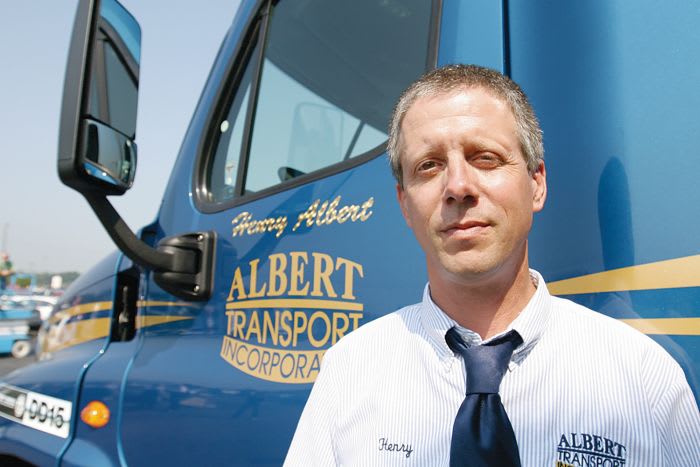
Henry Albert, veteran owner-operator from Mooresville, N.C., is exceptionally good at squeezing more miles out of each gallon of fuel. Photo: Albert Transport
3 min to read

Henry Albert, veteran owner-operator from Mooresville, N.C., is exceptionally good at squeezing more miles out of each gallon of fuel.Photo: Albert Transport
If there’s a driver on the road today who embodies how crucial the contribution of the professional behind the wheel is to fuel efficiency, it’s Henry Albert. The long-time owner-operator, who runs dedicated routes west out of his base in North Carolina, serves on Freightliner’s Team Run Smart, a group of drivers who showcase the latest trucks and technology from Daimler Trucks North America in real-world driving conditions.
Albert has made boosting mpg a high priority, adopting or testing every piece of fuel saving-technology he can. He once took a circular saw to his trailer mud flaps because he felt they were creating too much aerodynamic drag. He says consistent 10-mpg runs are still hard to achieve, but he did recently manage to hit a personal high of 11.4 mpg – for the entire trip.
He contends that if drivers want to achieve high fuel economy numbers, they simply cannot drive like they always have. Here are Albert’s top tips for boosting fuel economy:
1. Slow her down.
As an owner-operator, Albert has to make calculations as to what’s in his best interest on every trip. “Sometimes, there’s more money to be made by speeding up and getting the load there. But most times … I’m in full, fuel economy-optimized cruise control, tooling along all day at 62 mph.”
2. Stop Smart.
Albert plans meals, fuel, and rest stops to maximize fuel economy. “If I’m in mountainous terrain, I choose truck stops at the top of hills. I also identify truck stops with good layouts so I don’t have to spend a lot of time in low gears maneuvering around. Drivers can burn a lot of fuel just trying to get fuel. If you pull out of a hilltop truck stop, gravity is going to help you get the truck back up to highway speed without burning a bunch of diesel in the process.”
3. Keep a light foot.
While Albert is a fan of automated manual transmissions, he says most older drivers still put their foot in the throttle like they’re driving a manual. “A light touch on the throttle goes a long way with an AMT. You see a guy in low gears, with the truck jerking and jumping – he’s giving the ATM too much throttle and over-revving the engine. It’s ugly, uncomfortable and it just burns fuel up.”
4. Understand technology.
Drivers need to understand how to get the most out of today’s smart powertrains. “You have two types of drivers: Those who are constantly overriding technology, and drivers who never lift a finger, no matter what the ‘smart’ powertrain is doing. You need to know when to intervene, and when to leave technology alone. Remember: You send the truck a message with where you set your controls and your throttle. If you don’t like the response, change the message.”
Subscribe to Our Newsletter
More Drivers

Truck Drivers Need More Than Another Alert
Fleets have more visibility into truck health, safety events, and driver activity than ever. The next challenge is turning all that information into useful guidance for the person who has to decide what to do next.
Read More →
FMCSA Removes 110 Truck Driver Training Schools from Certified ELDT List
Federal regulators also are targeting more than 160 additional training providers and launching a nationwide audit of third-party CDL skills testers as part of a broader crackdown on trucking fraud.
Read More →
Hours of Service Pilot Programs: FMCSA Readies for 2027 Rollout
Two pilot programs could eventually reshape hours-of-service rules, giving truck drivers options to pause their 14-hour clock or use longer split sleeper rest periods.
Read More →
Medical Cards, English Proficiency Reshape Roadcheck Violations
Medical-card violations jumped to the top of the driver out-of-service list during CVSA’s 2026 International Roadcheck, while English-language proficiency violations appeared among the leading violations for the first time.
Read More →
Driver Trust Can Make or Break the Success of Fleet Safety Technology
New Teletrac Navman research suggests that onboarding, transparency about driver data, and positive feedback can play a significant role in how commercial drivers respond to safety and coaching technology.
Read More →
EEOC Sues KLLM Over Alleged Sex Discrimination in Driver Training
KLLM is facing a federal sex-discrimination lawsuit over policies the EEOC alleges put female truck driver trainees at a disadvantage.
Read More →
FMCSA Moves to Codify English Language Requirements for Commercial Drivers
By changing regulations on English-language proficiency requirements for commercial drivers, rather than relying on a guidance memo, the FMCSA said future administrations won't be able to walk back the Trump administration's stricter enforcement with just a memo.
Read More →
Drivers Put Western Star Trucks to the Test at Star Nation Experience
Watch to get an inside look at the Western Star trucks, technology, and community behind the Star Nation Experience 2026!
Read More →
Trump Administration Looks to Put More Veterans Behind the Wheel
The Freedom Haulers program pulls together existing and expanded programs at several federal agencies to recruit veterans to drive commercial heavy-duty trucks and cut the red tape for them to get a CDL, training, and employment.
Read More →
Putting Mack’s Command Steer to the Test
A test drive of Mack’s Command Steer active steering system evaluates how it can make truck driving easier and less tiring.
Read More →