Proper fastener torque is essential to a successful wheel-end program. Follow proper and documented installation procedures and then verify with a post-installation torque check.
Photo: Jim Park
6 min to read
Do truck operators really need to perform a wheel retorque some short time after every wheel installation? The short answer is yes — unless you have a clearly defined wheel-installation procedure in place, coupled to a wheel-nut torque monitoring program.
Ad Loading...
In simple terms, unless a wheel is correctly installed on a hub — by the book, using fasteners of predictable performance — it’s anybody’s guess how much clamping force is actually imposed by the nut or whether the wheel is even properly seated on the hub.
It’s one thing when we’re talking about new wheels mounted on new hubs with new fasteners. It’s quite another when installing previously used wheels and fasteners on in-service equipment. The repeatability is not there, so you need a back-up plan: retorquing.
Ad Loading...
Common wisdom holds that recently serviced wheels should be retorqued somewhere between 50 and 100 miles after a wheel has been installed. That’s a great idea, but the follow-through can be impractical.
In its most recent update to Recommended Practice 237, Torque Checking Guidelines for Hub-piloted Disc Wheels, 237C, the American Trucking Associations’ Technology & Maintenance Council suggests fleets can run the recently serviced truck on a minimum 5-mile drive with several turns to get the wheel(s) seated, and then check the torque. And retorque if necessary. There’s more on this below.
In the meantime, here are four reasons why you should never take wheel fastener torque for granted — plus one tip to ensure wheels stay properly torqued.
1. Wheel Mating Surface Conditions Vary
Rusty or dirty mating surfaces between the wheel and the hub can cause sub-optimal contact between the two.
Loose paint, rust flakes, dirt and other debris on the face of the mounting surfaces can interfere with a flush mount. The trouble begins when that material eventually dislodges as the wheel revolves and is subject to different directional stresses. The missing material leaves a gap between the hub mounting face and the wheel.
Ad Loading...
Once there’s a gap, the clamping force is reduced, and the fasteners can't help but come loose.
“Technicians should always completely clean the mounting faces of the hubs and the wheels with a wire brush or an abrasive disc on an air tool,” advises Brandon Uzarek, product design engineer for Accuride Corp.
2. Fastener Condition Affects Clamping Force
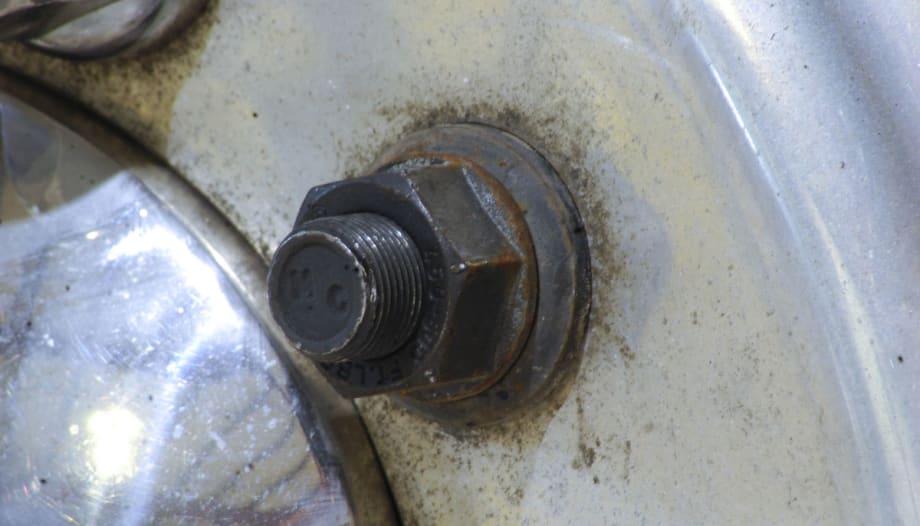
Fasteners that are rusty, stretched, or worn can cause unpredictable clamping force at each stud despite consistent torque application.
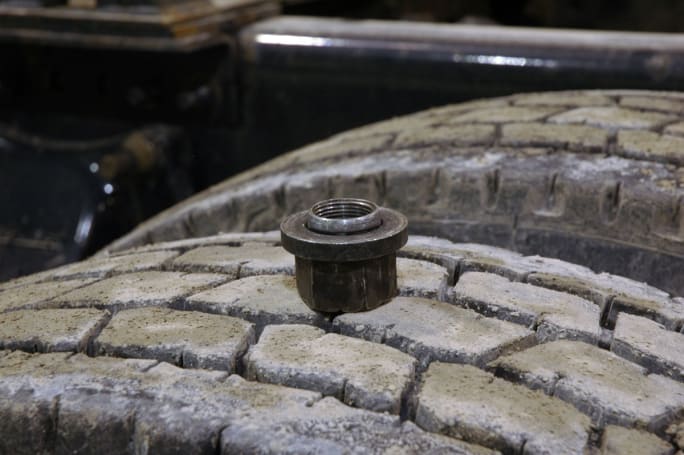
Ensure your fastening hardware is in good condition, and not damaged or badly corroded. Stretched studs will result in looser clamp load, as will seized flange nuts.
Photo: Jim Park
While there’s little published research on the impact of hardware aging and degradation caused by use and environmental factors, research by Ottawa, Ontario-based Woodrooffe and Associates suggests that re-using degraded flange nuts could be problematic.
“Anecdotal tests have shown that as [two-piece] flange nuts age, or when they are re-used, their torque/clamping force characteristics can be as little as 50% of the design value,” the company notes in its paper, Heavy Vehicle Wheel Separations: Exploring the Causes.
Ad Loading...
“Given that hub-piloted wheels depend exclusively on clamping force to prevent the wheel from separating from the hub, such a reduction in clamp force characteristics represents a significant risk to wheel separation," the report continued.
Technicians should check the condition of the studs with a thread pitch gauge before mounting the wheel. If the studs are in suitable condition, they should be thoroughly cleaned, deburred, and sparingly lubricated according to manufacturers’ recommendations.
Beware of fasteners of unknown origin, too. There’s a lot at stake with wheel fastening hardware. If the manufacturing pedigree isn’t known, its structural integrity will also be a mystery. Can you afford to take that chance?
3. Excessive Torque (or Not Enough) is Bad
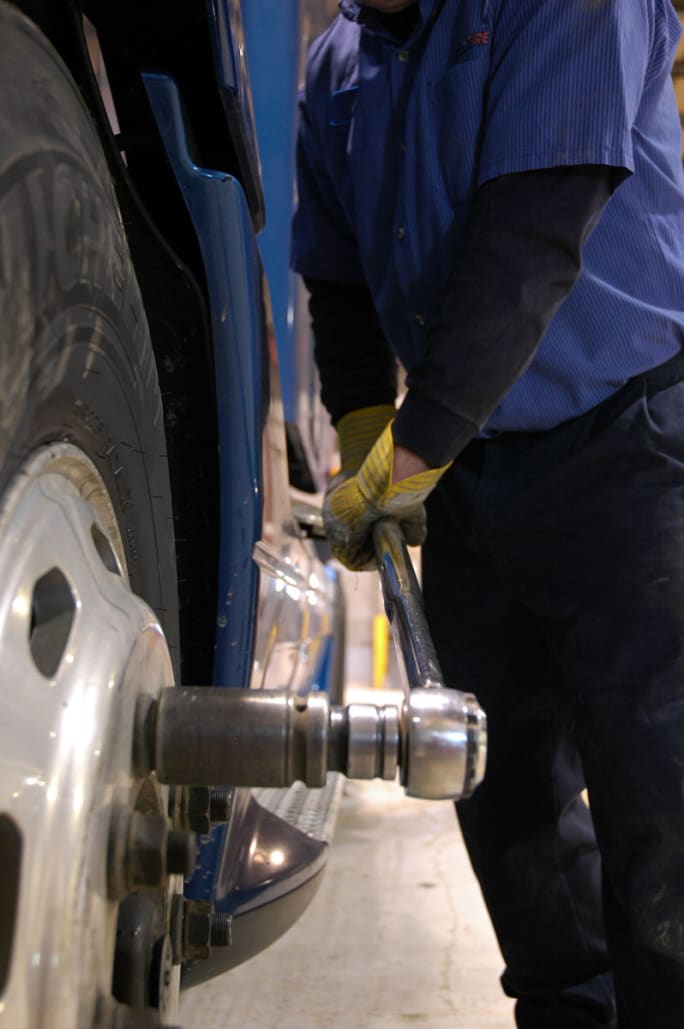
Use only a calibrated torque wrench when finalizing the installation. This is not a time to be using a 1-inch impact wrench. Check the wheel and fastener torque recommendations before assuming 400-500 lb-ft is the correct torque.
Photo: Jim Park
Excessive torque applied by large pneumatic impact wrenches can stretch the studs, dramatically reducing their ability to maintain adequate clamping force.
Tighter is not better, especially when re-using studs and nuts. Many technicians attempt to achieve maximum clamping force by applying more than 500 lb-ft of torque without realizing the possible consequences.
Ad Loading...
“Torque is critical due to the fact the stud stretches like a spring,” says David Walters, manager of field service at Alcoa Wheel Products. “If the correct torque is not applied you will not get the correct clamp load.
“Thus, you could either under torque to have loose wheels or over torque and yield [stretch] the stud. Over-torque is the most common in the industry, and usually leads to reduced clamping force.”
Stretched studs will have deformed threads. If you lack a thread pitch gauge, check the condition of the stud by hand threading a new nut and observing any unusual resistance to hand turning. That could indicate stretching.
The generally accepted torque for a typical fastener used on a hub-piloted disc wheel (M22 x 1.5) is 400-500 lb-ft. But check your supplier’s torque recommendations if there’s any uncertainty.
4. Wheel Installation Procedures Are Inconsistent
Installation procedures, and adherence to those procedures, vary from shop to shop and technician to technician.
Ad Loading...
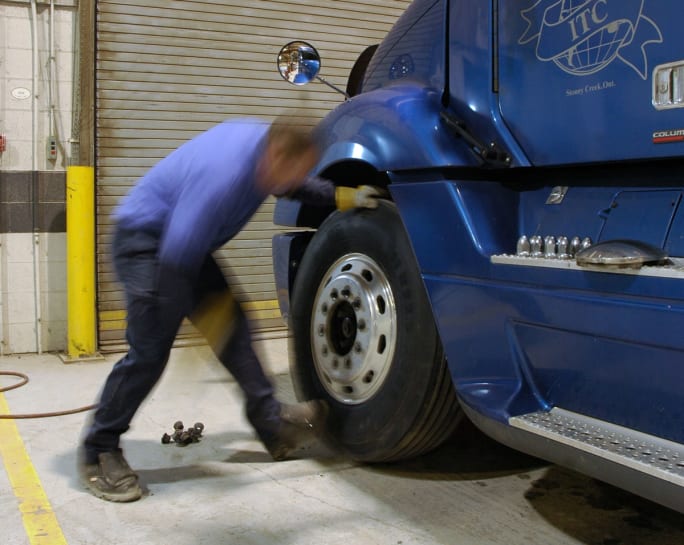
It’s nearly impossible to eliminate the inconsistency, so a backup procedure, such as retorqueing, is a good safety measure.
Installation procedures, and adherence to procedures, vary from shop to shop and technician to technician. You can't eliminate inconsistency, so a backup procedure, such as retorqueing, is a good safety measure.
Photo: Jim Park
Jeremy Gough, director of national fleet maintenance at Canadian-based fleet Bison Transport, takes steps to ensure bearing and wheel installation is done right in the first place. He has a second technician check the work before the truck or trailer is released from the shop.
Bison also puts every technician involved in wheel-end work through a training program at least once a year. Drivers get similar training, but specific to what they can do to prevent wheels from coming off, he says.
“We take the threat of wheel separation seriously,” he says. “We use the pointer-type wheel-nut indicators that will show us if a nut is loosening off. And we check all the wheel fasteners on every truck that comes into the shop, even if it’s for a lighting issue. We check the nuts first, then fix the lights.”
Bison uses a calibrated pneumatic torque wrench from McCann, which Gough says cost about $8,000.
Ad Loading...
“We don’t cut corners on wheel maintenance and service,” he says. “It’s not cheap, but the money is better spent being proactive than reactive.”
Establish a Fleet-Specific Torque Check Interval
TMC has established a torque-monitoring procedure fleets can use to verify the effectiveness the installation program in lieu of the post-installation retorque. The process involves documenting the torque values at installation and then checking again following a trip around a pre-determined course under load.
“Through this process, the fleet can determine the level of integrity of its wheel installations and the torque loss that’s inherent in them," explains RP 237C. The RP also requires torque checks on at least 30 randomly selected wheels at regular intervals. Consult TMC’s RP 237C for details.
It still requires a bit of work and extra diligence, but logistically it would be easier and safer than relying on drivers to ensure wheels are retorqued after servicing.
Resources to Help Keep Your Truck Wheels Where They Belong
The American Trucking Associations’ Technology & Maintenance Council offers several Recommended Practice documents concerned with wheel mounting, fasteners, tightening procedures, etc.
For instance, RP 237C, Torque Checking Guidelines for Hub-piloted Disc Wheels, for example, covers factors affecting clamp loads, correct torque values, and the proper use of various types of torque wrenches.
RP 222D, User’s Guide to Wheels and Rims, has everything you could ever want to know on how to identify possible threats to wheel-end integrity, including fastener out-of-service conditions.
Also check out:
217E Attaching Hardware for Disc Wheels
238B Troubleshooting Loose Wheel Causes
In addition, wheel manufacturers such as Accuride and Arconic (makers of Alcoa wheels) offer wheel maintenance guides that include inspection, mounting and fastening recommendations.
For fleet managers and collision repair professionals keeping heavy-duty trucks on the road, getting the color right the first time isn't just about appearance — it's about efficiency, turnaround time, and bottom-line results. Discover how today's digital color tools are transforming the repair process from guesswork to precision.
DTNA is recalling more than 2,400 trucks that received an incompatible software fix instead of the hardware repair required to address brake valve corrosion.
Fleets have more visibility into truck health, safety events, and driver activity than ever. The next challenge is turning all that information into useful guidance for the person who has to decide what to do next.
Making it through August isn’t the same as being ready for the next several months of operation. Find out what systems may have suffered from summer heat and need to be checked out before fall.
With freight improving but costs still climbing, fleet maintenance executives explain how they're balancing price, quality, and supplier relationships.
The new API PC-12 heavy-duty engine oil category reflects the changing demands of modern diesel engines. But fleets like Foodliner are looking to getting their own data before making decisions on adopting the new oils and questions such as extending oil drain intervals.
The joint venture will operate MCT's network of Carrier Transicold dealerships and mobile service locations, with the companies promising greater service capacity and uptime for refrigerated fleets.