





Related: The Truck Tire Trade War
What's Wrecking Your Tires?
Since tires rarely self-destruct, there is always a smoking gun, and it’s in your best interest to find it. You do that through failure analysis.
April 11, 2018
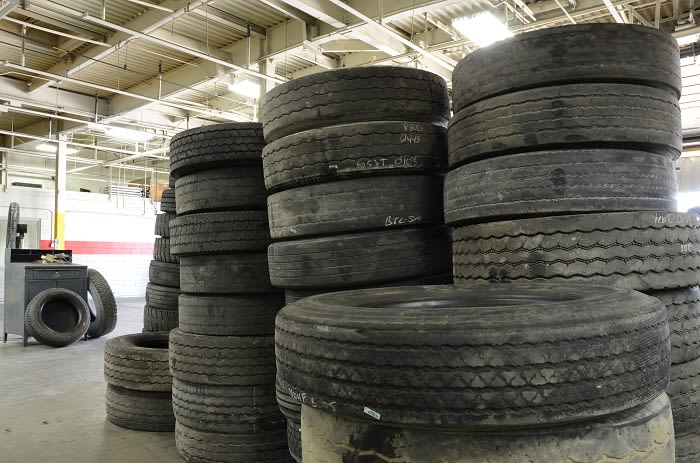
Tire service providers and retreaders can be a great source of failure analysis if the unit number and wheel position are tracked. Photos: Jim Park
5 min to read
It’s said that dead men tell no tales. Dead tires, however, sure do. Ignore them, and you do so at your expense. Since tires rarely self-destruct, there is always a smoking gun, and it’s in your best interest to find it. You do that through failure analysis.
An expert can tell at a glance what’s happening to a tire, often by just looking at it or rubbing a hand over the tread face. Tire wear, you see, isn’t the tire’s fault. There’s something wrong with the truck that’s aggravating the situation. You must fix that to arrest the tire wear. So where do you start?
If you do not have the luxury of an in-house expert, a service provider can probably help. Jeff Lecklider, president of Gem City Tire in Dayton, Ohio, performs that service for dozens of fleet customers.
“We work with the customer to help them to reduce their tire costs, and we usually start with a fleet survey,” he says. “We’ll give them a baseline of the condition of their fleet, including tread depth, air pressure, any tire conditions, irregular wear, flat tires, etc., and then we recommend a course of action. We do this regularly so we can spot problems as soon as they become visible.”
Various mechanical problems leave telltale signs on tires. Take cupping and scalloped wear on a steer tire. That’s usually caused by some non-uniformity in the tire/wheel assembly, such as non-concentric mounting or a moderate to severe out-of-balance condition. Feathered wear on a steer tire is another easy one – it’s a sign of misalignment. But which misalignment condition? Here you might need to dig a little deeper. It could be an excessive toe-in condition. It could be drive axle misalignment creating a side thrust. Or it could be a bent tie rod.
“Tires are symptomatic,” says tire expert and semi-retired consultant Asa Sharp. “There are a variety of other things on the truck that cause the wear. For that reason, it’s very important to conduct a thorough out-of-service analysis when the tire comes off the truck, or if you’re smart about it, during the regular fleet tire surveys — before the tires hit the scrap pile.”
During, after, and before
It obviously makes sense to monitor in-service tire performance, watching for irregular wear and mechanically induced damage, but tracking wear and using that insight for future tire purchases really pays off. Tire tracking can be tedious, but it is getting easier. Most maintenance software platforms enable tire tracking, and some of the tire pressure monitoring systems offer the ability to self-populate those databases.
“On top of providing real-time tire pressure and temperature readings and alert schedules, we’re also able to provide fleets with historical performance data to unlock tire performance trends,” says Vanessa Hargrave, CMO of Advantage PressurePro. “We’re now able to help fleets move their tire maintenance programs from reactive to proactive.”
When Kirk Altrichter was vice president of maintenance at Crete Carrier Corp. (he’s now vice president of fleet services at Kenan Advantage Group), he participated in a Tire Benchmarking panel discussion at a TMC meeting where he revealed some of the benefits of a diligent tracking program.
“With my supplier, we have been watching which tires fail at what wheel positions,” he said. “It was interesting but not unexpected that the right rear outer trailer was the most failure-prone position. We also found an unexpectedly high number of failures of the left rear inner tires.
“It’s all about trying to take cost out by identifying problems before they occur on the road. For the past several years we have tried to ensure we have the right tire at the right wheel position,” he added.
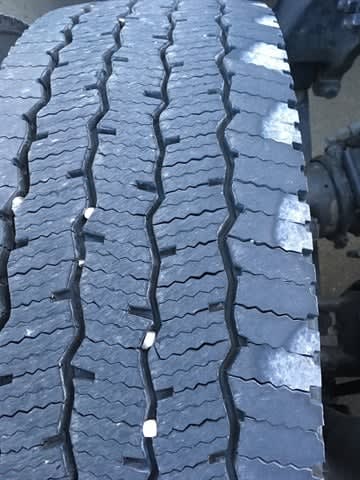
Mechanical problems with trucks always show up in tire treads. A trained eye can easily determine the cause. Tire analysis guides can be an equally revealing source of information.
If staying on top of your tires while they are still on the truck is too tall an order, there is always the fleet yard survey, or as a last resort, an objective study of your tire scrap pile. It’s too late for that tire once it hits the scrap pile, but if you kept a record of what truck and wheel position it came from, you can still glean some insight from it.
“You’re conducting a post-mortem of sorts,” Sharp says. “It’s easy to determine what happened to the tire. Even if you can’t make that determination yourself, your vendor or the TMC Tire Condition guides can help. Every type of calamity to befall a tire leaves a fingerprint.”
Most regrettable are tires that go missing in action. Their story is likely to remain untold unless the roadside repair service can determine the cause of the failure or get the carcass back to you. It’s estimated that about 80% of on-road tire failures not caused by a road hazard are the result of creeping air loss, or under-inflation. Keeping those tires properly inflated would likely have saved them.
FleetNet America recently produced a maintenance benchmarking report demonstrating the difference in various maintenance practices. In the tire category, for example, results of their collected data showed that the average fleet in the survey experienced on-road tire repair/replacement events every 35,166 miles. The worst-in-class fleet put in a service call every 34,438 miles. Astonishingly, the best-in-class fleet in the reporting group saw a service call frequency at half the rate of the worst fleet, with an event occurring only once every 71,238 miles. Those are averages, of course, but it shows pretty clearly that a bit of tire maintenance can go a really long way.
That fleet, and those like it, probably pay a lot more attention to their tires before and during their service life, rather than after.
Subscribe to Our Newsletter
More Maintenance

International Launches Online Truck Parts Store
Fleetrite.com lets fleets and repair shops find OEM and all-makes parts, check prices and availability, and order without calling a parts counter.
Read More →
Continental Introduces New Regional Truck Tires
Continental says its new Generation 5 steer and drive tires for regional operations offer longer tread life, with estimated mileage gains of 22% and 19%, respectively.
Read More →
Sponsored•October 1, 2026
How AI Can Help Your Techs’ Efficiency
The technician shortage isn't going away, and no single fix can close the gap on its own. Trent Broberg makes the case that AI's real job in the shop is protecting the billable hours and job satisfaction of the techs you already have, not asking them to work faster.
Read More →


Sponsored•September 16, 2026
Color Match Smarter: Tools That Restore & Perform
For fleet managers and collision repair professionals keeping heavy-duty trucks on the road, getting the color right the first time isn't just about appearance — it's about efficiency, turnaround time, and bottom-line results. Discover how today's digital color tools are transforming the repair process from guesswork to precision.
Read More →
Wrong Repair Prompts Recall of Freightliner, Western Star 4x2 Trucks
DTNA is recalling more than 2,400 trucks that received an incompatible software fix instead of the hardware repair required to address brake valve corrosion.
Read More →
Truck Drivers Need More Than Another Alert
Fleets have more visibility into truck health, safety events, and driver activity than ever. The next challenge is turning all that information into useful guidance for the person who has to decide what to do next.
Read More →
The Maintenance Checks Trucking Fleets Should Prioritize Before Fall Freight Picks Up
Making it through August isn’t the same as being ready for the next several months of operation. Find out what systems may have suffered from summer heat and need to be checked out before fall.
Read More →
What Three Fleets Are Doing Differently When Buying Truck Parts in 2026
With freight improving but costs still climbing, fleet maintenance executives explain how they're balancing price, quality, and supplier relationships.
Read More →
Paccar Recalls 2027 Trucks Built This Summer for Possible Electrical Problem
The nearly 6,000 Kenworth and Peterbilt trucks in the recall could potentially lose engine power, among other things.
Read More →
Could New Engine Oils Mean Longer Drain Intervals?
New CL-4 and FB-4 engine oils are coming in 2027. Foodliner wants to know whether they could support longer oil drains, but it won’t change its maintenance schedule without data from its own trucks.
Read More →