




Distracted Driving: Daydreaming Worse than Cell Phones
April is Distracted Driving Month, and research by Erie Insurance shows that daydreaming, or being "lost in thought," is far worse than cell phone use when it comes to distracted-driving crashes, Deborah Lockridge reports in her "All That's Trucking Blog."

Back in the early '90s, when the World Wide Web was new, I was so lost in thought about all the things we could do with the website we were designing that I drove right past my exit on my way home from work.
It brought home to me the fact that distracted driving doesn't have to involve texting or a cell phone or any other type of technology.
Now research by Erie Insurance shows that daydreaming, or being "lost in thought," is far worse than cell phone use when it comes to distracted-driving crashes.
Erie analyzed two years of police report data in the Fatality Analysis Reporting System (FARS), a nationwide census of fatal motor vehicle traffic crashes maintained by the National Highway Traffic Safety Administration. Erie Insurance consulted with the Insurance Institute for Highway Safety in its analysis.
"Distracted driving is any activity that takes your eyes off the road, your hands off the wheel, or your mind off your primary task of driving safely," said Doug Smith, senior vice president of personal lines at Erie Insurance. "We looked at what law enforcement officers across the country reported when they filled out reports on fatal crashes, and the results were disturbing."
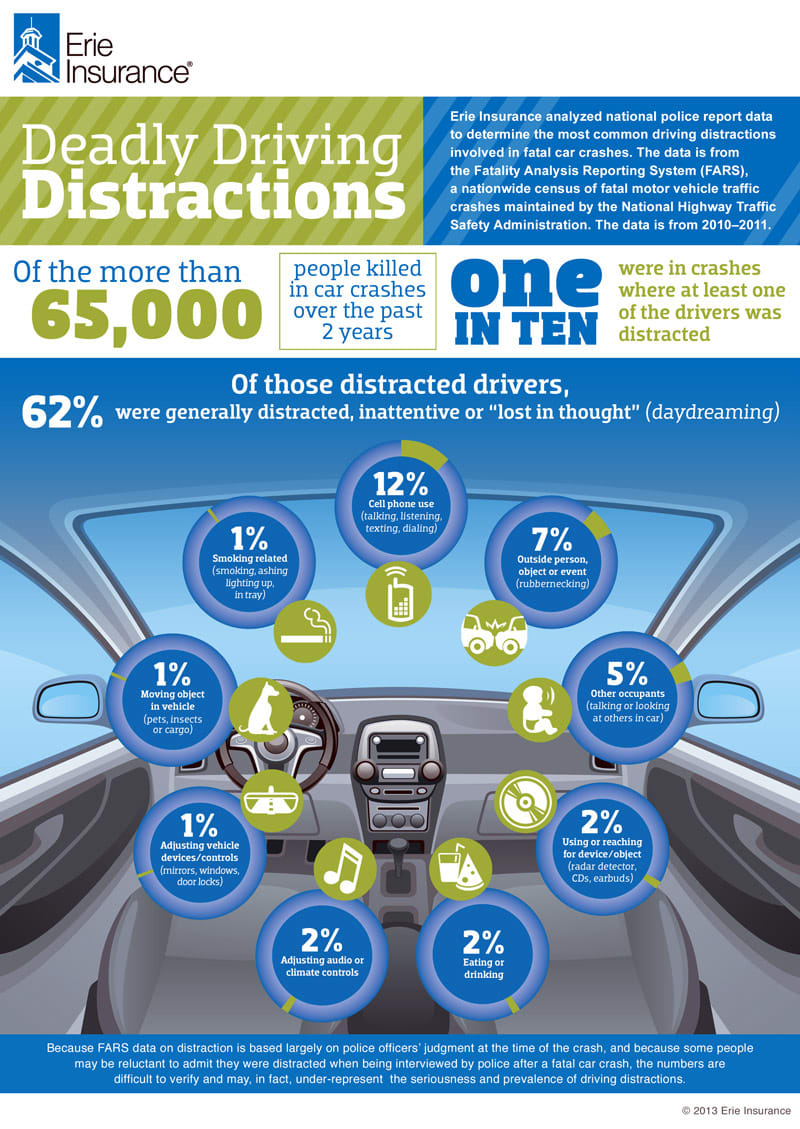
The analysis, which looked at data from 2010 and 2011, showed police listed the majority of drivers who were distracted as "generally distracted" or "lost in thought." Police also listed several more specific types of distractions.
Below are the top 10 distractions involved in fatal car crashes:
Generally distracted or "lost in thought": 62%
Cell phone use (talking listening, dialing, texting): 12%
Outside person, object or event, such as rubbernecking: 7%
Other occupants (talking with or looking at other people in car): 5%
Using or reaching for device brought into vehicle, such as navigational device, headphones: 2%
Eating or drinking: 2%
Adjusting audio or climate controls: 2%
Using other device/controls integral to the vehicle, such as adjusting rearview mirrors or using OE navigation system: 1%
Moving object in vehicle, such as pet or insect: 1%
Smoking-related: 1%
Smith added that because FARS data on distraction is based largely on police officers' judgment at the time of the crash, and because some people may be reluctant to admit they were distracted when being interviewed by police after a fatal car crash, the numbers are difficult to verify and may, in fact, under-represent the seriousness and prevalence of driving distractions.
Obviously this is not trucking-specific, but you have to wonder: How is Transportation Secretary Ray LaHood going to regulate daydreaming?
Click here to go to the full-size version of the infographic:
More Blog Posts

Beyond the Central Transport Settlement: Lessons on Hiring and Risk
The $5.5 million discrimination settlement raises broader questions about hiring practices, safety performance, and the hidden risks that can lurk in a fleet's recruiting process.
Read More →
Are Diesel Shortages Something to Worry About Again?
There’s a certain déjà vu when tensions flare in the Middle East and diesel price spikes can give you panic attacks. What parallels are there between the current situation and the 1970s energy crisis?
Read More →
NOx Isn’t Laughing Gas. Let’s Clear That Up.
A recent EPA reference mixed up NOx and nitrous oxide. It’s an easy mistake. Just not one you expect to see in emissions policy. Let’s look at the difference.
Read More →
TMC 2025 Takeaway 2: Buy... or Subscribe?
TaaS. Does that mean trucks as a service, trailers as a service, or tires as a service? HDT's Deborah Lockridge has another takeaway from the Technology & Maintenance Council meeting in her blog.
Read More →
TMC 2025 Takeaway: The Journey Toward Vertical Integration
HDT's Deborah Lockridge on how the trucking industry has moved toward "vertical integration" over the past 25 years.
Read More →
Trucks Are For Girls!
HDT Editor and Associate Publisher Deborah Lockridge is a longtime Girl Scout leader and loves to connect her passion for inspiring girls with her love of the trucking industry.
Read More →
Trucking Advocacy: Impact Beyond the 2024 Elections
No matter who wins the election, trucking continues to work to educate the people who pass the laws and make the rules that affect the industry. HDT's Deborah Lockridge shares insights from two major trucking associations in her All That's Trucking blog.
Read More →
Recharge Your Brain for Better Business
Skimping on vacation may be the worst thing you can do for your business, your career, and your mental health. In her All That's Trucking blog, Deborah Lockridge writes about the importance of giving your brain what it needs to be innovative.
Read More →
Trucker Pre-Trip Leads to Mission 'Im-paw-sible'
See what happened when a truck driver found an unexpected stowaway during his pre-trip inspection.
Read More →
HDT Editor: 2023's Most Important Trucking Topics
Read Deborah Lockridge's picks for the most significant stories we covered at HDT in 2023: freight recession, zero-emission trucks, drivers and marijuana, and more.
Read More →