




Driver Awake Over 28 Hours in Tracy Morgan Accident
The Walmart truck driver involved in a fatal crash with a limousine carrying comedian Tracy Morgan was awake for more than 28 hours prior to the crash, according to an NTSB investigation.

The probable cause of a highly publicized June 2014 fatal crash with a limousine carrying comedian Tracy Morgan was the truck driver’s fatigue, according to the National Transportation Safety Board. The Walmart driver who triggered the multi-vehicle pileup near Cranbury, New Jersey, was awake for more than 28 hours prior to the crash.
That fatigue, the board says, resulted in the driver's delayed response to brake to avoid traffic that was slowing and stopped for an active work zone. Another factor, the board reports, was the fact that the driver was speeding in a work zone. And contributing to the severity of the injuries was the fact that the passengers in the passenger compartment of the limo van were not using seat belts and properly adjusted head restraints.
When the crash occurred, Kevin Roper, was on hour 13 of a 14 hour shift, as documented by electronic logs -- but he had driven for 12 hours from his home in Georgia to Delaware, 800 miles away, to start his route.
“Hours-of-service rules cannot address what drivers do on their own time,” said NTSB Chairman Christopher A. Hart. “This driver had been on duty 13½ hours of a 14-hour workday, but had been awake more than 28 hours at the time of the crash. Fatigue management programs can help.”
At the time of the accident, Walmart addressed fatigue as a part of its driver training, but it did not have a structured fatigue management program in place that could have improved its ability to better monitor its drivers and educate them about the risks of fatigue, the NTSB noted.
The NTSB reiterated a 2010 recommendation to the Federal Motor Carrier Safety Administration to make fatigue management programs mandatory for all carriers.
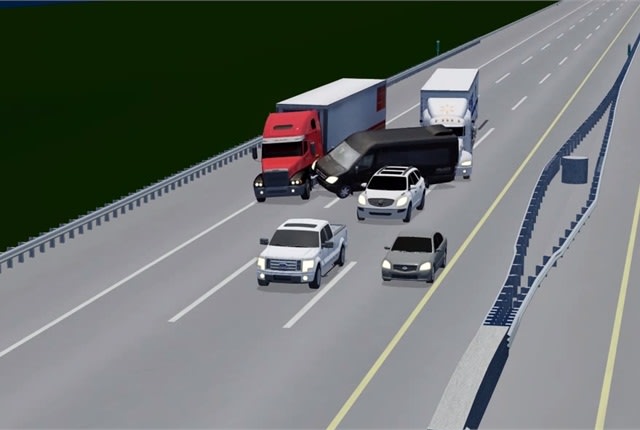
The NTSB also released computer simulation of the crash from different angles showing the vehicles involved in the accident. Traffic had slowed ahead of the Walmart truck on the New Jersey Turnpike. The truck was traveling in the middle lane behind Morgan’s SUV, but the driver did not notice the slow traffic ahead and struck it from behind, causing the Limo to strike other vehicles and flip over.
The driver made no moves to avoid the slow down until just before impact, when he turned slightly to the left and braked but it was too late.
The accident occurred in June 2014 and the driver faces charges, including death by auto, which could carry up to a 10-year prison sentence.
Among the board's recommendations resulting from its investigation, it recommended that Walmart develop and implement a fatigue management program based on the North American Fatigue Management Program guidelines and also that it incorporate a method of conducting on going analysis of critical event report data on hard braking and stability control events.
The NTSB reiterated a number of previous recommendations, such as one to the Federal Motor Carrier Safety Administration to make fatigue management programs mandatory, and one to the National Highway Traffic Safety Administration on mandating speed limiters and forward collision avoidance systems for commercial vehicles.
There were also recommendations regarding limo safety.
For an abstract of the board's findings, click here.
More Drivers

Nussbaum, Roehl Announce Second Driver Pay Increase This Year
This year has seen a swath of major truck driver pay increases as freight capacity has tightened.
Read More →
From One Generation to the Next: How Mentorship Builds Safer Truck Drivers
After three decades in trucking, Harold Perry shares what he's learned about driver safety, mentorship, and helping the next generation build confidence behind the wheel.
Read More →
Truck Drivers Need More Than Another Alert
Fleets have more visibility into truck health, safety events, and driver activity than ever. The next challenge is turning all that information into useful guidance for the person who has to decide what to do next.
Read More →
FMCSA Removes 110 Truck Driver Training Schools from Certified ELDT List
Federal regulators also are targeting more than 160 additional training providers and launching a nationwide audit of third-party CDL skills testers as part of a broader crackdown on trucking fraud.
Read More →
Hours of Service Pilot Programs: FMCSA Readies for 2027 Rollout
Two pilot programs could eventually reshape hours-of-service rules, giving truck drivers options to pause their 14-hour clock or use longer split sleeper rest periods.
Read More →
Medical Cards, English Proficiency Reshape Roadcheck Violations
Medical-card violations jumped to the top of the driver out-of-service list during CVSA’s 2026 International Roadcheck, while English-language proficiency violations appeared among the leading violations for the first time.
Read More →
Driver Trust Can Make or Break the Success of Fleet Safety Technology
New Teletrac Navman research suggests that onboarding, transparency about driver data, and positive feedback can play a significant role in how commercial drivers respond to safety and coaching technology.
Read More →
EEOC Sues KLLM Over Alleged Sex Discrimination in Driver Training
KLLM is facing a federal sex-discrimination lawsuit over policies the EEOC alleges put female truck driver trainees at a disadvantage.
Read More →
FMCSA Moves to Codify English Language Requirements for Commercial Drivers
By changing regulations on English-language proficiency requirements for commercial drivers, rather than relying on a guidance memo, the FMCSA said future administrations won't be able to walk back the Trump administration's stricter enforcement with just a memo.
Read More →
Drivers Put Western Star Trucks to the Test at Star Nation Experience
Watch to get an inside look at the Western Star trucks, technology, and community behind the Star Nation Experience 2026!
Read More →