




A Long History Shapes the Size and Weight Study
The Federal Highway Administration should have a pretty good idea of what to expect as it proceeds with its comprehensive study of truck sizes and weights. The study, which Congress will use to decide on possible changes in current standards, is the latest in a long line of similar research.

The Federal Highway Administration should have a pretty good idea of what to expect as it proceeds with its comprehensive study of truck sizes and weights. The study, which Congress will use to decide on possible changes in current standards, is the latest in a long line of similar research.
In fact, the study of truck size and weight regulation is an industry unto itself.
Since 1978 there have been more than 150 significant research projects on the issue, according to a 2011 directory prepared by the Texas Transportation Institute.
These studies cover nearly a dozen separate elements, each a highly specialized area of research in its own right.
They cover the engineering disciplines of the infrastructure itself: pavement surfaces and substructures, bridges and highway geometry.
They cover the economics of modal share, or the possibility of shifting freight volumes and distribution patterns within the trucking industry as well as between trucks and railroads.
They cover the highly charged and contentious issue of safety.
They cover costs and benefits, congestion, highway financing, environmental issues and public opinion.
To this the research has added perspectives from the federal level and the state level, as well as what other countries are doing with sizes and weights.
18 Months to Go
FHWA has 18 months left in a two-year project to pull all this material, plus new research, together into a peer-reviewed report ordered by Congress last year.
Some trucking and shipping interests had been hoping to get a change in the current standards through Congress in last year’s highway bill, MAP-21. But their proposal to allow states to permit 6-axle, 97,000-pound combinations on their Interstates ran into stiff opposition from traditional opponents in the safety advocacy community, rail industry and driver circles, so they had to settle for this study.
The agency will study three configurations: the current 5-axle, 80,000-pound standard; a 5-axle, 88,000-pound combination; and the 6-axle, 97,000-pound combination.
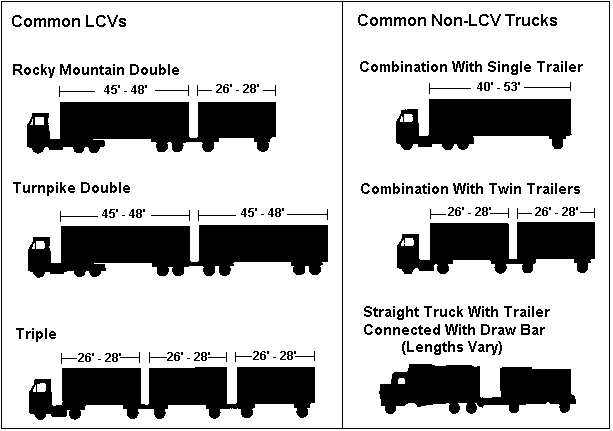
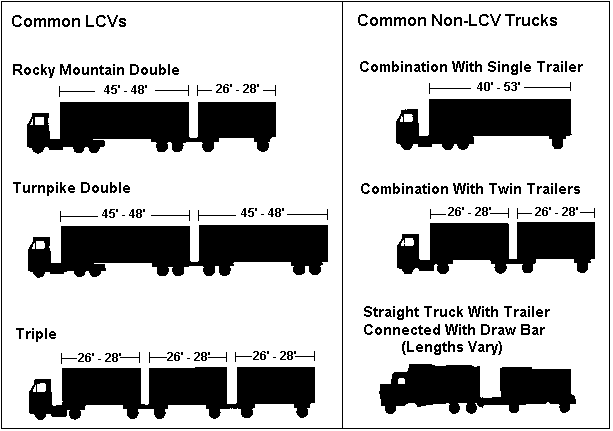
It is looking for help choosing an additional three configurations, possibly including twin 33-foot trailers, Rocky Mountain Doubles, Turnpike Doubles and triples.
On Wednesday this week FHWA hosted the first of four public sessions it plans to hold as part of the drafting process.
“We know there are diverse views,” said Jeffrey Paniati, executive director of the Federal Highway Administration, as he opened the session.
He was right about that. What emerged from the four-hour session attended by about 400 in person and online was an airing of familiar talking points and contentions by many of size and weight constituents.
Owner-operators, who generally are leery of raising the size and weight limits, raised long-standing concerns about the competitive impact on them if they had to buy new equipment.
Tilden Curl, an independent associated with the Owner-Operator Independent Drivers Association, said he would have to change out his entire fleet to adapt to new equipment, while larger carriers could focus on just a portion of theirs.
Scott Grenerth, another independent allied with OOIDA, urged the agency to look closely at road surfaces on ramps and just before stop lights, where the friction of heavy trucks can cause pavement to bend and buckle.
Also apparent were the longstanding contentions between the safety advocacy community, which adamantly opposes size and weight increases, and trucking interests that say increases can be safe and beneficial.
Stephen Owings, president of the safety advocacy group Road Safe America, cautioned the agency not to believe the trucking industry’s contention that bigger trucks will lead to relatively fewer trucks.
“We can’t make the assumption that if we add weight we reduce trucks,” he said. “Whenever trucks have gotten heavier there have been more of them.”
This drew a response from John Runyan, executive director of the Coalition for Transportation Productivity, which is pushing for the permissive 6-axle, 97,000-pound standard.
“It’s critical that you interview shippers,” he told the agency. Many shippers support the higher weight standard and argue that if they had it they could reduce the number of trucks they use.
To which owner-operator Tilden Curl responded, “If you’re going to interview shippers, you also should interview drivers. Any time you increase weight you increase responsibility and the risk of decreasing safety.”
Runyan also urged the agency to consider the way the industry currently operates, referencing the practice of loading 100,000-pound shipping containers on 5-axle combination chassis.
“Six axles would be far better than five for that situation,” he said.
John Lannen of the Truck Safety Coalition, which opposes bigger trucks, replied, saying that a 97,000-pound truck will never be safer than an 80,000-pound truck.
Runyan pointed out that what his group wants is a permissive standard: let the states decide individually whether or not to allow the bigger trucks. The point is to clear the way for the creation of freight corridors, he said.
Lannen said that if the agency considers the permissive approach it also must consider the pressure that may put on surrounding states.
One truckstop operator in the audience urged the agency to consider the impact of larger, heavier trucks on his business: they could force him to change the geometry of his lot and impact his pavements.
Dave Osiecki, senior vice president of policy and regulatory affairs at American Trucking Associations, said the agency could sharpen its bridge analysis by looking at the “practical” routing that would emerge from a change in the standards.
“You can make reasonable assumptions on routes based on costing,” he said.
Randal Mullett, vice president of government relations and public affairs for Con-way, suggested that the agency look at the impact larger trucks might have if safety were analyzed on a ton-mile basis rather than the standard mileage basis.
“If you can eliminate miles you can improve safety in relative terms,” he said.
Agency officials at the session said their intention at this point is to get suggestions on what should be in the study and how best to carry it out.
“We will not form policy but will summarize the data for Congress,” Paniati said. “We will consider everything from lives to livelihoods.”
More public sessions are scheduled for next fall, winter and spring in preparation for the final report, due to Congress in November 2014.
More Drivers

Truck Drivers Need More Than Another Alert
Fleets have more visibility into truck health, safety events, and driver activity than ever. The next challenge is turning all that information into useful guidance for the person who has to decide what to do next.
Read More →
FMCSA Removes 110 Truck Driver Training Schools from Certified ELDT List
Federal regulators also are targeting more than 160 additional training providers and launching a nationwide audit of third-party CDL skills testers as part of a broader crackdown on trucking fraud.
Read More →
Hours of Service Pilot Programs: FMCSA Readies for 2027 Rollout
Two pilot programs could eventually reshape hours-of-service rules, giving truck drivers options to pause their 14-hour clock or use longer split sleeper rest periods.
Read More →
Medical Cards, English Proficiency Reshape Roadcheck Violations
Medical-card violations jumped to the top of the driver out-of-service list during CVSA’s 2026 International Roadcheck, while English-language proficiency violations appeared among the leading violations for the first time.
Read More →
Driver Trust Can Make or Break the Success of Fleet Safety Technology
New Teletrac Navman research suggests that onboarding, transparency about driver data, and positive feedback can play a significant role in how commercial drivers respond to safety and coaching technology.
Read More →
EEOC Sues KLLM Over Alleged Sex Discrimination in Driver Training
KLLM is facing a federal sex-discrimination lawsuit over policies the EEOC alleges put female truck driver trainees at a disadvantage.
Read More →
FMCSA Moves to Codify English Language Requirements for Commercial Drivers
By changing regulations on English-language proficiency requirements for commercial drivers, rather than relying on a guidance memo, the FMCSA said future administrations won't be able to walk back the Trump administration's stricter enforcement with just a memo.
Read More →
Drivers Put Western Star Trucks to the Test at Star Nation Experience
Watch to get an inside look at the Western Star trucks, technology, and community behind the Star Nation Experience 2026!
Read More →
Trump Administration Looks to Put More Veterans Behind the Wheel
The Freedom Haulers program pulls together existing and expanded programs at several federal agencies to recruit veterans to drive commercial heavy-duty trucks and cut the red tape for them to get a CDL, training, and employment.
Read More →
Putting Mack’s Command Steer to the Test
A test drive of Mack’s Command Steer active steering system evaluates how it can make truck driving easier and less tiring.
Read More →