





2022 Recap: 5 Takeaways from ACT Expo 2022
ACT Expo to Explore ZEV Technology, Funding, Sustainability, Regulations
Fleet-focused sessions will cover zero-emission infrastructure, funding, upcoming regulations, and a range of sustainable transportation issues at this year's Advanced Clean Transportation (ACT) Expo.
December 13, 2022
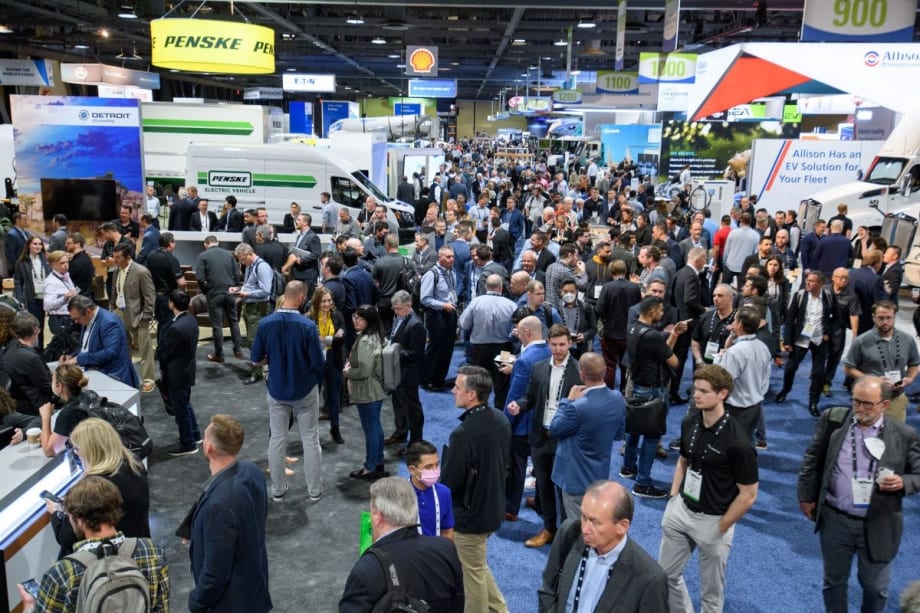
ACT Expo’s show floor will cover 330,000 square feet of exhibit hall space at the Anaheim Convention Center and will feature about 275 sponsors and exhibitors and 185 advanced clean vehicles and technologies.
Photo: ACT Expo
5 min to read
Organizers of the Advanced Clean Transportation (ACT) Expo announced the agenda of sessions and workshops for the event, May 1-4, 2023, at the Anaheim Convention Center in Southern California.
ACT Expo combines educational content with an exhibit hall showcasing innovative technologies. In its 12th year, the event is expected to draw about 8,500 attendees from across the advanced vehicle and alternative fuels industries.
The four-day conference will feature 150 speakers, executives, keynote addresses, panel discussions, and a variety of focused workshops to give fleet operators insights into the major trends, emerging funding opportunities, and technologies transforming the commercial transportation sector. Building and scaling zero- and near-zero-emission fueling and charging infrastructure, preparing for multiple upcoming state and federal regulations, and developing effective strategies to identify and secure new sources of clean transportation project funding will be a few of the core areas of focus. View the full agenda here.
ACT Expo 2023 sessions will include a focus on:
Simplifying Electrification: A significant amount of content will focus on the challenges of and opportunities for developing EV charging infrastructure to support zero-emission commercial fleet deployments. Innovative approaches to providing charging capabilities when power service is limited will also be highlighted, including the use of temporary power solutions, phased capacity, and distributed energy strategies.
Grant Funding and Incentives: With tens of billions of dollars in local, state, and federal funding available to support the growth of the clean fleet market in the next five years, funding workshops will showcase best practices for tracking, identifying, and applying for the right programs to support successful project development. Stacking multiple funding sources, leveraging tax and carbon credits, and identifying other innovative financing strategies will also be highlighted throughout the program.
Hydrogen’s Increasing Role: Fleet operators will share real-world case studies in hydrogen fuel cell electric vehicle deployments in drayage, long-haul freight, and transit applications. Experts will provide guidance on the growing hydrogen fuel cell electric vehicle market and on fueling station development, fuel sources and costs, and a range of other critical infrastructure issues.
Battery Technology Breakthroughs: These technological advancements promise to be one of the most important elements to reducing the cost and improving the performance of battery-electric vehicles and trucks. The annual Battery Workshop at ACT Expo will provide a landscape view of current and future battery technologies, and identify promising solutions to reduce weight and cost, optimize charge time, improve power density and range, and provide better thermal management capabilities. Understanding the timing for ongoing technology innovations, and the implications of vehicle-to-grid applications on battery cycle life and OEM warranties will also be a focus.
Sustainability Planning for Fleets: Corporate sustainability, net-zero, and ESG are the buzzwords du jour. ACT Expo will provide an overview of these evolving issues and showcase how fleets can create a realistic strategy to reduce carbon emissions from their operations. Case studies will present how carriers are leveraging low- and zero-emission technology investments to meet the increasing carbon reduction goals of the shippers they haul for, and attendees will learn how an effective carbon reduction strategy improves customer and employee retention and acquisition, and can be synchronized with available grant funding, incentives, and increasing regulatory requirements.
Staying Ahead of Regulations: Never has there been a time where so many local, state, and federal regulations were being simultaneously developed to require commercial fleets to invest in zero and near-zero emission technologies and fuels. Keeping track of the status of these regulations is one thing, coming up with an effective compliance plan is another. ACT Expo will provide a summary overview of these multiple regulations, including key timelines and compliance requirements. Case studies will present strategies to stay ahead of the regulatory curve, leverage grants and incentive funding to assist with advanced compliance, and how to develop cost-effective compliance strategies.
Emission Reductions from Next Generation Engines, Fuels, and Technologies: Fleets will share their experiences using low carbon renewable fuels and lower-emission combustion technologies to achieve sustainability goals. Updates on low NOx engine regulations and OEM strategies will be provided, together with presentations on innovative new engine technologies and strategies shaping the future of combustion-based low-emission transportation.
Autonomous and Connected Vehicle Technologies: Latest developments in these state-of-the art commercial vehicle technologies will be presented to help fleets evaluate the value proposition, lessons learned, timelines, and new efficiencies enabled by connected and autonomous technologies to help fleets improve economics, performance, safety, and sustainability.
“Infrastructure development is at the top of the list of challenges fleets face as they embark on zero-emission projects,” said Erik Neandross, CEO at Gladstein, Neandross & Associates (GNA), clean transportation and energy consulting firm and the producer of ACT Expo. “ACT Expo 2023 will provide comprehensive coverage on this topic, in addition to the billions of dollars of incentive funding becoming available, increased regulatory, and ESG-related pressures to decarbonize, and of course, the expo hall will offer the world’s greatest collection of advanced vehicle technologies, low carbon fuels, and innovative solution providers.”
ACT Expo’s show floor will cover 330,000 square feet of exhibit hall space at the Anaheim Convention Center and will feature about 275 sponsors and exhibitors and 185 advanced clean vehicles and technologies. Attendees will gain hands-on access to the wide range of vehicles spanning all weight classes, applications, and advanced technologies and fuel types, including battery-electric, hydrogen fuel cell, propane, and natural gas vehicles, along with autonomous and connected technologies and renewable fuels. ACT Expo provides fleet managers with an opportunity to connect with solution providers for the entire clean transportation ecosystem and learn best practices to deploy those technologies successfully and cost-effectively.
Daimler Truck North America, Penske Transportation Solutions, and Shell are returning as the event’s presenting sponsors.
Discounts are available for those who register before Feb. 24. For more information, visit www.actexpo.com.
More Fuel Smarts

How Volvo Updated Its D13 for EPA 2027 [Watch]
Volvo’s updated D13 promises lower emissions without sacrificing performance or fuel economy. Take a closer look at what changed inside the engine in this HDT Spotlight video.
Read More →
Diesel Price Spike Shortens Payback for Natural Gas Trucks, Report Says
Energy Vision estimates fleets could recover the higher purchase price of an RNG-fueled Class 8 tractor in 1.3 to 2.8 years under current fuel-price scenarios.
Read More →
Calstart Becomes Catalyst Mobility, Reflecting Broader Focus
Calstart is now Catalyst Mobility, reflecting the nonprofit’s growing national role in clean transportation, including zero-emission trucks, infrastructure and incentive programs.
Read More →

Record Diesel Prices Squeeze Trucking Fleets
Average U.S. diesel prices have climbed to nearly $6 a gallon, surpassing the 2022 record as tight refinery capacity and Middle East disruptions keep fuel costs elevated.
Read More →
Sponsored•September 9, 2026
How Fuel Delivery Shapes Engine Performance
Fuel delivery depends on more than what happens at the injector. For fleet, maintenance and technical professionals, looking at the full path from pump to injector can provide useful context for understanding engine performance.
Read More →
East Coast Port Launches $45M Electric Truck Push
The Port Authority of New York and New Jersey announced millions in incentives for zero-emission drayage trucks, yard tractors, and new charging hubs near the port.
Read More →
California Bill Could Shed Light on Electric Truck Prices
Why do battery-electric Class 8 trucks remain so expensive? A California bill headed to Gov. Gavin Newsom would give fleets and state agencies more visibility into what manufacturers charge.
Read More →
Detroit Opens Orders for EPA 2027 Engines
Detroit isn’t starting from scratch to meet EPA 2027 diesel emissions standards. Its Gen 6 DD13 and DD15 engines keep much of today’s platform while updating the fuel and aftertreatment systems.
Read More →
Zero-Emission Truck Corridor Planned for West Coast
California, Oregon, Washington, British Columbia and Baja California are coordinating plans for truck charging and hydrogen fueling from Canada to Mexico.
Read More →
A Closer Look at Kenworth’s Electric T880E Vocational Truck [Video]
Learn more about Kenworth's T880E battery-electric vocational truck at the Paccar Technical Center, including its range, applications, upfitting considerations, and PTO options, in this HDT Spotlight video.
Read More →