




President Announces 54.5 mpg Fuel Efficiency Standard

President Obama announced an agreement with 12 major auto makers to pursue the next phase in the administration's national vehicle program, increasing fuel economy to 54.5 mpg for cars and light-duty trucks by model year 2025 -- but one group says the move will mean billions in lost revenue for transportation infrastructure funding
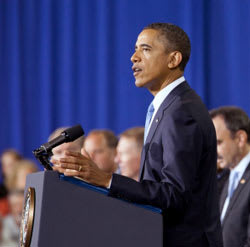
President Barack Obama delivers remarks on fuel efficiency standards for 2017-2025 model year cars and light-duty trucks during an event at the Washington Convention Center in Washington, D.C.
President Obama announced an agreement with 12 major auto makers to pursue the next phase in the administration's national vehicle program, increasing fuel economy to 54.5 mpg for cars and light-duty trucks by model year 2025 -- but one group says the move will mean billions in lost revenue for transportation infrastructure funding.
The president was joined Friday by GM, Ford, Chrysler, Toyota, Nissan, Honda, Hyundai, BMW, Volvo, Mazda, Mitsubishi and Jaguar, which make over 90% of vehicles sold in the U.S. The United Auto Workers and the State of California also helped make the agreement.
"This agreement on fuel standards represents the most important step we've ever taken as a nation to reduce our dependence on foreign oil," said President Obama.
Building on the Obama administration's agreement for Model Years 2012-2016 vehicles, which will raise fuel efficiency to 35.5 mpg, the next round of standards will require performance equivalent to 54.5 mpg by 2025.
The administration says that together, these programs will save $1.7 trillion dollars at the pump, and by 2025 result in an average fuel savings of over $8,000 per vehicle. Additionally, these programs will dramatically cut oil consumption, saving a total of 12 billion barrels of oil, and by 2025 reduce oil consumption by more than 4 million barrels of oil a day, more than America currently imports from the Persian Gulf, Venezuela, and Russia combined.
The standards also curb carbon pollution, cutting more than 6 billion metric tons of greenhouse gas over the life of the program, equivalent to an entire year's worth of carbon dioxide emissions from the United States.
Lost funding
The increased fuel efficiency standards would result in the loss of more than $65 billion in federal funding for state and local highway, bridge and transit improvements, an analysis by the American Road & Transportation Builders Association shows.
The impact on the nation's transportation improvement program, ARTBA President Pete Ruane said, would be like eliminating all federal highway funding for nearly two years.
"Like everyone else, we are supportive of efforts to reduce carbon emissions and improve fuel economy," Ruane said. "However, from a public policy perspective, this is a classic case of the left hand not knowing what the right hand is doing."
Per-gallon federal gasoline and diesel taxes collected at the pump are deposited into the federal Highway Trust Fund. By law, these excises are the primary revenue source for financing road, bridge and transit projects. The less motor fuel used by drivers, the less revenue generated for improvements financed through the HTF.
The details
The program would increase the stringency of standards for passenger cars by an average of 5% each year. The stringency of standards for pick-ups and other light-duty trucks would increase an average of 3.5% annually for the first five model years and an average of 5% annually for the last four model years of the program, to account for the unique challenges associated with this class of vehicles.
EPA and NHTSA are developing a joint proposed rulemaking, which will include full details on the proposed program and supporting analyses, including the costs and benefits of the proposal and its effects on the economy, auto manufacturers, and consumers.
The agencies plan to issue a Notice of Proposed Rulemaking by the end of September. California plans on adopting its proposed rule in the same time frame as the federal proposal. Volkswagen and Daimler may still oppose the standards because of the credits for light-duty trucks, which they accuse of being a de-facto subsidy for Chrysler, GM and Ford.
More diesel?
According to Allen Schaeffer, executive director of the Diesel Technology Forum, the new standards are expected to expand the opportunity for more clean diesel cars, light trucks and SUVs in the U.S.
Schaeffer said fuel-efficient clean diesel technology is expected to "play an expanded role in improving fuel economy of the fleet needed to achieve the 54.5 mpg level by 2025 as mandated by the new greenhouse gas and fuel efficiency standards."
Diesel cars offer higher fuel efficiency, low emissions and long-term durability. 2011 diesel car sales are already showing significant increases. In May, U.S. diesel car sales rose 34% over May 2010. This followed a 46% increase in U.S. diesel sales in March 2011 over March 2010.
However, despite the increase, these vehicles only comprise around 3% of U.S. vehicles, as opposed to nearly 50% in Europe.
More Drivers
Platform Science Adds Dispatch and Safety Tools
Four additions to PS Fleet help fleets monitor loads, manage driver coaching, share truck locations and adjust video system settings.
Read More →
When Language Stops the Truck: The Return of ELP Out-of-Service Orders
English language proficiency rules for commercial drivers aren’t new, but renewed out-of-service enforcement has raised the stakes. Here’s what carriers need to know before a driver reaches a roadside inspection.
Read More →
Samsara Launches Custom AI Agent Builder
Agent Studio lets fleets create AI tools for hours-of-service monitoring, reporting and driver support, including agents that communicate by phone.
Read More →
Trucker Path Expands Reserved Parking Network
Trucker Path has added close to 6,000 more truck parking spaces to its Trucker Path Reserved Parking Network with the addition of Safe Truck Parking.
Read More →
EEOC Sues Texas Trucking Company Over Driver Age Limits
The agency says Trancasa USA rejected applicants over 65 and applied tougher driving-record standards to those over 60.
Read More →
Nussbaum, Roehl Announce Second Driver Pay Increase This Year
This year has seen a swath of major truck driver pay increases as freight capacity has tightened.
Read More →
From One Generation to the Next: How Mentorship Builds Safer Truck Drivers
After three decades in trucking, Harold Perry shares what he's learned about driver safety, mentorship, and helping the next generation build confidence behind the wheel.
Read More →
Truck Drivers Need More Than Another Alert
Fleets have more visibility into truck health, safety events, and driver activity than ever. The next challenge is turning all that information into useful guidance for the person who has to decide what to do next.
Read More →
FMCSA Removes 110 Truck Driver Training Schools from Certified ELDT List
Federal regulators also are targeting more than 160 additional training providers and launching a nationwide audit of third-party CDL skills testers as part of a broader crackdown on trucking fraud.
Read More →
Hours of Service Pilot Programs: FMCSA Readies for 2027 Rollout
Two pilot programs could eventually reshape hours-of-service rules, giving truck drivers options to pause their 14-hour clock or use longer split sleeper rest periods.
Read More →