




Infrastructure Report: Change or be Left Behind
The United States needs to overhaul its outdated regional infrastructure planning process and create a viable federal framework, or face compromising its ability to compete in a global marketplace, according to a new repor
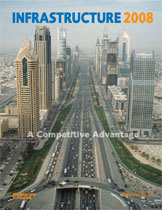
The United States needs to overhaul its outdated regional infrastructure planning process and create a viable federal framework, or face compromising its ability to compete in a global marketplace, according to a new report
co-published by the Urban Land Institute and Ernst & Young.
"Infrastructure 2008: A Competitive Advantage" provides a snapshot of current and planned infrastructure investment in a variety of categories across the globe, with an in-depth look at the United States, China, Japan, India and Europe. The second annual report also touches on the infrastructure needs in several of the nation's largest metropolitan areas, highlighting the consequences of inadequate federal policy and guidelines that have resulted in "a mish-mash of disconnected regional infrastructure management approaches."
"The status quo increasingly looks like a precarious option -- relying on existing networks and systems will only hamstring future growth and compromise sustainability," the report states. "2008 seemingly marks a critical juncture in a rapidly changing economic environment where new approaches to land use, infrastructure and energy efficiency will likely determine and possibly reorder the next generation of winners and losers-countries, companies, investors, and peoples."
The report says the United States is headed toward decline, and needs to wake up to the dire state of its infrastructure, but cautions that "political will may only emerge when people face imminent reward or immediate risk -- a bridge collapse or a burst levee, and maybe not even then." The report estimates that the U.S. has at least a $170 billion annual funding gap in addition to its outmoded land use and infrastructure models. "America heads for a crisis in the next 10 years if nothing is done," warns the report.
"It is increasingly clear that the infrastructure funding gap will need to be addressed with public/private partnerships," said Dale Anne Reiss, Global Director of Real Estate, Ernst & Young, LLP in New York City. "If the U.S. fails to embrace this model, it could lead to our economy falling behind more of our global competitors."
The report notes that a bill introduced in the U.S. Senate proposes a national infrastructure bank, while other proposed legislation calls for "Build America Bonds" to pay for transportation infrastructure. A number of recommendations are included in the report, such as: breaking down government silos, focusing on deferred maintenance, and developing national and regional infrastructure plans.
"Government needs to set a policy course that enables greater mobility and productivity as the nation's population grows and concentrates in major gateways and mega regions," the report concludes.
The proposed infrastructure bank might provide a solution to a weakening economy by funding job programs related to rebuilding infrastructure, states the report. "A jobs program can be a means to an end, a powerful tool for economic development, funding future infrastructure to increase employment and improve economic competitiveness."
Another key finding: "Land use and transportation planning must be coordinated at state and regional levels… and transit authorities need to operate with common purpose." And regional planning needs to align with national priorities.
The report also recommends new funding strategies, including: user fees; interstate toll roads; funding based on reducing vehicle miles traveled; subsidies to encourage infill housing and commercial development served by mass transit in pedestrian-friendly communities; stop subsidizing sprawl; and stop tapping user fees to make up for other shortfalls.
Copies of the report are available at www.uli.org/reports/i19.
More Drivers

Driver Trust Can Make or Break the Success of Fleet Safety Technology
New Teletrac Navman research suggests that onboarding, transparency about driver data, and positive feedback can play a significant role in how commercial drivers respond to safety and coaching technology.
Read More →
EEOC Sues KLLM Over Alleged Sex Discrimination in Driver Training
KLLM is facing a federal sex-discrimination lawsuit over policies the EEOC alleges put female truck driver trainees at a disadvantage.
Read More →
FMCSA Moves to Codify English Language Requirements for Commercial Drivers
By changing regulations on English-language proficiency requirements for commercial drivers, rather than relying on a guidance memo, the FMCSA said future administrations won't be able to walk back the Trump administration's stricter enforcement with just a memo.
Read More →
Drivers Put Western Star Trucks to the Test at Star Nation Experience
Watch to get an inside look at the Western Star trucks, technology, and community behind the Star Nation Experience 2026!
Read More →
Trump Administration Looks to Put More Veterans Behind the Wheel
The Freedom Haulers program pulls together existing and expanded programs at several federal agencies to recruit veterans to drive commercial heavy-duty trucks and cut the red tape for them to get a CDL, training, and employment.
Read More →
Putting Mack’s Command Steer to the Test
A test drive of Mack’s Command Steer active steering system evaluates how it can make truck driving easier and less tiring.
Read More →
Competition Heating Up for Truck Drivers
New report reveals rising driver hiring costs, the return of sign-on bonuses, growing AI advantages, and the operational factors shaping driver retention.
Read More →
How Fraley & Schilling Improved Logbook Compliance by Over 50%
Fraley & Schilling needed a way to close a compliance workflow gap in its ELD system without adding more work from driver training, reminders, and back-office follow-ups. It found the answer in a custom driver app.
Read More →
Volvo Goes Gaming
Volvo has roared into American Truck Simulator with two new flagship trucks.
Read More →
What the Best Fleets to Drive For Teach About Driver Retention
Survey fatigue, AI-powered routing, owner-operator expectations, and the decline of social media all emerged as themes from this year's Best Fleets to Drive For program.
Read More →