




Feds Try New Type Style for U.S. Highway Signs
According to a press release from Penn State University, the Federal Highway Administration has approved the interim use of a new typeface, called Clearview, for signs on all public streets, highways and byways
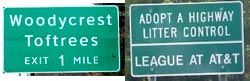
According to Penn State, it took perceptual psychologists, traffic engineers, type designers, graphic designers, vision experts and optics engineers ten years to develop Clearview on the left. Old-style type on the right.
According to a press release from Penn State University, the Federal Highway Administration has approved the interim use of a new typeface, called Clearview, for signs on all public streets, highways and byways.
New signs bearing Clearview, instead of the old familiar Highway Gothic, already appear on Routes 322 and 80 in Pennsylvania near Penn State, on highways throughout Texas and in Canada.
The Clearview Typeface System for traffic control devices was developed by a design team that included Dr. Martin Pietrucha, a civil engineer and director of the Penn State’s Science, Technology and Society program, and Philip Garvey, research associate at Penn State's Pennsylvania Transportation Institute.
According to the release, the Clearview typeface is so much more legible than the existing typeface that it gives drivers going 55 mph added seconds to respond to directions.
Clearview offers a 20% improvement in legibility and recognition with the same size sign as currently used. Replacing signs bearing the 50-year-old Standard Highway Sign Alphabet with new Clearview signs should not cause driver confusion or increase costs, the two Penn State researchers say.
An interdisciplinary team including perceptual psychologists, traffic engineers, type designers, graphic designers, vision experts and optics engineers developed Clearview. Their goal was to improve road sign legibility and recognition at night, especially for older drivers.
Pietrucha says, "Clearview achieves its greater legibility by using upper and lower case with initial capital letters, special spacing based on how a viewer reads a legend from an extended distance and by eliminating nighttime overglow or halo-ing."
He explains that overglow occurs when a car's headlights shine directly on a sign on which letters have been formed from highly reflective material. The letters become, momentarily, so bright that they lose their familiar shape and look instead like blobs. Overglow is especially troublesome for those over age 65.
Clearview retains its readability, despite overglow, because the letters have been designed to have more interior space. The B, e, g and a, for example, have more space inside the letters so that when halo-ing occurs, the overglow doesn't entirely fill them up.
Garvey notes that Clearview's design is based on the results of six formal studies and dozens of field reviews using younger drivers as well as older ones in both day and night driving conditions.
"Inadequate signing can be a contributing factor in roadway crashes," he adds. "Although Clearview was intended to help older drivers, our studies show that the appreciable gain in reaction time provided by the new typeface will be achieved by drivers regardless of age."
The Clearview Typeface system for traffic control devices was developed by a design team that included Donald Meeker and Christopher O'Hara of Meeker & Associates Inc., James Montalbano of Terminal Design Inc., and Pietrucha and Garvey, with supporting research by Dr. Gene Hawkins and Dr. Paul Carlson of the Texas Transportation Institute (TTI) sponsored by TxDOT. Susan T. Chrysler of TTI provided consultation on experimental design.
Support for the Clearview project came from a grant to PTI from the 3-M Corp. and assistance from Avery Dennison.
More Drivers

Platform Science Adds Dispatch and Safety Tools
Four additions to PS Fleet help fleets monitor loads, manage driver coaching, share truck locations and adjust video system settings.
Read More →
When Language Stops the Truck: The Return of ELP Out-of-Service Orders
English language proficiency rules for commercial drivers aren’t new, but renewed out-of-service enforcement has raised the stakes. Here’s what carriers need to know before a driver reaches a roadside inspection.
Read More →
Samsara Launches Custom AI Agent Builder
Agent Studio lets fleets create AI tools for hours-of-service monitoring, reporting and driver support, including agents that communicate by phone.
Read More →
Trucker Path Expands Reserved Parking Network
Trucker Path has added close to 6,000 more truck parking spaces to its Trucker Path Reserved Parking Network with the addition of Safe Truck Parking.
Read More →
EEOC Sues Texas Trucking Company Over Driver Age Limits
The agency says Trancasa USA rejected applicants over 65 and applied tougher driving-record standards to those over 60.
Read More →
Nussbaum, Roehl Announce Second Driver Pay Increase This Year
This year has seen a swath of major truck driver pay increases as freight capacity has tightened.
Read More →
From One Generation to the Next: How Mentorship Builds Safer Truck Drivers
After three decades in trucking, Harold Perry shares what he's learned about driver safety, mentorship, and helping the next generation build confidence behind the wheel.
Read More →
Truck Drivers Need More Than Another Alert
Fleets have more visibility into truck health, safety events, and driver activity than ever. The next challenge is turning all that information into useful guidance for the person who has to decide what to do next.
Read More →
FMCSA Removes 110 Truck Driver Training Schools from Certified ELDT List
Federal regulators also are targeting more than 160 additional training providers and launching a nationwide audit of third-party CDL skills testers as part of a broader crackdown on trucking fraud.
Read More →
Hours of Service Pilot Programs: FMCSA Readies for 2027 Rollout
Two pilot programs could eventually reshape hours-of-service rules, giving truck drivers options to pause their 14-hour clock or use longer split sleeper rest periods.
Read More →