




Clarios Expands Battery Health Management to Trailers
Prompted by a customer query, Clarios has expanded its fleet-focused battery management system to include trailers.

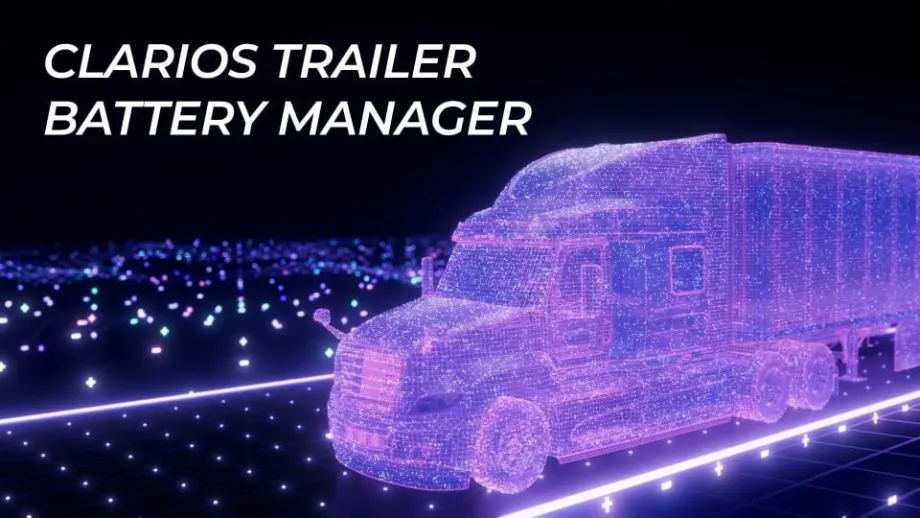
Clarios is expanding its Battery Management System for fleets to include trailer batteries.
Photo: Clarios
For heavy-duty trucking fleets trying to squeeze more uptime out of their equipment, batteries rarely get much attention — until they fail. And when they fail on a trailer, it’s almost always at the worst possible moment: at a customer dock, with a liftgate that won’t move.
That’s the problem Clarios is aiming to solve with a new trailer battery health management system unveiled this week, building on the company’s broader push into connected services for commercial vehicle fleets.
Speaking with trucking media at the CES electronics show in Las Vegas, Cagatay Topcu, vice president of the Connected Services Business Unit at Clarios, described the trailer solution as a natural extension of the company’s battery monitoring platform — one that was driven directly by fleet demand.
“We are focusing on heavy-duty and on fleets,” Topcu said. “We’ve been installing our sensors and gateways to get very high-quality data, and we’ve developed a lot of confidence in our algorithms using AI and machine learning.”
Finding the Source of Trailer Battery Failures
That confidence, he said, has allowed Clarios to expand beyond tractors and into one of the least-monitored assets in a fleet: the trailer.
Spring Into Summer With Heavy-Duty Truck Electrical System Maintenance
The idea for the trailer application came from a customer conversation. During a meeting about Clarios’ Battery Manager product, which monitors battery health and predicts failures, a fleet manager asked a simple question: Can you help us with our trailer batteries?
Clarios responded quickly, installing sensors and gateways on the trailers within a week. Within a few weeks of monitoring, the problem became clear.
The trailers were equipped with liftgates, powered by high-draw electric motors that require dedicated batteries. And those batteries were failing for two predictable reasons.
Drivers sometimes were pulling trailers without connecting the power cord to the tractor, leaving the batteries to drain.
Trailers were sitting idle in yards for extended periods, allowing batteries to deep-discharge and suffer permanent damage.
Both issues, Topcu said, are easy to identify once fleets have visibility into battery state of charge.
“In the first case, we notify the driver,” he explained. “You pulled the trailer, it’s not connected, and the state of charge is low. The driver pulls over, makes the connection, and the problem is solved before they ever reach the customer.”
In the second case, the alert goes to the yard manager.
“Tell me which trailers have low battery state of charge,” Topcu said. “We give them the GPS location so they can find and charge them.”
Delivering Actionable Insights
The result is fewer liftgate failures at customer sites, fewer service calls, and fewer unnecessary battery replacements, each of which can cost fleets $700 to $900 for a pair of trailer batteries.
More importantly, Topcu said, the value comes from delivering actionable insight to the right person at the right time.

Cagatay Topcu, VP, connected services business unit for Clarios, speaks to the House of Journalists at CES 2026.
Photo: House of Journalists
“You can have the best algorithm in the world,” he said. “But if you don’t change behavior, you don’t create value.”
That’s why Clarios is emphasizing flexible delivery of alerts and insights via mobile devices, dashboards, or direct integration into fleet maintenance software through APIs.
While the trailer solution uses the same sensors, gateways, and analytics as Clarios’ tractor-focused offering, Topcu said it highlights a broader strategic shift for the company: expanding its connected services portfolio by applying proven algorithms to new data sources and new use cases.
For fleets, the appeal is straightforward. Trailer batteries may be a small line item individually, but failures create outsized disruption. By catching problems early — and by preventing them altogether — Clarios believes it can eliminate a quiet but costly source of downtime.
And judging by early fleet interest, it’s a problem plenty of operators are ready to fix.
More Maintenance

Color Match Smarter: Tools That Restore & Perform
For fleet managers and collision repair professionals keeping heavy-duty trucks on the road, getting the color right the first time isn't just about appearance — it's about efficiency, turnaround time, and bottom-line results. Discover how today's digital color tools are transforming the repair process from guesswork to precision.
Read More →
Wrong Repair Prompts Recall of Freightliner, Western Star 4x2 Trucks
DTNA is recalling more than 2,400 trucks that received an incompatible software fix instead of the hardware repair required to address brake valve corrosion.
Read More →
Truck Drivers Need More Than Another Alert
Fleets have more visibility into truck health, safety events, and driver activity than ever. The next challenge is turning all that information into useful guidance for the person who has to decide what to do next.
Read More →

The Maintenance Checks Trucking Fleets Should Prioritize Before Fall Freight Picks Up
Making it through August isn’t the same as being ready for the next several months of operation. Find out what systems may have suffered from summer heat and need to be checked out before fall.
Read More →
What Three Fleets Are Doing Differently When Buying Truck Parts in 2026
With freight improving but costs still climbing, fleet maintenance executives explain how they're balancing price, quality, and supplier relationships.
Read More →
Paccar Recalls 2027 Trucks Built This Summer for Possible Electrical Problem
The nearly 6,000 Kenworth and Peterbilt trucks in the recall could potentially lose engine power, among other things.
Read More →
Will API PC-12 Oil Change Trucking Fleet Maintenance?
The new API PC-12 heavy-duty engine oil category reflects the changing demands of modern diesel engines. But fleets like Foodliner are looking to getting their own data before making decisions on adopting the new oils and questions such as extending oil drain intervals.
Read More →
Brake Safety Week to Focus on Drums and Rotors
Commercial vehicle inspectors are focusing on truck brakes during CVSA's Brake Safety Week, August 23-29.
Read More →Possible Battery-Cable Fires Prompt Recall of 15,000+ International MV and HV Trucks
On the recalled vehicles, manufacturing variations can cause the battery interconnect cable to contact the auxiliary stud and hold down the bracket.
Read More →
Rush, MCT Team Up to Grow Refrigeration Service Network
The joint venture will operate MCT's network of Carrier Transicold dealerships and mobile service locations, with the companies promising greater service capacity and uptime for refrigerated fleets.
Read More →