




Related: Spring Into Summer Maintenance
Average Roadside Repair Costs Up 30% Year Over Year
The average cost per roadside repair is up 30% year over year, but five systems account for almost 70% of the work – identifying where many fleets might want to focus their attention.
by John G. Smith, Today’s Trucking
June 25, 2020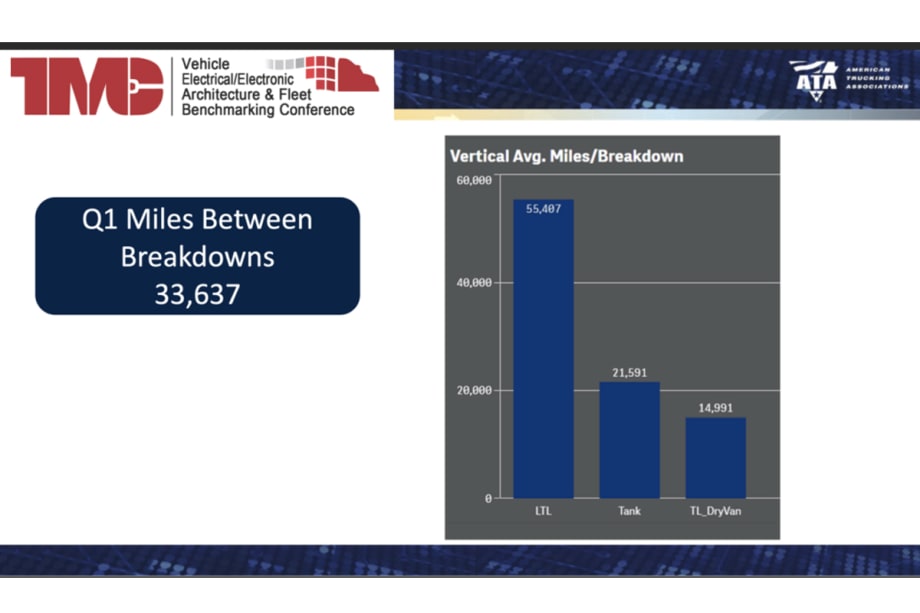
Fleets averaged 33,637 miles between breakdowns in Q1, but LTL fared best.
Source: ATA/TMC
3 min to read
The average cost per roadside repair is up 30% year over year, but five systems account for almost 70% of the work – identifying where many fleets might want to focus their attention.
The findings emerge in data collected under a benchmarking program that involves a collaboration between FleetNet America and the American Trucking Associations’ Technology and Maintenance Council (TMC). Results from the first quarter this year were unveiled during a virtual TMC presentation hosted on Wednesday.
About 140 Vehicle Maintenance Reporting Standards (VMRS) systems are tracked overall.
The average roadside repair recorded by participating fleets cost $491 in the first quarter of 2020, up from $378 in the first quarter of 2019.
Several factors play a role in the increases, says Jim Buell, executive vice-president of sales and marketing at FleetNet America.
Prices are pushed higher by a technician shortage that is particularly prevalent when it comes to the uncomfortable settings outside of shops, Buell said.
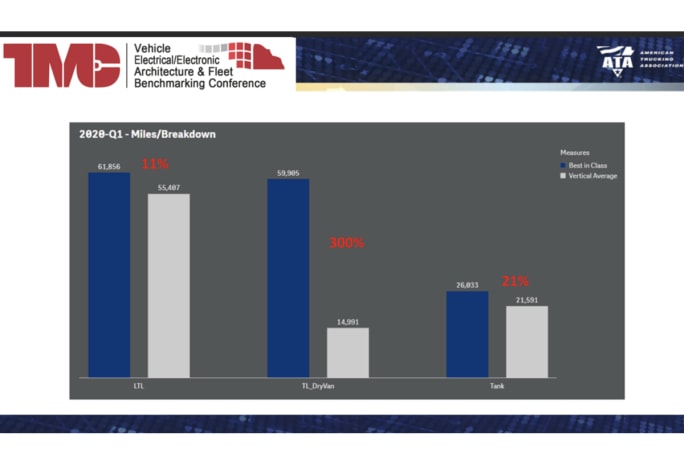
Miles between breakdowns vary by industry segment.
Source: ATA/TMC
Equipment has also become more complex, he added. Tire inflation systems, for example, need to be removed before damaged tires can be accessed.
“I don’t see this trend going away and I certainly don’t see it reversing,” Buell said of the rising costs.
While there was an average of 33,637 miles between breakdowns, the experience differed widely depending on applications. Truckload dry van fleets, which have participated in the service since it was launched in 2017, averaged 14,991 miles between breakdowns. Tank fleets saw an average of 21,591 miles, and LTL fleets saw 55,407 miles.
Best-in-class fleets also performed significantly better than the average participants. The best truckload dry van fleet averaged 59,905 miles between breakdowns, with the best LTL operation recording 61,856 miles, and the top tank fleet recording 26,033 miles.
“If one truckload carrier can run 60,000 miles between an unscheduled breakdown, why can’t everyone else running similar types of equipment, similar types of routes?” Buell asked, referring to the importance of benchmarking. Even the 11% difference seen between the best and average LTL fleet could deliver meaningful savings to the bottom line.
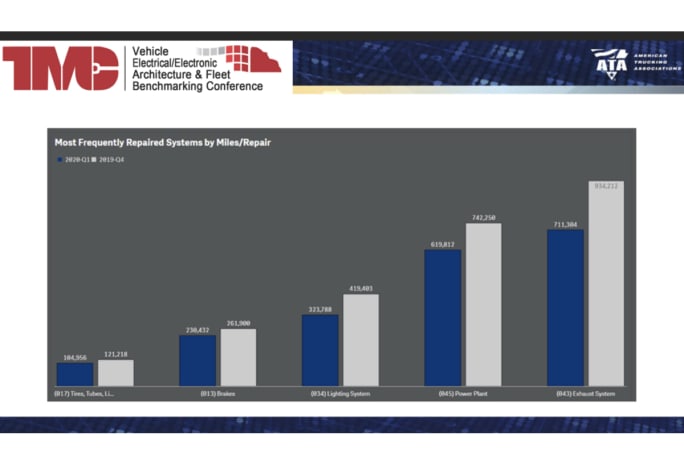
Tires continue to be the most frequently repaired systems.
Source: ATA/TMC
Tires were clearly the most common repair, averaging 104,956 miles between repairs, followed by brakes at 230,432 miles, lighting at 323,788 miles, power plants at 619,812 miles, and exhaust systems at 711,304 miles.
But there are differences between applications, Buell said, noting that truckload operations struggle more than their peers when it comes to lighting repairs.
In truckload operations, the average miles between repairs included lighting (60,277 miles), tires (76,883 miles), brakes (83,761 miles), exhaust systems (297,674 miles), and power plants (299,208 miles). “Some of the lighting issues has to do with foul weather, slush and snow penetrating the connectors,” he added, referring to the need to check connectors during fall preventive maintenance work.
In the less-than-truckload (LTL) segment, tires averaged 195,087 miles between breakdowns, followed by brakes (323,806), power plants (646,345), and lighting (842,557). The average cost per repair for the segment overall was $542.
For tanks, the most frequent issues included tires at an average of 26,291 miles between breakdowns, brakes (246,847 miles), cargo handling equipment such as valves (519,905 miles), exhaust systems (540,220), and lighting (640,882 miles).
Applications with sleepers can face more exhaust system repairs when auxiliary power units are unable to maintain comfortable temperatures inside the truck, requiring more engine run time, he said.
No matter how well a best-in-class fleet performs, Buell stressed they also benefit from benchmarking. It’s because no operation is the best at everything.
Participants in the benchmarking program are asked to share all unscheduled roadside repairs, assure accurate coding, and provide International Fuel Tax Agreement mileage.
John G. Smith is the editorial director of Today's Trucking, where this article originally appeared, and was used with permission from Newcom Media as part of a cooperative editorial agreement.
More Maintenance

Sponsored•September 16, 2026
Color Match Smarter: Tools That Restore & Perform
For fleet managers and collision repair professionals keeping heavy-duty trucks on the road, getting the color right the first time isn't just about appearance — it's about efficiency, turnaround time, and bottom-line results. Discover how today's digital color tools are transforming the repair process from guesswork to precision.
Read More →
Wrong Repair Prompts Recall of Freightliner, Western Star 4x2 Trucks
DTNA is recalling more than 2,400 trucks that received an incompatible software fix instead of the hardware repair required to address brake valve corrosion.
Read More →
Truck Drivers Need More Than Another Alert
Fleets have more visibility into truck health, safety events, and driver activity than ever. The next challenge is turning all that information into useful guidance for the person who has to decide what to do next.
Read More →
The Maintenance Checks Trucking Fleets Should Prioritize Before Fall Freight Picks Up
Making it through August isn’t the same as being ready for the next several months of operation. Find out what systems may have suffered from summer heat and need to be checked out before fall.
Read More →
What Three Fleets Are Doing Differently When Buying Truck Parts in 2026
With freight improving but costs still climbing, fleet maintenance executives explain how they're balancing price, quality, and supplier relationships.
Read More →
Paccar Recalls 2027 Trucks Built This Summer for Possible Electrical Problem
The nearly 6,000 Kenworth and Peterbilt trucks in the recall could potentially lose engine power, among other things.
Read More →
Will API PC-12 Oil Change Trucking Fleet Maintenance?
The new API PC-12 heavy-duty engine oil category reflects the changing demands of modern diesel engines. But fleets like Foodliner are looking to getting their own data before making decisions on adopting the new oils and questions such as extending oil drain intervals.
Read More →
Brake Safety Week to Focus on Drums and Rotors
Commercial vehicle inspectors are focusing on truck brakes during CVSA's Brake Safety Week, August 23-29.
Read More →Possible Battery-Cable Fires Prompt Recall of 15,000+ International MV and HV Trucks
On the recalled vehicles, manufacturing variations can cause the battery interconnect cable to contact the auxiliary stud and hold down the bracket.
Read More →
Rush, MCT Team Up to Grow Refrigeration Service Network
The joint venture will operate MCT's network of Carrier Transicold dealerships and mobile service locations, with the companies promising greater service capacity and uptime for refrigerated fleets.
Read More →