




ATA Is Among Those Calling for Reform of Commodities Markets
Excessive speculation in commodities markets helped create the economic crisis and plays a significant role in fuel price run-ups, and needs to be brought under federal control. That was the message to Congress yesterday from a coalition of commodities consumers
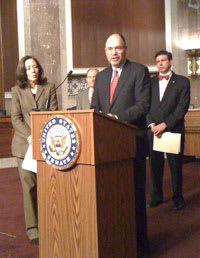
Excessive speculation in the commodities markets plays a significant role in the run-up of diesel fuel prices, said Randy Mullett, Vice President of Government Relations and Public Affairs at Con-way.
Excessive speculation in commodities markets helped create the economic crisis and plays a significant role in fuel price run-ups, and needs to be brought under federal control. That was the message to Congress yesterday from a coalition of commodities consumers,
including American Trucking Associations.
"One year ago, oil cost $42 a barrel. Today, oil has jumped to $74. Yet during this past year, global demand remained weak, crude oil inventory in storage was well above average, and the dollar declined by only 8 percent relative to the Euro," said Randy Mullett, Vice President of Government Relations and Public Affairs for Con-Way, and a spokesman for ATA. "In the face of these market realities, excessive speculation is the only other variable left unaccounted for."
Mullett was one of a group supporting an effort by Sen. Maria Cantwell, D-Wash., to draft a law that would establish tougher regulation of derivatives trading.
"Unregulated and highly leveraged gambling in derivatives (was) a major contributing factor in a financial crisis that has now become an economic crisis," Cantwell said. "Reining in the dark derivatives market is key to getting capital flowing to community banks and small businesses."
The House has passed legislation that would reform financial regulation, but it leaves loopholes that would allow excessive speculation to continue, Cantwell said. She said she is working with the Senate Finance and Agriculture Committees to draft a tighter bill.
ATA and the other members of the coalition want Congress to strengthen the Commodity Futures Trading Commission. The aim should be to make commodity derivative markets more transparent, Mullett said. Also, the government should establish position limits for traders in all markets, including over-the-counter markets and foreign exchanges, and the CFTC should tighten the definition of who qualifies as a commercial participant in a commodities trade.
"In petroleum markets, a commercial participant must take physical possession of a petroleum product," Mullett said. "The trucking industry typically hedges diesel fuel by purchasing heating oil and crude oil derivatives. Recognizing these hedging surrogates is important in determining the status of various commercial participants. At the same time, those that seek to hedge against inflation by purchasing petroleum derivatives contracts should not be considered commercial participants, as these so-called hedgers are more akin to pure speculators."
Mullett was joined by other members of the Derivatives Reform Alliance: Michael Masters of Masters Capital Management; Roger Johnson, President of the National Farmers Union; Paul Cicio, President of the Industrial Energy Consumers of America; Brother Dave Andrews of Food & Water Watch, a community organizing group; and Sean Cota, Cota & Cota Oil, a Vermont-based fuel oil company.
For more detailed coverage, see the next issue of HDT.
More Drivers

From One Generation to the Next: How Mentorship Builds Safer Truck Drivers
After three decades in trucking, Harold Perry shares what he's learned about driver safety, mentorship, and helping the next generation build confidence behind the wheel.
Read More →
Truck Drivers Need More Than Another Alert
Fleets have more visibility into truck health, safety events, and driver activity than ever. The next challenge is turning all that information into useful guidance for the person who has to decide what to do next.
Read More →
FMCSA Removes 110 Truck Driver Training Schools from Certified ELDT List
Federal regulators also are targeting more than 160 additional training providers and launching a nationwide audit of third-party CDL skills testers as part of a broader crackdown on trucking fraud.
Read More →
Hours of Service Pilot Programs: FMCSA Readies for 2027 Rollout
Two pilot programs could eventually reshape hours-of-service rules, giving truck drivers options to pause their 14-hour clock or use longer split sleeper rest periods.
Read More →
Medical Cards, English Proficiency Reshape Roadcheck Violations
Medical-card violations jumped to the top of the driver out-of-service list during CVSA’s 2026 International Roadcheck, while English-language proficiency violations appeared among the leading violations for the first time.
Read More →
Driver Trust Can Make or Break the Success of Fleet Safety Technology
New Teletrac Navman research suggests that onboarding, transparency about driver data, and positive feedback can play a significant role in how commercial drivers respond to safety and coaching technology.
Read More →
EEOC Sues KLLM Over Alleged Sex Discrimination in Driver Training
KLLM is facing a federal sex-discrimination lawsuit over policies the EEOC alleges put female truck driver trainees at a disadvantage.
Read More →
FMCSA Moves to Codify English Language Requirements for Commercial Drivers
By changing regulations on English-language proficiency requirements for commercial drivers, rather than relying on a guidance memo, the FMCSA said future administrations won't be able to walk back the Trump administration's stricter enforcement with just a memo.
Read More →
Drivers Put Western Star Trucks to the Test at Star Nation Experience
Watch to get an inside look at the Western Star trucks, technology, and community behind the Star Nation Experience 2026!
Read More →
Trump Administration Looks to Put More Veterans Behind the Wheel
The Freedom Haulers program pulls together existing and expanded programs at several federal agencies to recruit veterans to drive commercial heavy-duty trucks and cut the red tape for them to get a CDL, training, and employment.
Read More →