




Training Technicians - Part One
Training has probably never been more valuable or important than it is in 2011. That's true no matter what the trucking job, but it's especially true in the shop
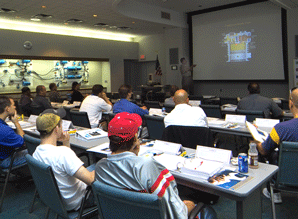
Understanding the knowledge shortfalls in your shop is the first step to designing a training program.
Training has probably never been more valuable or important than it is in 2011. That's true no matter what the trucking job, but it's especially true in the shop.
Added to the traditional obligation of getting trucks and trailers in and out of there faster than humanly possible, the maintenance chief has acquired the huge and ever-growing burden of compliance in recent years.
So the bedraggled shop super has what are often competing priorities. Fix it fast, but make darned sure you fix it right. No more cutting the odd corner, making a well-educated guess that a trailer's slightly iffy wiring can wait until the next PM. No more saying "Yeah, OK" to an anxious customer or a screaming dispatcher even if you'd like to hold that trailer for just half a day longer.
Given the risk of a failed on-the-road inspection and resulting poor CSA scores and out-of-service time - or worse yet, an accident - you can't run things like that anymore.
Whether the customer is a paying client or your own operations department, he should be hearing "No can do" a lot more often.
Training for technicians can help by making a big difference in your shop's efficiency. We're not talking just in terms of clearing jobs quickly, but also about ensuring that those jobs don't come back 500 miles later because the thing wasn't fixed right the first time.
"One thing's for sure," says Bendix veteran Ron Gervais, who now runs his own training company, Freinmeister Group, "is that it is less expensive to provide training than it is to allow an untrained employee to perform a task he or she knows little about."
The reality is that you probably don't have enough techs in the first place, which means each of those you do employ is crucial, their skills levels equally so. The answer is continuous, up-to-date training.
Remember, too, that for every four technicians retiring this year, most estimates say that, as an industry, we're only recruiting one. Retention is thus an issue as well, and training plays a role there. Mechanics typically appreciate the opportunity to learn and will be more likely to stay where that option is open to them.
So you decide you should do some training. What form will it take? The choices are fairly broad, but let's not get ahead of ourselves. A very deliberate approach is called for.
First, the experts will tell you, decide what you need. Take a look from 30,000 feet and assess your team's strengths and weaknesses. Do you need to improve performance? Specific product knowledge? Maybe a return to the fundamentals?
Really, it's a question of looking at who you're going to be training and working backwards. Talk to your technicians. Find out where they feel they're falling short. Many managers do the opposite, looking to see what training is available and blindly assuming it will fit. Start with conceiving the result you want, and only then go shopping.
"The single most effective way to train technicians is to understand their needs and design training that meets those needs," says Jeff Moss, learning technology manager at Mack North American Institute (the training arm of Mack Trucks).
You'll likely find that their needs differ quite a lot from one mechanic to the next. As much as needs differ from one person to another, so will their ability to absorb training in the first place. Language competency and basic literacy will come into play here, too, though they're often ignored, the latter especially.
"Literacy plays a key role in our approach to training," says Jeff Moss. "Beyond reading comprehension, we consider computer literacy and technical literacy, essential skill sets for today's service technician."
Everyone has time and budget constraints these days, so your company's capacity to create a useful training program has to be realistic. Can you afford to send people offsite for a day or two at a time? How many people are you going to be training? Are they spread out geographically or all in one place? If you're looking to buy CD/DVD-based programs, do you buy off-the-shelf material or can you afford to have it custom-designed? Are your techs sufficiently disciplined that they can handle self-managed online training without a live instructor?
The questions are endless, really, and choosing the means of training delivery will be as important as decisions on content.
The genesis of this article was a desire to examine how things have changed in the last 10 to 20 years in terms of delivering training to technicians. It's no longer feasible for many shops to send their people away for a few days to some distant classroom, and even finding time at home base can be tough. We wanted to know what has changed, but in fact we discovered that the old ways are still with us for the most part.
That said, they're being supplemented and in some cases replaced by Web-based options, though not at the rate we expected to find.
Bendix, for example, still runs its long-established three-day product schools at various fixed locations throughout the U.S. and Canada, 24 of them this year. It also just introduced new, on-site product schools to provide customer flexibility and reduced expenses. The company also conducts product-specific training at fleets, dealers, distributors and OEMs. By year's end it will have trained 8,000 students with more than 35,000 training hours.
Another approach is coming, however.
"In 2012, we will be introducing a new program through our Web Learning Center," explains John Reid, manager of service, warranty and training at Bendix. "This will allow customers to go to the Bendix website and take specific training modules. Students will be tested as they progress through the module. Once completed and they have passed the test, they will be able to print out a certificate of completion."
Traditional training, with a teacher at the front of a classroom, a video being played or slides being shown, is essentially a one-way process with not too much interaction. There's very often no test at the end, no measurement of a trainee's comprehension. But according to the only research we could find, the retention rate using this method is just 20 to 25%.
Hands-on interactive workshops are much more effective. Instructor-led, and popular with technicians themselves, they have the advantage of mixing written materials, video demonstration, and participation in tasks such as teardown/rebuild and fault diagnosis, usually with real trucks and components.
Everyone we interviewed for this story agreed that it's the best approach, and retention can be above 80%. That is, if you can gather technicians together in one place, either in your own shop or by sending them to off-site sessions that are often held at local colleges, trade schools and sometimes hotel meeting rooms.
"For our product line, we find classroom training works the best because it gets the technician out of the shop and into a quiet environment that is conducive for learning," says Bendix's Reid.
"Once the classroom training is complete, a trip to the vehicle may help. In many cases, we have found that actually conducting training on a vehicle is good for the few people that are in close proximity to the trainer and can actually see and hear what the trainer is doing. The technicians that are not in close proximity can get distracted, especially in a shop environment."
Every product trainer we spoke with added that such interactive, hands-on instruction is best preceded by a fair bit of material that the trainee must absorb on his own before heading to class.
Rick Martin, manager of technical training at Meritor, has learned that lesson during his long experience on the teaching job. In fact, he insists that trainees complete online basic training, starting with things like fundame
More Maintenance

Shell Prepares Rotella Oils for 2027
New CL-4 and FB-4 formulations will begin arriving in early 2027, with improved protection against oil breakdown, wear and deposits, according to Shell.
Read More →
Mack Expands Extended Coverage With Four Chassis System Plans
Mack Trucks' new system-specific coverage options allow heavy-duty fleets to select protection for driveline, cab, HVAC, electronics, and advanced safety components.
Read More →
What an Out-of-Service Order Really Costs, and How to Plan for One
The repair invoice is the first number you see — and often one of the smallest. Here’s what else an out-of-service order can cost a fleet, and how planning can reduce the damage.
Read More →

International Launches Online Truck Parts Store
Fleetrite.com lets fleets and repair shops find OEM and all-makes parts, check prices and availability, and order without calling a parts counter.
Read More →
Continental Introduces New Regional Truck Tires
Continental says its new Generation 5 steer and drive tires for regional operations offer longer tread life, with estimated mileage gains of 22% and 19%, respectively.
Read More →
How AI Can Help Your Techs’ Efficiency
The technician shortage isn't going away, and no single fix can close the gap on its own. Trent Broberg makes the case that AI's real job in the shop is protecting the billable hours and job satisfaction of the techs you already have, not asking them to work faster.
Read More →
Color Match Smarter: Tools That Restore & Perform
For fleet managers and collision repair professionals keeping heavy-duty trucks on the road, getting the color right the first time isn't just about appearance — it's about efficiency, turnaround time, and bottom-line results. Discover how today's digital color tools are transforming the repair process from guesswork to precision.
Read More →
Wrong Repair Prompts Recall of Freightliner, Western Star 4x2 Trucks
DTNA is recalling more than 2,400 trucks that received an incompatible software fix instead of the hardware repair required to address brake valve corrosion.
Read More →
Truck Drivers Need More Than Another Alert
Fleets have more visibility into truck health, safety events, and driver activity than ever. The next challenge is turning all that information into useful guidance for the person who has to decide what to do next.
Read More →
The Maintenance Checks Trucking Fleets Should Prioritize Before Fall Freight Picks Up
Making it through August isn’t the same as being ready for the next several months of operation. Find out what systems may have suffered from summer heat and need to be checked out before fall.
Read More →