




Tips for Checking Greased Wheel Ends
Maintenance tips to help achieve maximum service life for greased wheel ends, as well as several symptoms that may indicate potential problems down the road.
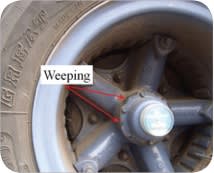
This wheel is weeping but is essentially OK. Photo courtesy SKF
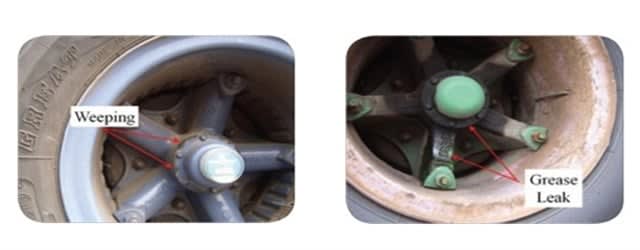
To the left is a wheel that is wheeping but is essentially OK. The right wheel shows significant leakage. Photo courtesy SKF.
Greased wheel ends can provide many thousands of miles of reliable service, provided proper maintenance procedures are followed.
Symptoms
First, check for the symptoms that indicate a wheel end needs service:
A hot to the touch hubcap – take precautions to avoid burns – is one sign, as is site glass (oil) on a hubcap that is discolored or burnt.
Low lubrication levels and wetness around either the hubcap gasket area or wheel seal are problematic, while vibration or wobble indicates a serious condition that requires immediate service.
A grinding noise, a burning smell, smoke or abnormal side pull while braking also means something’s not right.
Any vehicle being put into service after long storage faces the possibility that its seals may have dried out or become contaminated.
Any time a wheel end has been submerged in floodwater, it must be inspected. As the water could be toxic, wear safety equipment.
Inspections
Lift and support each axle. Rotate the wheel, checking for vibration. If the rotation is not smooth or if a vibration is detected, inspect the bearings.
Check the bearing endplay with a dial indicator. If endplay is out of the recommended .001” to .005” range, inspect the bearings for wear and damage.
Pull the outer bearing and inspect the lubricant level, as both over- and under-fill conditions shorten wheel end life. Semi-fluid grease should be at the 3:00/9:00 fill level, while hard grease should be present between all rollers and filled in the hub cavity to the bearing races.
Inspect the grease. If it is milky white or foamy, the grease has been contaminated with moisture. Remove all lubricant out of the hub and clean and inspect the bearings for damage. If grit or hard particles are present, grease has been contaminated with external dirt, rust, grit or metal debris from failed wheel end components. Use a magnet to determine if the debris is metallic; if so, inspect bearings and other internal metal components.
Safety
As always, safety comes first.
Never work under a vehicle supported by only a jack. Always support the vehicle with proper stands. Block the wheels and make sure the vehicle won’t roll before releasing the brakes. Always wear eye protection and protective apparel. Follow all safety policies and regulations.
This article was authored under the guidance and editorial standards of HDT's editors to provide useful information to our readers. Scott Simmonds is Vice President of Heavy Duty Sales for SKF USA Inc. SKF is a global supplier of bearings, seals, mechatronics, lubrication systems and services.
More Maintenance

Color Match Smarter: Tools That Restore & Perform
For fleet managers and collision repair professionals keeping heavy-duty trucks on the road, getting the color right the first time isn't just about appearance — it's about efficiency, turnaround time, and bottom-line results. Discover how today's digital color tools are transforming the repair process from guesswork to precision.
Read More →
Wrong Repair Prompts Recall of Freightliner, Western Star 4x2 Trucks
DTNA is recalling more than 2,400 trucks that received an incompatible software fix instead of the hardware repair required to address brake valve corrosion.
Read More →
Truck Drivers Need More Than Another Alert
Fleets have more visibility into truck health, safety events, and driver activity than ever. The next challenge is turning all that information into useful guidance for the person who has to decide what to do next.
Read More →
The Maintenance Checks Trucking Fleets Should Prioritize Before Fall Freight Picks Up
Making it through August isn’t the same as being ready for the next several months of operation. Find out what systems may have suffered from summer heat and need to be checked out before fall.
Read More →
What Three Fleets Are Doing Differently When Buying Truck Parts in 2026
With freight improving but costs still climbing, fleet maintenance executives explain how they're balancing price, quality, and supplier relationships.
Read More →
Paccar Recalls 2027 Trucks Built This Summer for Possible Electrical Problem
The nearly 6,000 Kenworth and Peterbilt trucks in the recall could potentially lose engine power, among other things.
Read More →
Will API PC-12 Oil Change Trucking Fleet Maintenance?
The new API PC-12 heavy-duty engine oil category reflects the changing demands of modern diesel engines. But fleets like Foodliner are looking to getting their own data before making decisions on adopting the new oils and questions such as extending oil drain intervals.
Read More →
Brake Safety Week to Focus on Drums and Rotors
Commercial vehicle inspectors are focusing on truck brakes during CVSA's Brake Safety Week, August 23-29.
Read More →Possible Battery-Cable Fires Prompt Recall of 15,000+ International MV and HV Trucks
On the recalled vehicles, manufacturing variations can cause the battery interconnect cable to contact the auxiliary stud and hold down the bracket.
Read More →
Rush, MCT Team Up to Grow Refrigeration Service Network
The joint venture will operate MCT's network of Carrier Transicold dealerships and mobile service locations, with the companies promising greater service capacity and uptime for refrigerated fleets.
Read More →