




Tight, but Not Too Tight With Wheel Bearing Adjustments
Wheel bearing adjustment can be a finicky process with uncertain results unless procedures are followed to the letter. There are simpler and less time-consuming ways to achieve better results.


Properly adjusted wheel bearings minimize irregular tire wear, reduce the potential for wheel separation, and may help improve fuel economy.
Photo: Jim Park
Somewhere between the thickness of a human hair and a sheet of paper. That’s the tolerance you’re toying with when adjusting wheel bearings. Various sources put the diameter of an average strand of hair at 0.001 and a sheet of standard office paper at 0.005 inches. For context, the tolerable end-play for truck wheel bearings is the same: 0.001 to 0.005 inches, also expressed as 1 to 5 mil or 0.025 to 0.127 mm. In other words, it’s perfectly acceptable to adjust wheel bearings so that they are just a little bit loose, but not too loose.
The procedure described in Recommended Practice 618B from the American Trucking Associations’ Technology & Maintenance Council will tighten a standard wheel bearing to those tolerances if it’s followed scrupulously and then verified with a dial indicator. Maintenance managers following RP 618B can be fairly certain that their wheels will stay in place, they won’t be a drag on fuel economy, seals won’t leak, and tires won’t experience certain types of irregular wear.
It’s actually better for the bearings if they are a little bit tight, but since it’s nearly impossible to measure tightness, otherwise known as preload, the industry settled on a “good-enough” solution and developed an adjustment procedure that allows for a slight bit of endplay. While endplay is not the perfect wheel bearing condition, it can be accurately measured and repeated by skilled technicians who are willing to spend about 10 minutes per wheel-end to get the adjustment as close to ideal as possible.
Ideal, of course, is zero endplay or slight preload. Bearing maker Timken says slight preload can improve bearing, seal and tire life, but only if the entire process is in control. In this context, “in control” means you actually know the bearing setting process will result in a consistent bearing setting range.
The difference between endplay and preload from the bearing’s perspective is significant. The potential for reduced bearing life at excessive preloads is far higher than life reduction at excessive clearance, says Divjot Singh, an applications engineer at NTN Bearing Corporation of America.
“Excessive preload will cause excessive friction and the bearing will run hot, compromising lubrication and eventually leading to flaking (material coming off) at the large end of the rollers/races,” he says. “On the other hand, adjusting the bearing too loose causes excessive looseness and vibration in the system. This could lead to a multitude of issues, such as, but not limited to, wheel wobble and seal leakage, along with ABS and braking problems. Eventually a too-loose setting will cause flaking at the small end of the rollers/races, which can lead to failure and possible wheel loss.”
With endplay, you’re essentially measuring a gap. From 0.001 to infinity; it’s still a gap. A gap means there is “zero” force applied against the bearing. The width of the gap matters, as Divjot explains, because it allows for movement in the bearing, which can produce undesirable results. With preload, the two surfaces are in contact and the nut exerts force on the bearing. The problem lies in determining the strength of the force. There is no correlation between the amount of torque used to fasten the nut and the amount of force applied to the bearing. And the force applied to the bearing with a torque wrench is exponential rather than linear. In other words, once the gap is eliminated and the two surfaces are in contact, even a slight increase in torque applied to the nut will cause the force applied to the bearing to skyrocket, thus increasing the risk of excessive preload.
You could say that RP 618B or any other procedure that results in 0.001 to 0.005 of endplay is a compromise that errs on the side of caution in order to prevent excessive preload from damaging the bearing.
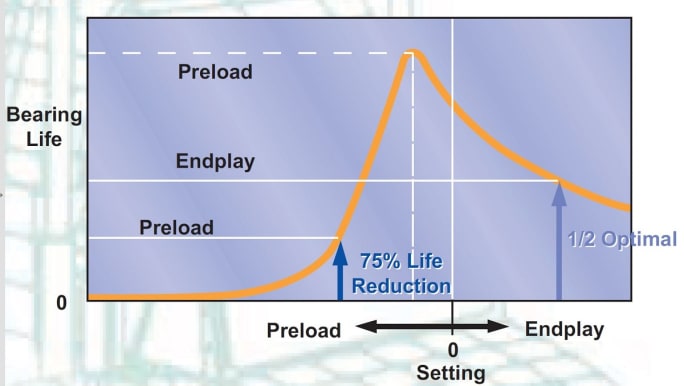
The difference between endplay and preload from the bearing’s perspective is significant. The potential for reduced bearing life at excessive preloads is far higher than life reduction at excessive clearance.
Source: Timken
Pre-adjusted or preloaded
TMC’s RP 618B is widely used in trucking, but manually adjusting wheel bearings is a finicky procedure. Many fleets and most OEMs are now using pre-adjusted hubs and bearing sets from the likes of ConMet and Stemco. These designs use an engineered spacer between the bearings to achieve the correct bearing settings by simply applying a certain amount of torque when installing the outer nut. The bearings are forced together by the tightening of the nut, but only as far as the spacer will permit. With the correct amount of torque, the bearings are set as close to zero endplay as possible or with very slight preload — the optimal condition for bearing life.
Pre-adjusted hubs relieve the technician of the need to measure endplay and generally save a great deal of installation time while providing greater accuracy in bearing adjustment. Still, technicians need to be aware of the procedures associated with the various systems and use properly calibrated tools.
“Our 200-lb-ft torque requirement is the recommended minimum torque value. If an end user would prefer to torque the system to up to 250 lb-ft, that is permissible to account for torque wrench torque setting variations,” explains Jim Rosema, category director for wheel end products at Stemco. “But if a technician inadvertently torques the Trifecta system to a higher value, the system will operate as designed.”
With standard wheel-end systems, different spindle nut types have different torque procedures. It’s important for technicians to be able to identify the different spindle nuts and be aware of the correct procedure for each type.
“It’s important for technicians to be knowledgeable in order to not only identify the different spindle nut styles, but also to be educated on the correct procedure for each type,” cautions Tony Ryan, technical service and training manager at SAF-Holland. “A common mistake made by technicians is using multiple extensions on torque wrenches while tightening the axle spindle nut. Extensions can compromise the accuracy of the torque wrench reading.”
The other alternative to RP 618B and pre-adjusted hubs is to set slight preload on your bearing with a patented tool called Dr. Preload. It’s designed by Temper Axle and distributed by Meritor. It simplifies installation, cuts installation to just a few minutes, and sets a measured amount of preload on the bearings.
“SAE’s recommended procedure, J2535, provides target and maximum preload settings for Class 8 tractor and trailer axles as a guide to any supplier that would develop systems for setting wheel-end bearings to preload,” says Ray Piascik, director of marketing and sales at Temper Axle, makers of the Dr. Preload system. “Our system was designed to meet those targets when installing bearings with slight preload.”
TMC’s Radial Tire Conditions Analysis Guide lists no less than 14 tire-wear conditions that can be traced back to bearing adjustment, which helps illustrate the importance of getting this process right.
More Maintenance

Color Match Smarter: Tools That Restore & Perform
For fleet managers and collision repair professionals keeping heavy-duty trucks on the road, getting the color right the first time isn't just about appearance — it's about efficiency, turnaround time, and bottom-line results. Discover how today's digital color tools are transforming the repair process from guesswork to precision.
Read More →
Wrong Repair Prompts Recall of Freightliner, Western Star 4x2 Trucks
DTNA is recalling more than 2,400 trucks that received an incompatible software fix instead of the hardware repair required to address brake valve corrosion.
Read More →
Truck Drivers Need More Than Another Alert
Fleets have more visibility into truck health, safety events, and driver activity than ever. The next challenge is turning all that information into useful guidance for the person who has to decide what to do next.
Read More →
The Maintenance Checks Trucking Fleets Should Prioritize Before Fall Freight Picks Up
Making it through August isn’t the same as being ready for the next several months of operation. Find out what systems may have suffered from summer heat and need to be checked out before fall.
Read More →
What Three Fleets Are Doing Differently When Buying Truck Parts in 2026
With freight improving but costs still climbing, fleet maintenance executives explain how they're balancing price, quality, and supplier relationships.
Read More →
Paccar Recalls 2027 Trucks Built This Summer for Possible Electrical Problem
The nearly 6,000 Kenworth and Peterbilt trucks in the recall could potentially lose engine power, among other things.
Read More →
Will API PC-12 Oil Change Trucking Fleet Maintenance?
The new API PC-12 heavy-duty engine oil category reflects the changing demands of modern diesel engines. But fleets like Foodliner are looking to getting their own data before making decisions on adopting the new oils and questions such as extending oil drain intervals.
Read More →
Brake Safety Week to Focus on Drums and Rotors
Commercial vehicle inspectors are focusing on truck brakes during CVSA's Brake Safety Week, August 23-29.
Read More →Possible Battery-Cable Fires Prompt Recall of 15,000+ International MV and HV Trucks
On the recalled vehicles, manufacturing variations can cause the battery interconnect cable to contact the auxiliary stud and hold down the bracket.
Read More →
Rush, MCT Team Up to Grow Refrigeration Service Network
The joint venture will operate MCT's network of Carrier Transicold dealerships and mobile service locations, with the companies promising greater service capacity and uptime for refrigerated fleets.
Read More →