





Related: What 48-Volt Electrical Systems Could Mean for Trucking
The Slow Switch to FA-4 Engine Oils
Even with potential fuel economy gains, fleets have been slow to adopt the new FA-4 engine oils. Experts from ATA's Technology & Maintenance Council explore some of the reasons why fleets seem to be waiting.
May 7, 2019
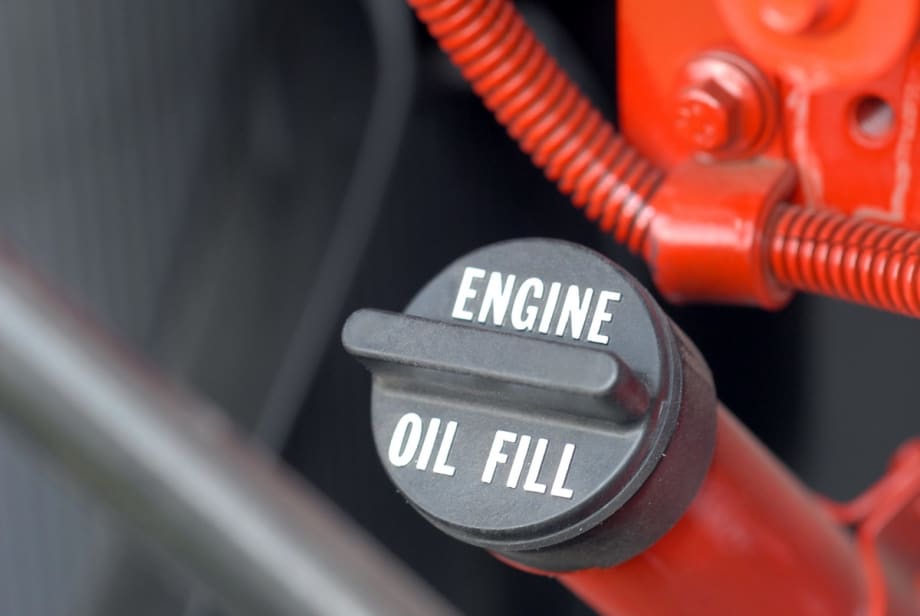
Fleets appear reluctant to stock two types of oil in their shops and are therefore steering away from newer FA-4 oils despite the claimed benefits of greater fuel economy.
Photo: Jim Park
6 min to read
Even with a potential fuel economy gain of about 2%, sales of FA-4 engine oils remain underwhelming. The fuel economy gains alone make the switch worthwhile, but fleets just aren’t biting. An S.3 Study Group session at the ATA’s Technology & Maintenance Council’s Annual Meeting in February explored some of the reasons why fleets are waiting before they pull the trigger.
Part if not most of the reason is backward compatibility. Fleets are running mixes of older and newer equipment, and rather than keep inventories of two separate oils for different engine generations, fleets see it as simpler and less costly to maintain stocks of just one oil formulation, probably CJ-4 or CK-4 oils. Low-viscosity, semi-synthetic blends yield almost all the benefits of FA-4, including improvements in oxidation stability, shear stability, wear protection and aeration control, without the risks and costs associated with stocking two oils.
"Low-viscosity FA-4 oils were the biggest change to engine lubrication in the past decade or since the last significant upgrade that brought us CJ-4," said panelist Brian Humphrey, OEM technical liaison for Petro-Canada. FA-4 first became available in December 2016, yet 15W-40 oils are still the bulk of the market even today."
From a supplier's point of view, the FA-4 roll-out is going pretty much as expected. "It's not exactly flying off the shelves," he said. "Fleets that have tried it like it, and we have seen no negative results so far. With the recent and prolonged upsurge in Class 8 sales, I don't think it will be long until there are more FA-4-eligible trucks on the road, and that should help with market penetration."
Some OEMs are now factory filling with FA-4, but sadly it usually comes out at the first PM replaced by whatever the fleet currently uses, says Doug Kading, vice president of maintenance at C.R. England Inc. He wants to make the switch to FA-4 but he can't, for a couple of reasons.
"We operate 4,000 tractors and 6,300 trailers with refrigeration units on them, so I'm a fairly high-volume buyer," he said. "I prefer to buy in bulk and take deliveries in bulk, but with limited uptake, there's limited production, and I like to use bulk oil in my shop.
"I want my third-party suppliers to use bulk tanks, too because it lowers the price, if I do oil changes there. Right now, bulk is kind of non-existent in most markets that I'm in. A few markets have it, but there are too few with the size of the footprint of my fleet to be able to switch all the way over," he added.
Kading said right off the top of his presentation that he was there to convince other fleets to make the switch to FA-4 as quickly as possible so he could reap the benefits. In fact, everyone would. With greater market acceptance, comes better pricing and better availability. Clearly many fleets and service providers, such as truck stop chains, are all playing a bit of waiting game. They don't want to get stuck with thousands of gallons of oil that nobody yet wants.
Packaging, Labeling and Mixing
Packaging and labeling is a large consideration for fleets that carry two oils. Carrying two "incompatible" products demands some investment in storage and dispensing equipment.
"If you're going to have a specialty product or a new product that may not be compatible in every single vehicle, I would strongly suggest that you label them," said Kading. "We always label when we have test trucks, for example. Even if you run dual oils you might want to consider labeling all of your vehicles as well. It's very confusing for mechanics, to pull the reel down and not know what's being dispensed or which truck or trailer it goes in. So labeling is a must."
And it's no less confusing for drivers. If they need to add make-up oil, they will need to be aware of which products they have in the engine.
Of course, all that storage and dispensing equipment costs money at the fleet level and with suppliers and service providers. You'll pay more for an oil change at a location that is filling from jugs rather than bulk tanks. And that will likely shrink the cost benefit of switching to the more fuel-efficient oil, at least in the short term.
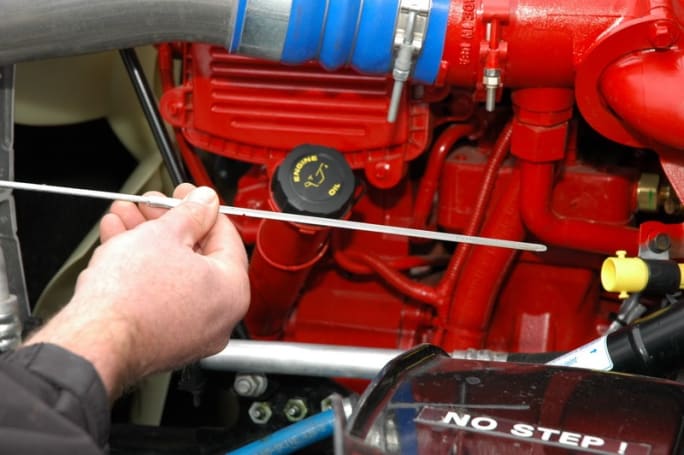
Mixing oil types will be confusing for drivers too. If they need to add make-up oil, they will need to be aware of which products they have in the engine.
Photo: Jim Park
Cost/Benefit Analysis
Even before FA-4 oils were introduced, they were touted as offering about a 1% gain in fuel efficiency. Panelist Greg Matheson, OE account manager for Librizol Corporation, says those estimates have held up in fleet testing. He says fleets that have switched from a 15W-40 CK-4 oil to a lower viscosity 5W-30 or 10W30 CK-4, have shown 0.5% to 1.5% gains in fuel efficiency -- application dependent of course.
"If you then move to a 5W- or 10W-30 FA-4 lubricant, the additional gain could be 0.4% to 0.7%," he said. "Gains from going directly from CK-4 15W-40 to FA-4 5W-30 could be close to 2%. The expected savings could be significant and implemented easily, without capital cost, just by switching engine oil."
In testing Kading has done comparing CJ-4 and CK-4 10W-30 against FA4 oil, he said he saw a one-half-percent gain. "We were already at a lower viscosity, so we just moved from CK-4 to FA-4 and we think we will be about half a percent," he noted.
"Expanding on the math, and considering a switch directly from a 15W-40 to a lower viscosity FA4, my half of a percent could be 2% or more for your fleet," he said. "The benefit for my fleet of 4,000 tractors running 120,000 miles a year at 7.5 MPG, with fuel at about three dollars a gallon, is almost $750,000 dollars a year. I am not a wizard; I can't save $750,000 in my fleet that easily. This is easy money to me, and it's great. It's also good for the environment because we're burning less fuel. There's a lot of positives to FA-4 -- if people would just start buying the stuff."
Study Group Session moderator, Paul Cigala of ExxonMobil, conducted a couple of audience surveys during the session, asking the reason fleet attendees had not yet made the switch. Most respondents said they were waiting until their fleet acquired more new trucks.
Panelist Suzanne Neal, powertrain operating fluids engineer at Detroit Diesel, said she believed the slow uptake was due to the high number of fleets with older equipment and mixed engine brands. "Not all OEMs are approving FA-4 yet," she said. "OEM acceptance is big factor in this, as is backward compatibility. If you have older trucks in the fleet, maybe EPA '07 or earlier, you might not be able to switch the entire fleet over because you don't want multiple oils in your shop.
Market availability is still low because low because not many fleets have switched to FA-4," she added. "It's a challenge because the market price may appear to be a bit higher but over time, we expect this to balance out and FA-4 oils will likely be the same price as CK-4 oils if not even lower if they become the market majority."
Subscribe to Our Newsletter
More Maintenance

Sponsored•September 16, 2026
Color Match Smarter: Tools That Restore & Perform
For fleet managers and collision repair professionals keeping heavy-duty trucks on the road, getting the color right the first time isn't just about appearance — it's about efficiency, turnaround time, and bottom-line results. Discover how today's digital color tools are transforming the repair process from guesswork to precision.
Read More →
Wrong Repair Prompts Recall of Freightliner, Western Star 4x2 Trucks
DTNA is recalling more than 2,400 trucks that received an incompatible software fix instead of the hardware repair required to address brake valve corrosion.
Read More →
Truck Drivers Need More Than Another Alert
Fleets have more visibility into truck health, safety events, and driver activity than ever. The next challenge is turning all that information into useful guidance for the person who has to decide what to do next.
Read More →

The Maintenance Checks Trucking Fleets Should Prioritize Before Fall Freight Picks Up
Making it through August isn’t the same as being ready for the next several months of operation. Find out what systems may have suffered from summer heat and need to be checked out before fall.
Read More →
What Three Fleets Are Doing Differently When Buying Truck Parts in 2026
With freight improving but costs still climbing, fleet maintenance executives explain how they're balancing price, quality, and supplier relationships.
Read More →
Paccar Recalls 2027 Trucks Built This Summer for Possible Electrical Problem
The nearly 6,000 Kenworth and Peterbilt trucks in the recall could potentially lose engine power, among other things.
Read More →
Will API PC-12 Oil Change Trucking Fleet Maintenance?
The new API PC-12 heavy-duty engine oil category reflects the changing demands of modern diesel engines. But fleets like Foodliner are looking to getting their own data before making decisions on adopting the new oils and questions such as extending oil drain intervals.
Read More →
Brake Safety Week to Focus on Drums and Rotors
Commercial vehicle inspectors are focusing on truck brakes during CVSA's Brake Safety Week, August 23-29.
Read More →Possible Battery-Cable Fires Prompt Recall of 15,000+ International MV and HV Trucks
On the recalled vehicles, manufacturing variations can cause the battery interconnect cable to contact the auxiliary stud and hold down the bracket.
Read More →
Rush, MCT Team Up to Grow Refrigeration Service Network
The joint venture will operate MCT's network of Carrier Transicold dealerships and mobile service locations, with the companies promising greater service capacity and uptime for refrigerated fleets.
Read More →