




3 Tips to Protect Your Heavy-Duty Truck Tires from Summer Heat
There's no better time to prepare truck tires for summer heat than in the spring before those temperatures soar.
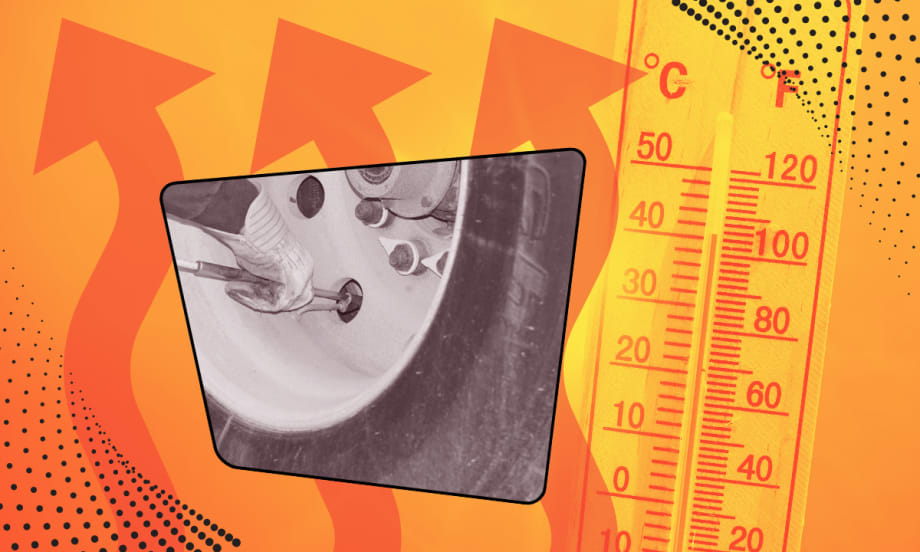
Tires in motion are hot tires. Add in summer ambient temperatures and your inflation readings may be all wrong.
Image: HDT Graphic/Jim Park Photo
As we move into warmer weather this spring, now is the perfect time to implement spring maintenance to keep your trucking fleet tires healthy as temperatures heat up.
Aperia Technologies shared these three temperature-related tips to keep in mind as you prepare your tractors and trailers for warm weather driving:
1. Account for Added Heat and Sun Exposure
Believe it or not, just like us, tires can get “sunburned.”
Tires heat up when exposed to direct sunlight, which can cause tire pressure to increase by as much as 20 psi. As a result, tires may experience irregular wear, which will shorten their lifespan and increase your tire expenses.
To avoid irregular wear due to over-inflation this summer, check tires after they have effectively cooled following operation and drop tire pressure if readings are over their target cold inflation pressure.
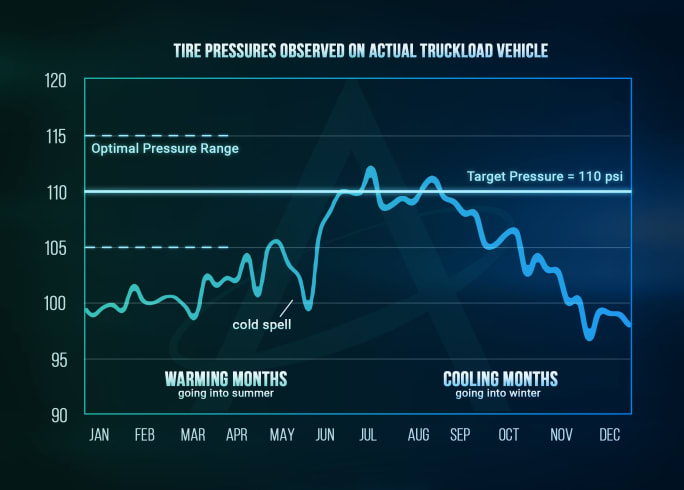
The effects of temperature fluctuations on tire pressure. Notice the increased tire pressure during the day and in warmer months, and decreased pressure during the evening and in cooler months.
Source: Aperia
2. Account for Operational Heating
Tires in motion are hot tires. The operation of a vehicle causes tires to heat up by as much as 20 psi. It is natural for tires to bend, stretch, and deflect while in motion, creating heat and a temporary increase in inflation pressure.
This phenomenon causes optimally inflated tires to produce manual pressure readings up to 20 psi higher due to operational heating while driving. And underinflated tires will produce pressure readings that misleadingly suggest they are optimally inflated.
Unless you’re using a tire analytics platform to secure accurate real-time temperature-adjusted pressure readings, tires should cool for three to four hours before pressure is checked to avoid the pressure-reading inaccuracies that lead to irregular tire wear.
3. Account for Ambient Temperature
Your tires’ ambient air temperature fluctuates seasonally, daily, and even hourly. In response, the air molecules inside your tires adapt their movement.
Every 10-degree increase in ambient temperature causes tire pressure to rise by 1 psi. Similarly, for every 10-degree decrease in ambient temperature, it drops 1 psi.
While summer temperatures are commonly 40 to 50 degrees higher than those in the winter, even daily afternoon temperatures are often 20 degrees warmer than morning lows.
Account for seasonal temperature fluctuations by securing cold inflation readings on your tires during planned maintenance this spring and adjust pressure up or down as needed.
Consider investing in smart tire pressure monitoring and inflation technology such to add air and balance pressure between tires to account for daily and hourly pressure fluctuations.
More Maintenance

Color Match Smarter: Tools That Restore & Perform
For fleet managers and collision repair professionals keeping heavy-duty trucks on the road, getting the color right the first time isn't just about appearance — it's about efficiency, turnaround time, and bottom-line results. Discover how today's digital color tools are transforming the repair process from guesswork to precision.
Read More →
Wrong Repair Prompts Recall of Freightliner, Western Star 4x2 Trucks
DTNA is recalling more than 2,400 trucks that received an incompatible software fix instead of the hardware repair required to address brake valve corrosion.
Read More →
Truck Drivers Need More Than Another Alert
Fleets have more visibility into truck health, safety events, and driver activity than ever. The next challenge is turning all that information into useful guidance for the person who has to decide what to do next.
Read More →
The Maintenance Checks Trucking Fleets Should Prioritize Before Fall Freight Picks Up
Making it through August isn’t the same as being ready for the next several months of operation. Find out what systems may have suffered from summer heat and need to be checked out before fall.
Read More →
What Three Fleets Are Doing Differently When Buying Truck Parts in 2026
With freight improving but costs still climbing, fleet maintenance executives explain how they're balancing price, quality, and supplier relationships.
Read More →
Paccar Recalls 2027 Trucks Built This Summer for Possible Electrical Problem
The nearly 6,000 Kenworth and Peterbilt trucks in the recall could potentially lose engine power, among other things.
Read More →
Will API PC-12 Oil Change Trucking Fleet Maintenance?
The new API PC-12 heavy-duty engine oil category reflects the changing demands of modern diesel engines. But fleets like Foodliner are looking to getting their own data before making decisions on adopting the new oils and questions such as extending oil drain intervals.
Read More →
Brake Safety Week to Focus on Drums and Rotors
Commercial vehicle inspectors are focusing on truck brakes during CVSA's Brake Safety Week, August 23-29.
Read More →Possible Battery-Cable Fires Prompt Recall of 15,000+ International MV and HV Trucks
On the recalled vehicles, manufacturing variations can cause the battery interconnect cable to contact the auxiliary stud and hold down the bracket.
Read More →
Rush, MCT Team Up to Grow Refrigeration Service Network
The joint venture will operate MCT's network of Carrier Transicold dealerships and mobile service locations, with the companies promising greater service capacity and uptime for refrigerated fleets.
Read More →