




Swift Celebrates Tech Excellence With SwiftTech Competition
Swift’s annual SwiftTech competition goes beyond pitting techs against each other in a series of trials. Learn more in the November HDT Fleet Talk.


At the SwiftTech competition, technicians were given simulated problems to troubleshoot and solve within a set time limit. Photos: Steven Martinez
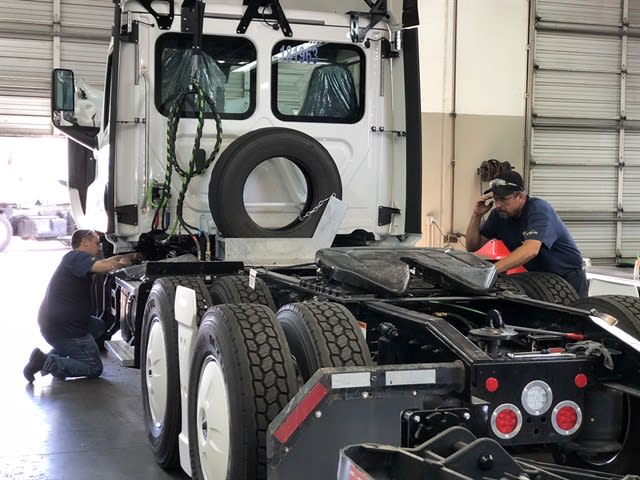
At the SwiftTech competition, technicians were given simulated problems to troubleshoot and solve within a set time limit.Photos: Steven Martinez
A palpable sense of excitement and anxiety was in the air at Swift Transportation’s sprawling complex on the outskirts of Phoenix last month, as technicians showed off their skills in the annual SwiftTech technician competition. The competition pits maintenance personnel against each other in timed troubleshooting trials, not unlike the American Trucking Associations’ Technology & Maintenance Council SuperTech competition. But Swift is taking it a step further.
Planning for the event starts six months ahead of time, explained Angel Chavez, director of shop training operations and compliance. Chavez has been at Swift for more than a decade, and the SwiftTech competition is, in part, his brainchild.
Each technician is given a truck with a pre-determined problem and tasked with identifying and troubleshooting the problem to the satisfaction of an on-the-spot judge. A bullhorn sounds at the end of each timed event to alert participants that time’s up. A complicated schedule indicates which technicians should be at which station, at what time.
Chavez, a technician before moving into his role as head of training at Swift, explained that sometimes a really good technician can get lost in the world of test scores. Some employees might have an intuitive ability to understand a maintenance problem but have a harder time explaining it on pen and paper.
So instead of relying solely on test scores, Swift allows the maintenance directors at each terminal to choose who they want to compete in SwiftTech. This allows somebody who isn’t the absolute best test taker to have a shot at competing based on the director’s knowledge of his or her actual work.
This year the competition was broadened to include not just tractor technicians, but also trailer techs, tire techs, and parts personnel. The technicians came from Swift terminals across the U.S., flown into Phoenix for the two-day event, which also includes training sessions the day after the competition. Competitors are hosted at a nice hotel and get a chance to meet other top Swift technicians from around the country. At the end of the day, scores are tallied and the winners announced at a dinner and ceremony. Like a mini Stanley Cup, the top winner and top region take trophies back to their terminal and display for the year.
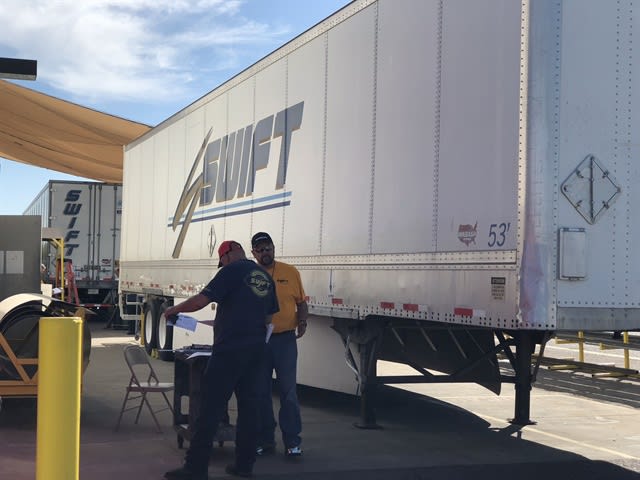
A judge at each station then graded the technician on ability to diagnose the issue and adherence to maintenance standards.
“This is about celebrating technicians,” said Phil Mellor, recruiting supervisor at Swift. “They can network with other technicians and get recognized for their special skills.”
Mellor participated in the competition earlier in his career when he was a technician. Not competitive by nature, he said he was at first uninterested in winning. However, once he got a chance to see and meet the kind of technicians who win the event, he came back the next year more prepared to make a better showing.
“Being in the competition gives technicians good exposure and opens up opportunities for them when they arise,” Mellor said.
It’s well known that trucking is experiencing an industry-wide shortage of technicians. Technicians may move on from a company for a variety of reasons ranging from professional to personal, Mellor said. And while the SwiftTech competition isn’t necessarily viewed as a retention tool, he added, technicians who participate tend to stick around for a long time.
More Maintenance

Color Match Smarter: Tools That Restore & Perform
For fleet managers and collision repair professionals keeping heavy-duty trucks on the road, getting the color right the first time isn't just about appearance — it's about efficiency, turnaround time, and bottom-line results. Discover how today's digital color tools are transforming the repair process from guesswork to precision.
Read More →
Wrong Repair Prompts Recall of Freightliner, Western Star 4x2 Trucks
DTNA is recalling more than 2,400 trucks that received an incompatible software fix instead of the hardware repair required to address brake valve corrosion.
Read More →
Truck Drivers Need More Than Another Alert
Fleets have more visibility into truck health, safety events, and driver activity than ever. The next challenge is turning all that information into useful guidance for the person who has to decide what to do next.
Read More →
The Maintenance Checks Trucking Fleets Should Prioritize Before Fall Freight Picks Up
Making it through August isn’t the same as being ready for the next several months of operation. Find out what systems may have suffered from summer heat and need to be checked out before fall.
Read More →
What Three Fleets Are Doing Differently When Buying Truck Parts in 2026
With freight improving but costs still climbing, fleet maintenance executives explain how they're balancing price, quality, and supplier relationships.
Read More →
Paccar Recalls 2027 Trucks Built This Summer for Possible Electrical Problem
The nearly 6,000 Kenworth and Peterbilt trucks in the recall could potentially lose engine power, among other things.
Read More →
Will API PC-12 Oil Change Trucking Fleet Maintenance?
The new API PC-12 heavy-duty engine oil category reflects the changing demands of modern diesel engines. But fleets like Foodliner are looking to getting their own data before making decisions on adopting the new oils and questions such as extending oil drain intervals.
Read More →
Brake Safety Week to Focus on Drums and Rotors
Commercial vehicle inspectors are focusing on truck brakes during CVSA's Brake Safety Week, August 23-29.
Read More →Possible Battery-Cable Fires Prompt Recall of 15,000+ International MV and HV Trucks
On the recalled vehicles, manufacturing variations can cause the battery interconnect cable to contact the auxiliary stud and hold down the bracket.
Read More →
Rush, MCT Team Up to Grow Refrigeration Service Network
The joint venture will operate MCT's network of Carrier Transicold dealerships and mobile service locations, with the companies promising greater service capacity and uptime for refrigerated fleets.
Read More →