




Running Cool: Maintaining Your Cooling System
Twenty years ago, putting coolant in a heavy truck could be a bit like a kid's chemistry experiment. You started out with silicate-based coolant/antifreeze designed for cars and light trucks

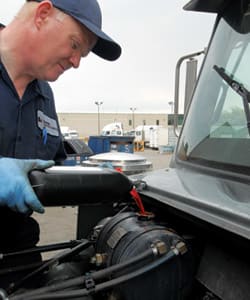
Your coolant/antifreeze is the heart of your cooling system - and there are more choices to keep on top of than there used to be. (Photo by Jim Park)
Twenty years ago, putting coolant in a heavy truck could be a bit like a kid's chemistry experiment. You started out with silicate-based coolant/antifreeze designed for cars and light trucks.
You had to dilute it with water, then "precharge" it with a big dose of supplemental coolant additives to protect the cylinder liners from pitting. Then at regular intervals you either had to pour in a refreshing dose of supplemental coolant additives, or SCAs, or spin on a new filter containing a refreshing dose of chemicals. You were really supposed to dip a little test strip in there first to see how much of a dose it needed, but in real life, cooling systems were regularly over-dosed with SCAs, leading to problems with additive dropout and plugging from "green goo."
"Customers would screw that process up on a regular basis," says Doug Hudgens, senior technical advisor for Cummins Filtration. "There was this mindset that if a little's good, then more is better." But too much, it turned out, would just gunk up the system.
Today, Hudgens notes, Cummins has a coolant maintenance service bulletin that recommends against trying to take a light-duty product and precharge it for use in heavy-duty engines. "Some customers still want to do it because they've been doing it so long."
But today, there are easier options out there. In the last 15 years or so, we've seen two major developments that have improved the coolant maintenance scene: fully formulated coolants and extended-life (aka extended-service-interval) coolants. Both are still based on ethylene glycol, which makes up the vast majority of the market (less-toxic propylene glycol is more expensive and only used in some very specific applications). But the additive packages are quite different.
First there's the fully formulated coolant designed for heavy-duty diesel engines.
"A diesel engine coolant really does a different job than a light-duty coolant," explains David Turcotte, technical director for Valvoline's Zerex line of coolant/antifreeze. "Diesel engines suffer from corrosion problems, particularly cylinder liner pitting or cavitation corrosion, you don't see in light-duty engines. We have to be concerned with things like keeping heat rejection surfaces clean."
So today's fully formulated heavy-duty coolants feature additives such as silicate, nitrate, borate and phosphate to protect the engine.
"The newer versions of coolants have been tweaked and supplemented to meet the challenges associated with running coolant in a wet-sleeve diesel engine," explains Joel Gresmer, national sales manager for Penray. "They are also very low in solids, extending normal drain intervals as long as the chemical package is maintained properly."
Organic additives
In the mid-'90s, Texaco came up with a revolutionary coolant concept: extended life coolant that used "organic acids" as additives rather than the traditional additives.
"We really have changed the coolant business with extended life coolant," says Carmen Ulabarro, direct marketing manager at Chevron Products Co., which merged with Texaco and now uses the same technology in both its Texaco and Delo brand extended-life coolants.
In general, the extended-life coolants were dubbed OAT, or organic acid technology, coolants - although because of the confusion the word "acid" brings, the acronym is more typically used today to refer to the term organic additive technology.
"Today, there's a lot more competition out there, but there are also a lot more formulas out there," Ulabarro says.
Most ELCs on the market today actually are what are called NOAT coolants, or nitrited organic additive technology. "There's very little pure OAT sold into the heavy-duty industry, because that nitrite really helps with cavitation better than a whole lot of inhibitors," Ulabarro says. She says in the case of Delo Extended Life coolant, the nitrite levels are extremely low compared to the old technology, meaning you may well be able to use it in a mixed fleet with vehicles requiring pure OAT.
Cummins Filtrations' Hudgens, however, says now there is a trend away from nitrite. "There is reasonable concern that under some circumstances it can be aggressive to aluminum, and you're seeing more and more aluminum in heavy-duty cooling systems," he says. "The other thing is, some people think it's an environmental hazard."
Goodbye to nitrites?
Up till now, you've seen "pure" OAT coolants more in light-and medium-duty, such as GM's Dex-Cool. But there are heavy-duty versions coming into the market. Cummins Filtration, for instance, recently announced a nitrite, amine and phosphate free OAT coolant, Fleetguard ES Compleat OAT. Cummins says the formula offers solid liner pitting protection and better aluminum protection than conventional nitrited OAT coolants.
"What you have seen historically with the OAT coolants that have been used for heavy-duty is they have always had inorganics in there, like nitrite, to help protect the liners," says Hudgens. Instead of using inorganic additives, he explains, you can use higher concentrations of the organic additives. "You just load it up," he says, saying the new Fleetguard OAT has about three times the organic additives compared to a NOAT.
However, he admits, that can drive the price up. "To protect liners, you only need about 3/10 of a percent of nitrite. But for organic acids, you need 20 times that amount. And there's a cost associated with that." However, Cummins Filtration has been able to keep the price of its new OAT coolant the same as the legacy product in that category.
Shell's Rotella ELC currently has nitrite built into it. However, Granger says, "we are now finding with some new technology OAT coolant that we don't need that nitrite, and companies such as Detroit Diesel are encouraging and approving ELCs without nitrites. There's some indications that as we go down the road, that maybe there's some interaction with nitrite and aluminum, so we could be switching to OAT coolants without nitrites." In fact, Shell has come out with Rotella Ultra ELC, which is nitrite-free.
Then there are hybrids, which in addition to the organic additives also have conventional inhibitors such as nitrites, silicates and phosphates. They usually don't have as long a service life as OAT or NOAT, Ulabarro says.
According to the American Trucking Associations' Technology and Maintenance Council, hybrid coolants are often designed for the needs of both automotive and heavy-duty cooling systems. The use of supplemental coolant additives is still required to maintain liner protection.
"In my book, silicate is one of the biggest additives in the old-style coolants, and most hybrids contain some amount of that as well," says Shell's Granger. "In general, there haven't been a lot of true hybrids."
Some people might say that adding nitrite to OAT makes it a hybrid, but generally the industry seems to make a distinction between NOAT and hybrids.
Making things even more confusing, different brands and formulations are different colors - green, red, pink, orange, blue and more.
Which to choose
OAT coolants are increasingly becoming the factory fill in new trucks - but that doesn't automatically mean they're the best answer for your company's ongoing fleet maintenance needs.
"What I'm seeing is, [ELC] it's going to be standard for everybody in the near future," says Shell's Granger. "There are too many advantages of running the ELC or OAT type coolants. I think for today's [lower] emissions engines that it's the way to go." He points out that Ryder and Penske, which together operate hundreds of thousands of trucks, both use OAT extended-life coolants exclusively in their fleets.
Although the coolants cost more up front, Granger says, over the long term they can save a fleet money because you aren't draining and refilling coolant; you aren't adding as many additi
More Maintenance

Color Match Smarter: Tools That Restore & Perform
For fleet managers and collision repair professionals keeping heavy-duty trucks on the road, getting the color right the first time isn't just about appearance — it's about efficiency, turnaround time, and bottom-line results. Discover how today's digital color tools are transforming the repair process from guesswork to precision.
Read More →
Wrong Repair Prompts Recall of Freightliner, Western Star 4x2 Trucks
DTNA is recalling more than 2,400 trucks that received an incompatible software fix instead of the hardware repair required to address brake valve corrosion.
Read More →
Truck Drivers Need More Than Another Alert
Fleets have more visibility into truck health, safety events, and driver activity than ever. The next challenge is turning all that information into useful guidance for the person who has to decide what to do next.
Read More →
The Maintenance Checks Trucking Fleets Should Prioritize Before Fall Freight Picks Up
Making it through August isn’t the same as being ready for the next several months of operation. Find out what systems may have suffered from summer heat and need to be checked out before fall.
Read More →
What Three Fleets Are Doing Differently When Buying Truck Parts in 2026
With freight improving but costs still climbing, fleet maintenance executives explain how they're balancing price, quality, and supplier relationships.
Read More →
Paccar Recalls 2027 Trucks Built This Summer for Possible Electrical Problem
The nearly 6,000 Kenworth and Peterbilt trucks in the recall could potentially lose engine power, among other things.
Read More →
Will API PC-12 Oil Change Trucking Fleet Maintenance?
The new API PC-12 heavy-duty engine oil category reflects the changing demands of modern diesel engines. But fleets like Foodliner are looking to getting their own data before making decisions on adopting the new oils and questions such as extending oil drain intervals.
Read More →
Brake Safety Week to Focus on Drums and Rotors
Commercial vehicle inspectors are focusing on truck brakes during CVSA's Brake Safety Week, August 23-29.
Read More →Possible Battery-Cable Fires Prompt Recall of 15,000+ International MV and HV Trucks
On the recalled vehicles, manufacturing variations can cause the battery interconnect cable to contact the auxiliary stud and hold down the bracket.
Read More →
Rush, MCT Team Up to Grow Refrigeration Service Network
The joint venture will operate MCT's network of Carrier Transicold dealerships and mobile service locations, with the companies promising greater service capacity and uptime for refrigerated fleets.
Read More →