




Outside Shops Demand 'Right To Repair,' But That's Not Fair to Dealers, One Says
The "right to repair" one's vehicle wherever one chooses isn't in the U.S. Constitution or Bill of Rights, but many people in the maintenance and parts business believe it almost should be
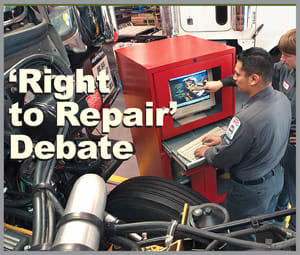
The "right to repair" one's vehicle wherever one chooses isn't in the U.S. Constitution or Bill of Rights, but many people in the maintenance and parts business believe it almost should be.
Original-equipment dealers don't agree and have some real-money reasons why certain servicing information should remain proprietary. The issue has a lengthy history, and now there's legislation pending in Congress that would give independent shops what they want.
They want access to information and special tools needed to service and repair modern trucks, said two shop proprietors at the recent Fall Meeting of the Technology & Maintenance Council of the American Trucking Associations. OE truck dealers refuse to provide these, forcing owners to take their vehicles to dealers' shops where they sit in line and charges are often higher.
This is a monopoly and it ought to be illegal, the independents said. House Resolution 2057 would make it so, said the two shop owners, Marc Karon, president of Total Truck Parts, with several facilities in Florida, and Dave Scheer, president of Inland Truck Parts, with 27 locations in the central U.S.
OE dealers don't have the capacity to handle all repairs of late-model trucks, so they concentrate on warranty fixes and more routine work waits, Karon charged. The nature of OE franchising means there is only one dealer in a given geographic area, so customers are forced to use it. An industry agreement forged in 2001 allows for arbitrating disputes, but it requires face-to-face negotiations among lawyers who must travel to Loudon County, Va., for meetings.
HR 2057 Opposition
The service industry would prefer a more effective industry solution, maybe through TMC, to government intervention, Karon said. But opposition from dealers and truck OE manufacturers might make passage of HR 2057 necessary. It has several sponsors in the House of Representatives but faces an uncertain future. A similar bill was considered in the Senate nine years ago but died.
Like Karon's company, Scheer's has trained, certified technicians and large stocks of parts and the tools to install them, Sheer said. But his people are hobbled when they encounter diagnostic fault codes that they cannot decipher or can't get specialty tools. On several occasions mechanics needed only vehicle wiring diagrams to repair a truck or install new equipment, but the local dealers refused to provide them. So the trucks had to be sent to their shops for work involving the wiring system, then returned to an Inland shop where the work was completed.
"I'll pay a fair market price for this information," Scheer said. "I don't want design information and proprietary knowledge. These restrictions are artificial and are not free enterprise... Let the market decide" who should repair motor vehicles.
The OE Side
There are legal and competitive reasons for dealers guarding information about the trucks they sell, said Gerald Chunn of the Lone Star Truck Group, a Freightliner and Western Star dealer with facilities in Texas, Louisiana and New Mexico. An OE dealer has to meet expensive requirements that independent shops don't, he said, so deserve special protection. Selling trucks in this economy has become unprofitable, but franchise laws in Texas require that dealers take trade-ins, even if they lose money on them.
The OEM requires dealers to invest millions of dollars in facilities, parts and tools and assumes the dealer can pay for them. Some parts are never sold and some tools are never used, but the OEM insists that dealers buy them on the chance that they will be, Chunn said. Meanwhile, the OE invests hundreds of millions of dollars a year developing new trucks and systems to make them more efficient and keep them legal, and wants to be sure the vehicles are properly maintained. Dealers provide a nationwide network that over-the-road users can use, and they back each others' work.
Getting Information
"Independent shops bring no new products to market, they don't sell trucks, and they stock few of the parts I must," Chunn said. As to information needed to work on a truck, "If an '88 Mack comes into my shop in New Mexico, I can find 99 percent of the information I need to work on that Mack on the Internet," so independent shops should try harder to obtain what they need on the Net. To fleet managers in the audience, Chunn said, "You as customers can get 100 percent of the information you need for your trucks from OE repair shops."
In the case of those trucks Scheer talked about - the ones whose wiring diagrams were unobtainable to his mechanics - could the trucks' owners have gotten the diagrams from dealers, then turned them over to Sheer's people? "Absolutely," Chunn said. "'Give me your fax number - I'll send it right over.'" Did Sheer's people ask the trucks' owners to do that? "I don't know," Sheer answered, but suggested that would've been awkward.
A Balance
But increasingly complex vehicles and OEMs' swing to use of proprietary components makes the situation more serious, said Darry Stuart, a fleet consultant and former TMC general chairman, during a question-and-answer session. Information becomes more specialized, and only OE dealers have direct access to it. Independent technicians can't rely on their years of experience to sort out problems.
"We're trapped by technology and vertical integration," Stuart declared. "It's changing so fast that experience doesn't prevail anymore... There has to be a balance."
Updated 9/29/09 to correct the spelling of Gerald Chunn's name and to clarify the lead sentence.
More Maintenance

Color Match Smarter: Tools That Restore & Perform
For fleet managers and collision repair professionals keeping heavy-duty trucks on the road, getting the color right the first time isn't just about appearance — it's about efficiency, turnaround time, and bottom-line results. Discover how today's digital color tools are transforming the repair process from guesswork to precision.
Read More →
Wrong Repair Prompts Recall of Freightliner, Western Star 4x2 Trucks
DTNA is recalling more than 2,400 trucks that received an incompatible software fix instead of the hardware repair required to address brake valve corrosion.
Read More →
Truck Drivers Need More Than Another Alert
Fleets have more visibility into truck health, safety events, and driver activity than ever. The next challenge is turning all that information into useful guidance for the person who has to decide what to do next.
Read More →
The Maintenance Checks Trucking Fleets Should Prioritize Before Fall Freight Picks Up
Making it through August isn’t the same as being ready for the next several months of operation. Find out what systems may have suffered from summer heat and need to be checked out before fall.
Read More →
What Three Fleets Are Doing Differently When Buying Truck Parts in 2026
With freight improving but costs still climbing, fleet maintenance executives explain how they're balancing price, quality, and supplier relationships.
Read More →
Paccar Recalls 2027 Trucks Built This Summer for Possible Electrical Problem
The nearly 6,000 Kenworth and Peterbilt trucks in the recall could potentially lose engine power, among other things.
Read More →
Will API PC-12 Oil Change Trucking Fleet Maintenance?
The new API PC-12 heavy-duty engine oil category reflects the changing demands of modern diesel engines. But fleets like Foodliner are looking to getting their own data before making decisions on adopting the new oils and questions such as extending oil drain intervals.
Read More →
Brake Safety Week to Focus on Drums and Rotors
Commercial vehicle inspectors are focusing on truck brakes during CVSA's Brake Safety Week, August 23-29.
Read More →Possible Battery-Cable Fires Prompt Recall of 15,000+ International MV and HV Trucks
On the recalled vehicles, manufacturing variations can cause the battery interconnect cable to contact the auxiliary stud and hold down the bracket.
Read More →
Rush, MCT Team Up to Grow Refrigeration Service Network
The joint venture will operate MCT's network of Carrier Transicold dealerships and mobile service locations, with the companies promising greater service capacity and uptime for refrigerated fleets.
Read More →