




Make Supplemental Filters Pay
Cleanliness is next to godliness, so some truck operators change motor oil religiously according to manufacturers' recommendations. Others extend drain intervals but use supplemental filtration and oil analysis to do it safely and make sure the oil stays clea

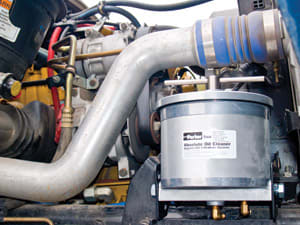
A supplemental filter must be carefully mounted so it works effectively and allows the engine's oil circulation system to continue its job.
Cleanliness is next to godliness, so some truck operators change motor oil religiously according to manufacturers' recommendations. Others extend drain intervals but use supplemental filtration and oil analysis to do it safely and make sure the oil stays clean
and effective. But adding a bypass filter to any engine should include considerations of cost effectiveness, according to a new set of recommendations from the Technology & Maintenance Council of the American Trucking Associations.
A task force of TMC members wrote Recommended Practice 359, "Qualifying Questions for Evaluation of Supplemental Engine Oil Filtration Systems," and TMC will soon publish it. Karl Dedolph, an automotive industry veteran who runs D3 Consulting out of Bloomington, Minn., chaired the task force, which included truck users and representatives of the filter business.
Supplemental filters are commonly called "bypass" because they draw a small percentage of the motor oil from the engine's circulatory system and eventually process all of it. The idea is they can take out more contaminants over time than the standard full-flow filters, which treat all the oil all the time.
A supplemental filter can help lengthen engine life and extend drain intervals by three or four times what manufacturers cite. But they must pay for themselves to be financially effective.
A supplemental filtration product usually costs $300 to $500, though one costs only about $50. The resulting extended drain interval should save much more than that in a reasonable amount of time. Savings should come from fewer oil changes, less downtime and labor cost, less spent motor oil to dispose of, and, if the supplemental filter is effective, longer engine life.
But how much time and bother will the oil analysis program be, and how will a prospective second owner look at a truck whose engine saw extended drain intervals?
Engine makers should always be consulted about a prospective product and its installation, Dedolph says.
Supplemental filters do not remove the additives needed for long engine life. Some feared that centrifugal filters - one of the four main types - spun out additives, but testing showed that they don't. They spin fast enough to throw out contaminants, but not the emulsified additives. The media of the other filter types also leave additives suspended in the oil.
CI-4 and CJ-4 oils are formulated to endure longer times in engines if oil is monitored by a well-run analysis program.
Exactly how long should the new drain interval be? "I defer to oil analysis companies to make that kind of decision, because they have lots of experience with just that kind of engine in just that kind of service with just that kind of oil in just that kind of weather," Dedolph says.
RP 359 lists the types of supplemental filters - spin-on, canister, centrifugal, and combination full-flow - and briefly explain their operation. Over the years about 10 manufacturers have marketed a variety of products, and all can be effective if properly installed and managed.
Do your homework
The TMC Recommended Practice lists five multi-part questions any operator should ask himself and prospective suppliers before deciding on a product:
1. What end-result benefits are desired for the vehicle(s) or the fleet? Maybe other methods will achieve the same goals.
2. What is the impact on warranty terms? That's why makers of the engine, oil and truck should be consulted, and the filter manufacturer should provide written assurance that all warranties will remain in force, or provide a warranty to make up for loss of others.
3. How will the service interval be impacted? Can a longer oil-drain interval be made to jibe with other scheduled service on the rest of the truck?
4. What are the economics of the product? What does it cost to buy and install, what will it cost to service over the vehicle's life, and how will it - and an extended drain interval - affect the truck's resale value? The RP includes a Return on Investment section that truck operators can use for calculations.
5. Are there any ancillary considerations to evaluate? Flow mechanics - how the device works with the engine's normal oil circulation - are among the things to learn. Others are technician training, materials stocking, supplier support, and modified maintenance procedures.
Other considerations
There is a limit to how far from the engine block a supplemental filter can be mounted, the RP says. The shorter the distance and the length of hoses the better, though complexity of today's engines can make it difficult to accomplish. Underhood heat is not a problem, and in fact a supplemental filter can act as an oil cooler.
Reputable manufacturers rate their filter products according to a method set by the International Standards Organization. It states efficiency at a specific micron size. A correct rating would be "5 micron at 95 percent efficiency," meaning the filter is 95 percent efficient at removing impurities as small as 5 microns per ISO 4548-12" (1 micron is one millionths of a meter or about 1/25,000-inch). Something that's labeled as simply a "5 micron filter" rating would be incorrect, the RP says. While it may be able to remove 5-micron particles, there's no information on just how good it is at doing that.
Standard full-flow filters grab contaminants as small as 30 to 40 microns, Dedolph explains. That's why oil should be changed fairly often. Most engine damage is done by contaminants 3 to 7 microns in size, so a supplemental filter that grabs contaminants as small as 2 to 4 microns is good, and is why drain intervals can be extended.
A safe basic drain interval depends on the type of service and where the truck operates. An engine builder's basic recommendation of 15,000 miles could be extended to 45,000 or even 60,000 miles if the manufacturer agrees that the motor oil, filter product and the analysis program are sufficient.
TMC will publish RP 359 in its 2010-11 Engineering Practices manual. The RP is now available to TMC members online at www.truckline.com.
From the February 2010 issue of Heavy Duty Trucking.
More Maintenance

Color Match Smarter: Tools That Restore & Perform
For fleet managers and collision repair professionals keeping heavy-duty trucks on the road, getting the color right the first time isn't just about appearance — it's about efficiency, turnaround time, and bottom-line results. Discover how today's digital color tools are transforming the repair process from guesswork to precision.
Read More →
Wrong Repair Prompts Recall of Freightliner, Western Star 4x2 Trucks
DTNA is recalling more than 2,400 trucks that received an incompatible software fix instead of the hardware repair required to address brake valve corrosion.
Read More →
Truck Drivers Need More Than Another Alert
Fleets have more visibility into truck health, safety events, and driver activity than ever. The next challenge is turning all that information into useful guidance for the person who has to decide what to do next.
Read More →

The Maintenance Checks Trucking Fleets Should Prioritize Before Fall Freight Picks Up
Making it through August isn’t the same as being ready for the next several months of operation. Find out what systems may have suffered from summer heat and need to be checked out before fall.
Read More →
What Three Fleets Are Doing Differently When Buying Truck Parts in 2026
With freight improving but costs still climbing, fleet maintenance executives explain how they're balancing price, quality, and supplier relationships.
Read More →
Paccar Recalls 2027 Trucks Built This Summer for Possible Electrical Problem
The nearly 6,000 Kenworth and Peterbilt trucks in the recall could potentially lose engine power, among other things.
Read More →
Will API PC-12 Oil Change Trucking Fleet Maintenance?
The new API PC-12 heavy-duty engine oil category reflects the changing demands of modern diesel engines. But fleets like Foodliner are looking to getting their own data before making decisions on adopting the new oils and questions such as extending oil drain intervals.
Read More →
Brake Safety Week to Focus on Drums and Rotors
Commercial vehicle inspectors are focusing on truck brakes during CVSA's Brake Safety Week, August 23-29.
Read More →Possible Battery-Cable Fires Prompt Recall of 15,000+ International MV and HV Trucks
On the recalled vehicles, manufacturing variations can cause the battery interconnect cable to contact the auxiliary stud and hold down the bracket.
Read More →
Rush, MCT Team Up to Grow Refrigeration Service Network
The joint venture will operate MCT's network of Carrier Transicold dealerships and mobile service locations, with the companies promising greater service capacity and uptime for refrigerated fleets.
Read More →