




Maintaining and Servicing Diesel Particulate Filters
Diesel particulate filters trap soot from the exhaust and ash from motor oil. Most soot is burned off in the course of a truck's operations, but ash stays in the filter's honeycomb substrate and is removed through periodic servicing.

Diesel particulate filters trap soot from the exhaust and ash from motor oil. Most soot is burned off in the course of a truck's operations, but ash stays in the filter's honeycomb substrate and is removed through periodic servicing.
Exhaust in highway trucks is usually hot enough to burn off most soot in a process called "passive regeneration." However, those involved in stop-and-go operations or that idle a lot don't get their exhaust hot enough. The latter must "actively" burn out soot from the substrate by injecting extra fuel just upstream of an oxygen catalyst or by plugging in an electric heater when parked.
Active removal of soot through on-board regeneration can occur one or more times a day, depending on its type of operation, manufacturers say. Often it goes unnoticed by the driver, who may or may not see the indicator light in the instrument panel. But sometimes a warning gets more insistent through the light indicators and the driver must stop and initiate an active regeneration.
Ash from motor oil stays in the filter's substrate and must be periodically blown or washed out. This is done by removing the DPF from the truck and placing it on a special machine. It sends compressed air through the substrate in a series of measured puffs. Detroit Diesel's filters are pressure-washed with de-ionized water, then dried.
Most filters seen by Cleaire Advanced Emissions Controls, which air-cleans DPFs it has previously made and sold, collect about 200 grams (7 ounces) of ash. Some come in with as much as 600 grams (21 ounces).
Blowing or washing out of ash must be done every 50,000 miles or once a year. This, too, is indicated by a warning light. Large fleets have purchased machines to do the cleaning themselves, but most owners take filters or entire trucks to dealers and independent shops for cleaning.
Some owner-operators running out of the Port of Oakland, Calif., have used state money to retrofit their older trucks with DPFs, only to discover they need frequent removal and cleaning. So it's important to ask upfront what the cleaning requirements will be, how long they will take and how much they will cost.
Sometimes an engine produces extra soot or spits out unburned fuel and burned motor oil. These, too, are captured by the DPF, and usually it can't burn them out through normal processes. So occasionally the substrate must be removed from the DPF, then heated and baked in a special machine to burn out the crud. About 10% of filters brought in for servicing need this, manufacturers say.
Once a mechanic gets at a truck, it usually takes about 60 to 90 minutes to remove the DPF, set it on a machine, clean it for about a half hour, then reinstall the filter on the truck. If baking is required, it may take up to eight hours in the machine. The advantage is that the original DPF stays with the truck, which might add to resale value because its owner can show complete servicing records.
An alternative is the owner removing the DPF and taking it, or a batch of them, to a servicing shop. Here the owner gets back his DPFs, even if he moves them among like-spec'd vehicles in the fleet. This requires him to keep a stock of new or cleaned DPFs to install when loaded up units are removed. An advantage is low downtime for individual vehicles.
Some DPF makers offer an exchange program. Owners send in dirty DPFs and get already cleaned ones to use on their trucks. This reduces the need to stock many DPFs, and the cleaned units are warranted - but the owner doesn't know where they've been. As long as they work well, most owners don't care. A new exchange program by Cleaire charges $450 to $650 to swap a dirty filter for a cleansed one.
Recently, each DPF manufacturer has had to approach CARB for approval of this exchange program. Swapping refers to the movement of the same DPFs among different vehicles within the same common-ownership fleet. Re-designation means the movement of a used DPF from an appropriate engine and application to another, within the same fleet.
Not all manufacturers allow component swapping and/or re-designation. So in some cases, the original filter must remain on the original vehicle in order to stay within CARB compliance.
A manufacturer may deny a warranty claim if swapping or re-designation is performed by a fleet owner, and either the policies approved by the manufacturer are not followed or if the policies are not approved in writing by CARB.
If you have a large fleet and want to look at cleaning your own DPFs, you can purchase machines from several manufacturers, such as Donaldson, FSX and OTC/SPX.
From the August 2011 issue of HDT.
More Maintenance
What Three Fleets Are Doing Differently When Buying Truck Parts in 2026
With freight improving but costs still climbing, fleet maintenance executives explain how they're balancing price, quality, and supplier relationships.
Read More →
Paccar Recalls 2027 Trucks Built This Summer for Possible Electrical Problem
The nearly 6,000 Kenworth and Peterbilt trucks in the recall could potentially lose engine power, among other things.
Read More →
Will API PC-12 Oil Change Trucking Fleet Maintenance?
The new API PC-12 heavy-duty engine oil category reflects the changing demands of modern diesel engines. But fleets like Foodliner are looking to getting their own data before making decisions on adopting the new oils and questions such as extending oil drain intervals.
Read More →
Brake Safety Week to Focus on Drums and Rotors
Commercial vehicle inspectors will be focusing on brakes during CVSA's Brake Safety Week, August 23-29.
Read More →
Possible Battery-Cable Fires Prompt Recall of 15,000+ International MV and HV Trucks
On the recalled vehicles, manufacturing variations can cause the battery interconnect cable to contact the auxiliary stud and hold down the bracket.
Read More →
Rush, MCT Team Up to Grow Refrigeration Service Network
The joint venture will operate MCT's network of Carrier Transicold dealerships and mobile service locations, with the companies promising greater service capacity and uptime for refrigerated fleets.
Read More →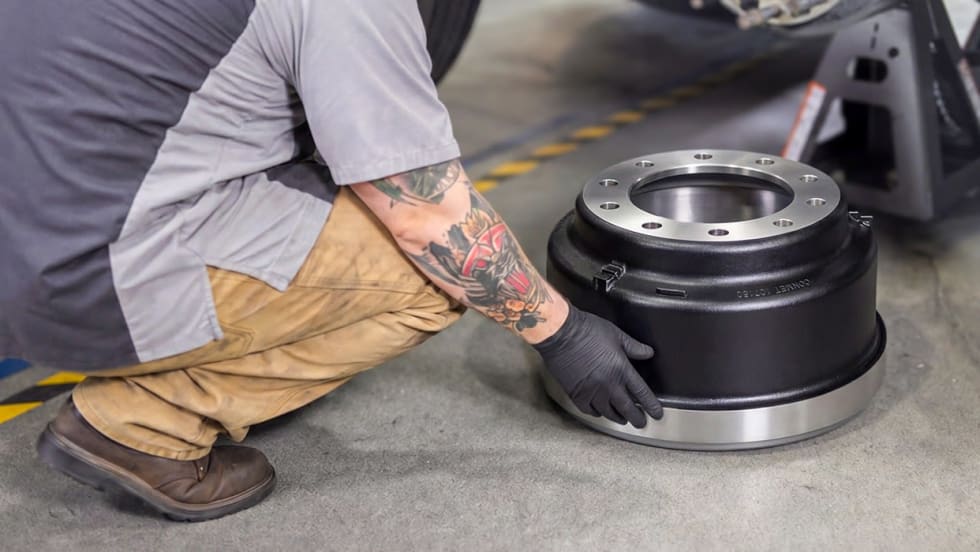
ConMet Expands Aftermarket Brake Drum Lineup With TruCast
A new heavy-duty truck brake drum option in the aftermarket gives customers more flexibility within the ConMet product family.
Read More →
Mack Expands Premium Service Contract Coverage to Medium-Duty MD
With a service contract, inspections, preventive maintenance and repairs can be handled in a single visit instead of multiple ones.
Read More →
Maintenance in the Messy Middle Part 5: Battery-Electric Trucks
No oil changes. No diesel exhaust fluid. No exhaust aftertreatment. But NACFE battery-electric trucks still require specialized maintenance procedures.
Read More →
Trucking Fleets Faced Record Operating Costs During Third Year of Freight Recession
ATRI's annual operational cost report shows carriers trimmed fleets, delayed equipment purchases, and ran older trucks as expenses continued to outpace freight rates.
Read More →