




Maintaining Air Springs and Shock Absorbers
Air suspensions are subject to wear and aging, and must be regularly inspected and repaired or replaced when necessary.

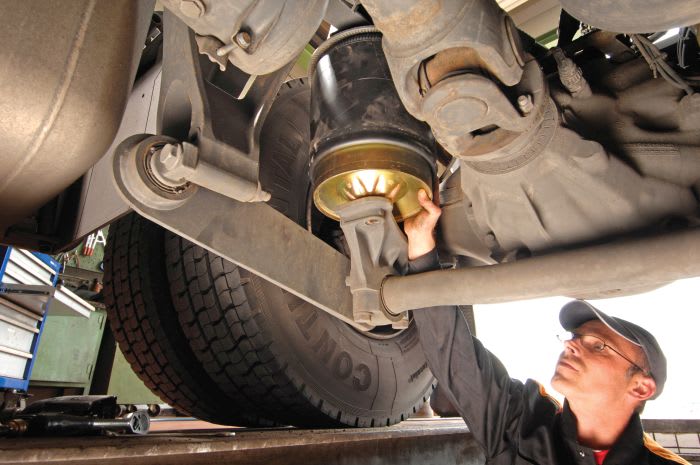
This brand-new air spring won’t need much attention until it’s worked for many miles and its rubber bag ages through contact with the elements. Its operating range is 40 to 100 psi. Photo: ContiTech North America
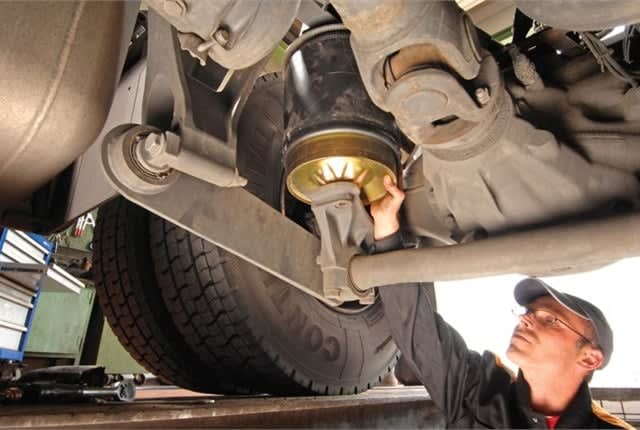
This brand-new air spring won’t need much attention until it’s worked for many miles and its rubber bag ages through contact with the elements. Its operating range is 40 to 100 psi. Photo: ContiTech North America
Air suspensions cushion the ride for drivers, vehicles and loads. Among their components are the springs themselves and shock absorbers, which help control the movement of the bags and the rest of the suspension. These parts are subject to wear and aging, and must be regularly inspected and repaired or replaced when necessary.
The American Trucking Associations’ Technology & Maintenance Council recently revised its Recommended Practice 643A, Air Ride Suspension Maintenance Guidelines.
“Generally speaking, air springs are very durable components,” says John Healy with Stemco, which offers Goodyear brand air springs.
Because they’re made of rubber, air bags usually “age out” before they wear out, notes Dave Vanette, new business development manager at Firestone Industrial Products. “This aging out process has a lot to do with the heat history of the part and exposure to ozone,” he explains. If an air spring is run predominately where the average temperature is high, it accelerates this process.
“The typical failure mode for an aged-out air spring is not catastrophic, but would more likely be a slow leak that eventually becomes too much for the compressor to keep up with,” Vanette notes.
As it ages, you will see cracking or horizontal splits in the rolling lobe portion of the air spring, which is under the highest stress. By itself, cracking on the surface does not mean a leak. When the cracking actually starts happening on the inner liner inside of the air spring is when leaks occur. However, Vanette says, “this horizontal cracking of the rubber in the rolling lobe area is a good indication that the aging process is pretty well advanced and it will just be a matter of time before the air spring starts to leak, so it is probably a good time to change out your air springs.”
Try to track the age of the air spring by the purchase date of the truck or trailer, the purchase date of a replacement air spring, or by reading the date code on the air spring, he says. Knowing that the air spring is, say, more than five years old might prompt a closer inspection.
Damage can also result from tough operations, and RP 643 includes an inspection guide that lists various types of damage to air bags.
Are shocks working?
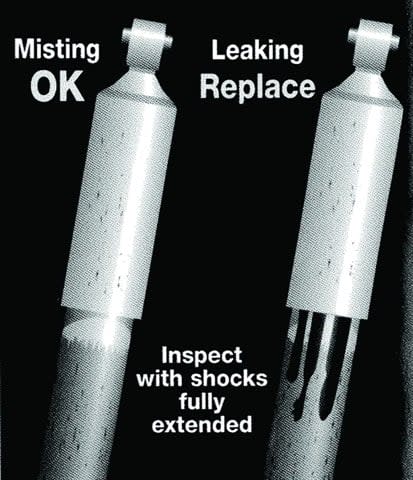
TMC guidelines say misting oil is OK for a shock absorber, but leakage isn’t. ART: ATA Technology & Maintenance Council
Today’s low friction Class 3-8 suspensions require high-functioning shock absorbers to minimize wear and protect suspension components from vibration damage, according to shock maker Gabriel.
“The number one cause of air spring failure is overextension caused by an improperly functioning shock absorber,” says Stemco’s Healy.
But the shocks themselves can be harmed if a suspension bumper or stop is damaged or missing, according to Joe Bacarella, manager, product training and technical resource centers at Tenneco North American Aftermarket, which markets Monroe shock absorbers.
“Bumpers keep the suspension from articulating too far and the shocks from stretching beyond their limits, to where internal parts are damaged,” he says. “Some bumpers are rubber and some are metal; they can be compressed by sharp contact or knocked off. If they’re missing, there’s nothing to keep the vertical movement under control.”
The folks at Gabriel say you should check your shocks for possible replacement if you experience uneven tire wear, ride deterioration, excess vibration, sagging taper leaf springs, premature wear, and broken or torn air springs.
“It is very important to ensure that your shocks are providing dampening and not just going along for the ride,” says Jason Heath, product manager, Powered Vehicle Systems at SAF-Holland. “We’ve all seen tractor-trailers bobbing up and down endlessly while going down the highway. This needless undulation results in unnatural, accelerated tire wear.
“A simple way to check if your shocks are working is to take the truck for a spin and check the temperature of the shock. If it is warm or hot, it’s working,” he says.
RP 643A says shocks on both sides of the vehicle should be checked in this manner, one right after the other. Both shocks should be warmer than the reference point (a frame rail, for instance) when touched, and be similar in temperature to each other. A cooler or cold shock may have failed. Stemco recommends using an infrared temperature gauge. When doing so, TMC’s RP says, there may be up to a 20% temperature difference between the two compared shocks. If the difference is greater than 20%, it may indicate a shock failure and should be removed for closer examination.
For that, check for visible signs of wear. Turn the shock upside down and shake while listening for any rattling that would indicate a broken internal piece. Also stroke the shock several times in an upright position to determine if there is any resistance. Stroke gas-charged shocks in the same way; it should return to a full-height position after release. A gas-cell shock needs to be removed, held in a horizontal position and stroked several times. If a lag develops, replace the shock. Unless a shock has been damaged by an external blow, replace both shocks of a pair so performance is equal on both sides of a vehicle.
More Maintenance

Color Match Smarter: Tools That Restore & Perform
For fleet managers and collision repair professionals keeping heavy-duty trucks on the road, getting the color right the first time isn't just about appearance — it's about efficiency, turnaround time, and bottom-line results. Discover how today's digital color tools are transforming the repair process from guesswork to precision.
Read More →
Wrong Repair Prompts Recall of Freightliner, Western Star 4x2 Trucks
DTNA is recalling more than 2,400 trucks that received an incompatible software fix instead of the hardware repair required to address brake valve corrosion.
Read More →
Truck Drivers Need More Than Another Alert
Fleets have more visibility into truck health, safety events, and driver activity than ever. The next challenge is turning all that information into useful guidance for the person who has to decide what to do next.
Read More →
The Maintenance Checks Trucking Fleets Should Prioritize Before Fall Freight Picks Up
Making it through August isn’t the same as being ready for the next several months of operation. Find out what systems may have suffered from summer heat and need to be checked out before fall.
Read More →
What Three Fleets Are Doing Differently When Buying Truck Parts in 2026
With freight improving but costs still climbing, fleet maintenance executives explain how they're balancing price, quality, and supplier relationships.
Read More →
Paccar Recalls 2027 Trucks Built This Summer for Possible Electrical Problem
The nearly 6,000 Kenworth and Peterbilt trucks in the recall could potentially lose engine power, among other things.
Read More →
Will API PC-12 Oil Change Trucking Fleet Maintenance?
The new API PC-12 heavy-duty engine oil category reflects the changing demands of modern diesel engines. But fleets like Foodliner are looking to getting their own data before making decisions on adopting the new oils and questions such as extending oil drain intervals.
Read More →
Brake Safety Week to Focus on Drums and Rotors
Commercial vehicle inspectors are focusing on truck brakes during CVSA's Brake Safety Week, August 23-29.
Read More →Possible Battery-Cable Fires Prompt Recall of 15,000+ International MV and HV Trucks
On the recalled vehicles, manufacturing variations can cause the battery interconnect cable to contact the auxiliary stud and hold down the bracket.
Read More →
Rush, MCT Team Up to Grow Refrigeration Service Network
The joint venture will operate MCT's network of Carrier Transicold dealerships and mobile service locations, with the companies promising greater service capacity and uptime for refrigerated fleets.
Read More →