




4 Questions About Brake Violations
Why was your truck put out of service? Answers to common questions about brake inspections.

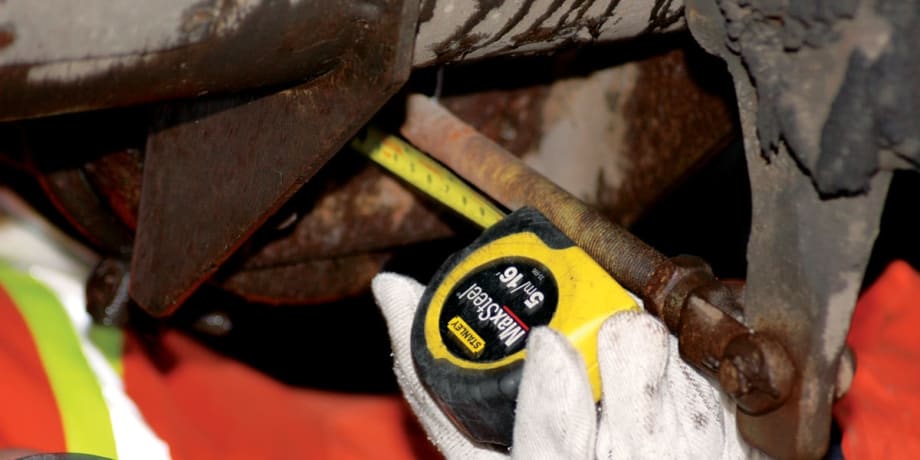
Some brake violations are easy to understand. Brake adjustment can be confirmed by marking and measuring a push rod. Others can be baffling.
Photo: Jim Park
The Commercial Vehicle Safety Alliance’s annual Brake Safety Week last fall saw 12% of the 43,565 commercial motor vehicles inspected placed out of service for brake-related violations.
With more than one out of every 10 trucks operating with brake-related violations serious enough to take it off the road, we talked to Kerri Wirachowsky, the director of CVSA’s roadside inspection program, about some of the recurring questions she faces regarding brake violations.
1. How can I be put out of service for one service brake violation? The last time it happened, I was allowed to continue my trip.
The out-of-service criteria for service brakes is broken into two parts. You have service brakes over the entire combination, but there’s a separate section just for the steering axle brakes.
Steering axle brake violations are more critical than those on the rest of the combination. If you have a brake on the left and you don’t have a brake on the right, it’s going to pull to the left. So if you have an inoperative brake on the steer axle, that truck is automatically put out of service.
If that same inoperative brake is on the second or third axle of a tractor, that one inoperative brake will not exceed the 20% calculation for the out-of-service criteria. [No more than 20% of the vehicle’s brakes can be defective.] Therefore, that truck will leave with an inoperative brake violation on the tractor, but it is allowed to continue to its destination.
If I also have a brake out of adjustment or a contaminated lining somewhere else in that combination, the inspector is going to use that inoperative brake as one defective brake towards the 20%. Now I have two service brakes that are in violation, and that, too, will place the vehicle out of service.
2. How can I receive multiple violations for the same brake?
Let’s say you’ve got a contaminated lining, and it’s inoperative, and the brake is out of adjustment – it’s bottoming out, and the linings are not contacting the drum.
That will only account for one defective brake. I have three violations, and they’re all going to be documented on the inspection report. But it’s only counted as one defect towards that 20% out-of-service calculation. The driver can go and repair that at his final destination.
If I find another brake that has a violation, now he’s out of service for two defective brakes.
All of those violations get documented, and all of those have to be repaired.
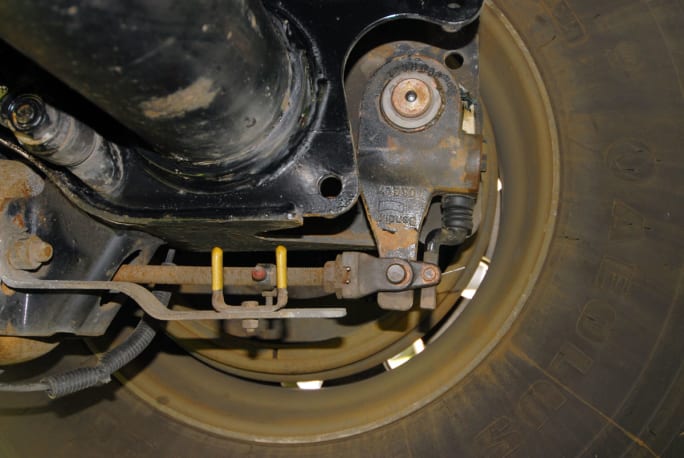
Brake stroke indicators provide a visual reference of brake stroke for drivers. Roadside inspectors will measure brake stroke before issuing citations, so the brake stroke indicators are not giving away any secrets.
Photo: Jim Park
3. Does the root cause of the brake violation matter?
Inspectors are not trained to diagnose why something is happening. They are trained to document violations. They will document what they see, and it’s up to you to repair [the issue].
You may have an inoperative brake and you may have a brake out of adjustment. That adjustment may be a factor with the inoperative brake, but maybe not. [You won’t know] until you actually adjust that brake and get it within the allowances. There could be seized roller pins, seized anchor pins, seized clevis pins — other things that are causing that brake to have more issues.
Another example would be steering wheel free play due to a pitman arm being loose on an output shaft of a steering box. The steering wheel free play is one violation, and potentially out of service if it’s excessive. Any loose pitman arm is out of service on a steering box. You will — if you exceed the steering wheel free play — end up with two out-of-service violations on your inspection report. It’s quite possible that the loose pitman arm on the output shaft caused the steering wheel free play to be the way that it is, but I don’t know that 100%. There could be something wrong with the gearbox. But until you tighten that pitman arm, I don’t know the answer to that question.
4. How can one worn air hose be OK but the next one take me out of service?
Obviously, air hoses — to get from a tractor to the back of a trailer — have to touch something. They can’t be suspended in mid-air, never to rub on anything. You’ll see them going through grommets. You’ll see them tacked against the frame rail. If the gladhand hoses are a little too long, sometimes they rest on the catwalk or the back of the tractor.
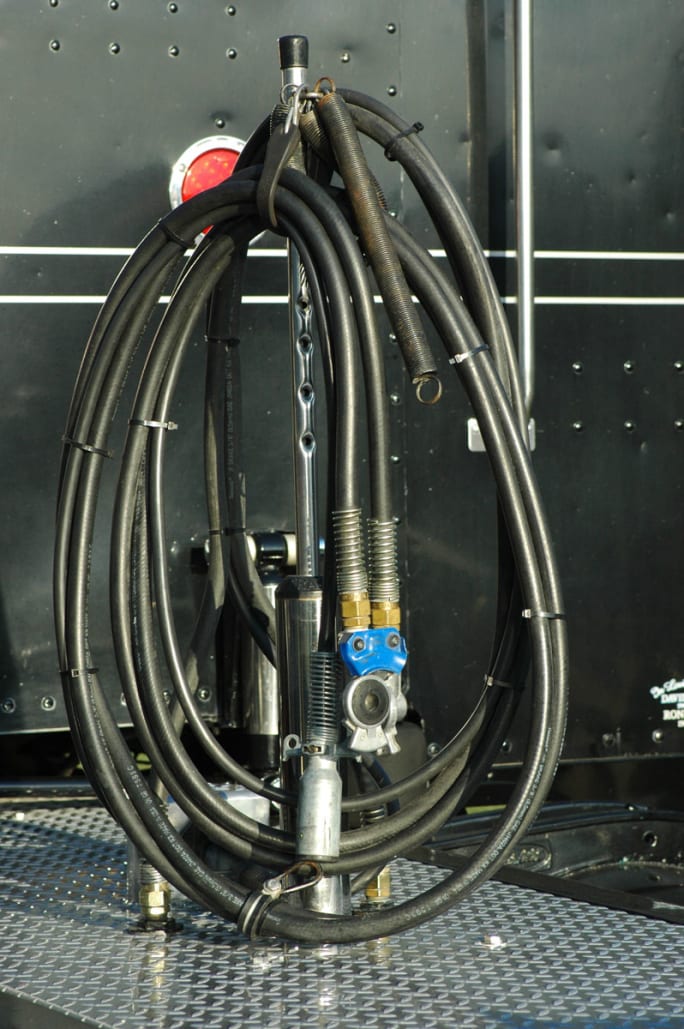
Preventing brake hoses from dragging on the rear deck reduces the possibility of hose damage from chafing and cuts.
Photo: Jim Park
Just because it’s rubbing doesn’t necessarily mean that it should be written up as a violation.
In order for it to be a violation, it should have some reduction in diameter. Just because it’s shiny doesn’t necessarily mean that it’s in violation.
Then it gets into, when does it have to be repaired and when is it out of service. That’s when you get down into the second color of thermoplastic, or you get down to the reinforcement ply in a rubber hose.
Inspectors need to document the violations well, and they need to say what hose [they are] talking about. There are a lot of air hoses on tractor-trailers. So when they document violations, we have a policy that says, “Make sure you say it’s on the second axle, left side service hose going to the service chamber, so it takes the motor carrier’s technician directly to the right hose.” If you don’t give them the appropriate information, they might get under there and repair a different hose altogether.
Talk to the inspector. Inspectors should be marking or chalking what defects they find so that it’s easier for the industry to find it.
About the Author: John G. Smith is the editorial director of Newcom Media's trucking and supply chain publications – including Today's Trucking, trucknews.com, and others. A version of this article first appeared on trucknews.com and was used with permission as part of a cooperative editorial agreement. To watch the full video interview with Kerri Wirachowsky about understanding truck out-of-service violations, go to www.trucknews.com/videos
More Maintenance

Color Match Smarter: Tools That Restore & Perform
For fleet managers and collision repair professionals keeping heavy-duty trucks on the road, getting the color right the first time isn't just about appearance — it's about efficiency, turnaround time, and bottom-line results. Discover how today's digital color tools are transforming the repair process from guesswork to precision.
Read More →
Wrong Repair Prompts Recall of Freightliner, Western Star 4x2 Trucks
DTNA is recalling more than 2,400 trucks that received an incompatible software fix instead of the hardware repair required to address brake valve corrosion.
Read More →
Truck Drivers Need More Than Another Alert
Fleets have more visibility into truck health, safety events, and driver activity than ever. The next challenge is turning all that information into useful guidance for the person who has to decide what to do next.
Read More →
The Maintenance Checks Trucking Fleets Should Prioritize Before Fall Freight Picks Up
Making it through August isn’t the same as being ready for the next several months of operation. Find out what systems may have suffered from summer heat and need to be checked out before fall.
Read More →
What Three Fleets Are Doing Differently When Buying Truck Parts in 2026
With freight improving but costs still climbing, fleet maintenance executives explain how they're balancing price, quality, and supplier relationships.
Read More →
Paccar Recalls 2027 Trucks Built This Summer for Possible Electrical Problem
The nearly 6,000 Kenworth and Peterbilt trucks in the recall could potentially lose engine power, among other things.
Read More →
Will API PC-12 Oil Change Trucking Fleet Maintenance?
The new API PC-12 heavy-duty engine oil category reflects the changing demands of modern diesel engines. But fleets like Foodliner are looking to getting their own data before making decisions on adopting the new oils and questions such as extending oil drain intervals.
Read More →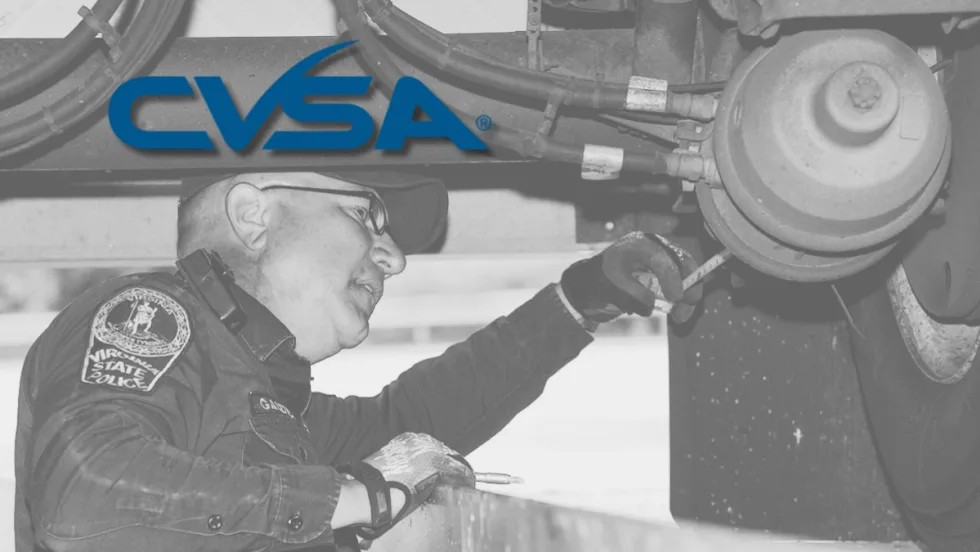
Brake Safety Week to Focus on Drums and Rotors
Commercial vehicle inspectors are focusing on truck brakes during CVSA's Brake Safety Week, August 23-29.
Read More →Possible Battery-Cable Fires Prompt Recall of 15,000+ International MV and HV Trucks
On the recalled vehicles, manufacturing variations can cause the battery interconnect cable to contact the auxiliary stud and hold down the bracket.
Read More →
Rush, MCT Team Up to Grow Refrigeration Service Network
The joint venture will operate MCT's network of Carrier Transicold dealerships and mobile service locations, with the companies promising greater service capacity and uptime for refrigerated fleets.
Read More →