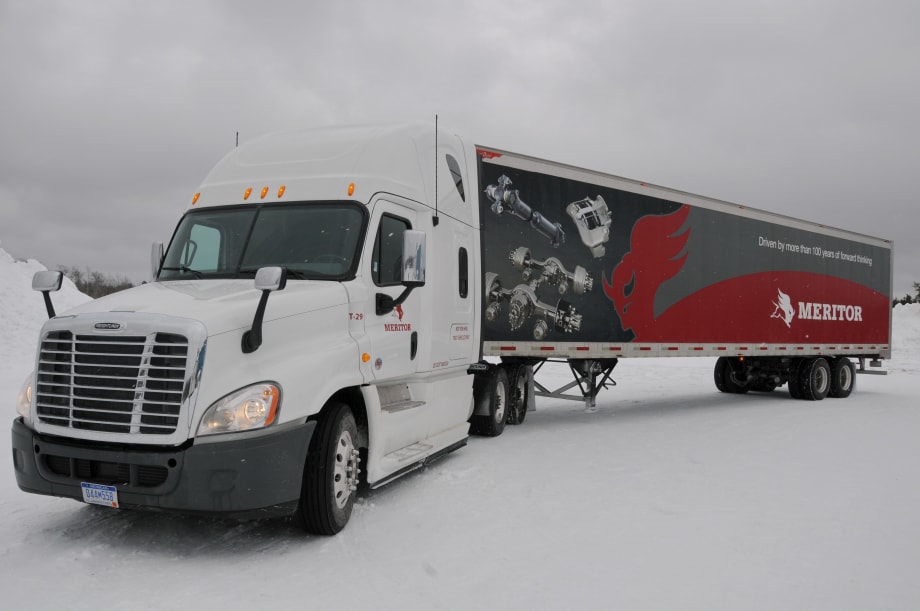
The 6x2 concept isn't new, but it's not popular on our side of the Atlantic Ocean. Meritor aims to change that with its new SmarTandem single-drive-axle tandem configuration. Equipment Editor Jim Park reports on his driving impressions.
What better place to traction-test a 6x2 drive axle system than Michigan's Upper Pennisula in February?
7 min to read
What better place to traction-test a 6x2 drive axle system than Michigan's Upper Pennisula in February?
The 6x2 concept isn't new, but it's not popular on our side of the Atlantic Ocean. Meritor aims to change that with its new SmarTandem single-drive-axle tandem configuration.
Meritor estimates using one drive axle instead of two will im prove fuel economy by as much as 2%, but we've heard user testimonials claiming as much as half a mile per gallon.
Ad Loading...
The single axle eliminates two of the three gear sets found in a twin-screw tandem (inter-axle differential gearing, drop gears and a second ring-and-pinion set), and the newly designed ring-and-pin-ion gears offer a significant reduction in gear-mesh friction, Meritor claims. The SmartTandem also weighs about 400 pounds less than a similar twin-screw setup.
The increased tire wear often seen on the drive axle of a 6x2 is typical of any single-axle drive setup, as only two wheels are driving versus four wheels on a twin-screw. The cost of the increased wear can be partially offset by the lower cost of the tag axle tires. Trailer tires, which cost less than drive tires, are suitable at that position.
Additionally, the electronic controls of the SmarTandem micro-manage load distribution across the four wheel positions, all but eliminating uneven wear caused by weight imbalance.
That leaves one outstanding concern: traction. And Meritor may have put that to rest as well.
In mid-February, I spent a morning at the Smithers Winter Test facility in Brimley, Mich., evaluating SmarTandem's handling on snow and ice and mixed surfaces. As any driver will tell you, icy surfaces make life more interesting that it needs to be. I found Meritor's new traction technology performed as well as any cross-lockable 6x4 setup — better in some cases, and way better than a twin-screw setup with only inter-axle diff locks.
Ad Loading...
On different surfaces, the differential locks automatically, sending 100% of the available torque to the non-slipping wheel.
The trouble with traction
As Bridgestone's Guy Walenga noted in a recent tire column I penned about low-rolling-resistance tires, “Traction is a funny thing: We know when we don't have enough of it, but can we quantify how much we need or how much is enough? More might be better and less might be worse, but we don't know what's ideal.”
So it is with a single- versus a twin-screw drive-axle grouping. Normally, all four wheels in a 6x4 share the tractive duties on good surfaces. Likewise for a single drive axle. On less than ideal surfaces, if one of the four wheels in a 6x4 loses traction, the vehicle won't move until the inter-axle diff is locked. However, if the truck is on a split surface, i.e., ice on one side and pavement on the other, locking the IAD won't help. There, you need a cross-lock differential — and it's the same with a single drive axle.
Meritor's SmarTandem levels out that little playing field.
The SmarTandem actually improves the single-screw's tractive properties in a couple of ways, and it virtually eliminates the possibility of a driver wrecking a differential by engaging the locks while a wheel is spinning.
“The SmarTandem is an electronic control system as well as an axle system,” explains Charlie Allen, general manager of Meritor's Customer Technical Support. “It monitors wheel speed and wheel slip to determine wheel slippage. With that information, the system brings several levels of intervention to the traction problem.”
Ad Loading...
First, Meritor's SmarTandem controller system will automatically shift the load from the tag to the drive axle to bias the load for the greatest tractive effort. Allen says the weight transfer stays within the mechanical rating of the drive axle, and within the bridge formula, so it's not running overloaded.
With the second level of intervention, the electronic controls sense wheel slippage off the ABS exciter ring, and automatically engage the cross-locks on the differential to get torque out to the non-slipping wheel.
“If shifting the load to the driving axle isn't enough, the system can automatically lock the differential so 100% of the available torque can be applied to one wheel end,” Allen says.
As an additional proactive function, the driver can manually lock the diffs and shift the weight onto the drive before wheel slippage occurs. The system automatically disengages at 25 mph or with a 90-degree turn of the steering wheel, so there's no possibility of forgetting to disengage the system.
To protect itself from damage, the diff lock uses a face-clutch mechanism rather than a full spline lock. The clutch allows for safe, smooth engagement even if a wheel is already spinning on ice, but the system will not engage the cross-lock if there is a great difference in wheel speed.
Ad Loading...
The face-clutch versus splined coupling (as found on the FuelLite's 160-series axle) makes the difference, Allen says.
“With the 160 series you have to be almost stopped to lock the diffs,” he explains. “SmarTandem has a face clutch that can be engaged with a greater speed differential between the wheel-ends. The control system manages the engagement and lockup almost immediately upon sensing slippage, so it's very proactive, as opposed to a driver's reaction, which would normally be after-the-fact and only at very slow speeds.”
Next Page: But Does it Work?[PAGEBREAK]
Both axles use the same R-Series spindle with common hubs, bearings and seals for easier parts management.
But does it work?
Over the course of two decades and 2 million miles, I've found myself stuck more than once. A common winter hazard is warm tires parked on hard-packed snow. They melt themselves into cups in the ice that might as well be wheel chocks. That actually happened to the engineering crew that brought the truck from Troy, Mich, up to Smithers for our test drive. They had parked it the night before on a hard-packed surface, and the next morning found it sunk almost an inch into the ice.
The driver, Mark Kleckner, a development and test engineer in Meritor's Advanced Engineering & Electronics department, engaged the system and rocked the truck gently back and forth a few times and out she came.
Ad Loading...
Test No. 1: Pass
I drove the truck about 20 miles from the hotel to the track on some northern Michigan two-lane roads and noted no shortage of traction, even in sharp turns where the grade of the two intersecting roads was uneven.
At the track, we ran the truck over several different surfaces, from glare ice to hard-packed snow and even loose and broken icy snow. We also ran it over some mixed coefficient-of-friction pads with hard snow and dry pavement, ice and dry pavement, and ice and hard snow.
Tests No. 2, 3, 4: Pass
Because the truck was an engineering test truck, it was equipped with gauges to monitor air pressure and blinking lights to indicate system status that a stock truck wouldn't have. I had the benefit of “seeing” the system perform as well as feeling it. The transfer of weight from back to front was very fast. It took between five and eight seconds for the pressure in the suspension to go from about 50 psi in each axle to about 75/25. And it returned to normal just as quickly. I never heard any grinding sounds when the cross-locks were engaging, contrary to my previous experience with locking inter-axle diffs.
Ad Loading...
I have never had to use cross-locking diffs before, so I can't provide a 6x4 versus 6x2 perspective, but this truck had very little difficulty launching on any surface. Naturally, with both wheels on glare ice there was a bit of slippage even with the differential locked, but the traction control gently applied a little brake to the wheels to minimize the spinning.
Test No. 5: Pass
After a few hours on the track, I concluded that about the only situation where the SmarTandem might be at a disadvantage compared to a 6x4 setup would be on dramatically uneven ground, where the drive axle was left, literally, dangling in the air. If you were you to back the tractor up onto a curb, it would take a few seconds for the pressure in the tag axle to bleed off and the pressure in the drive axle to push the wheels onto the pavement. I suppose the height of the curb would be a factor in the effectiveness of the system, but what's a driver doing backing over a curb to begin with?
Test No. 6: Conditional pass
Allen is quick to point out that SmarTandem is designed for on-highway operation, which implies a minimum amount of time spent off-roading. How often your trucks wind up on really uneven terrain would be something to consider when specing such a system.
Ad Loading...
I'm sure some driver will find a way to get stuck with the SmartTandem, but in my short time on some really dicey surfaces, I don't think there's any situation where a full 6x4 could do any better than this 6x2. And I'll even say that the SmartTandem would do a better job in some situations, one being its ability to protect itself. Allen says it will not do anything beyond its design envelope, and as soon as the truck reaches 25 mph, or the steering wheel is turned beyond one-quarter turn from straight ahead, the system completely disengages.
Listen as transportation attorney and TruckSafe Consulting President Brandon Wiseman joins the HDT Talks Trucking podcast to unpack the “regulatory turbulence” of last year and what it means for trucking fleets in 2026.
Safety, uptime, and insurance costs directly impact profitability. This eBook looks at how fleet software is evolving to deliver real ROI through proactive maintenance, AI-powered video telematics, and real-time driver coaching. Learn how fleets are reducing crashes, defending claims, and using integrated data to make smarter operational decisions.
Fleet software is getting more sophisticated and effective than ever, tying big data models together to transform maintenance, safety, and the value of your existing tech stack. Fleet technology upgrades are undoubtedly an investment, but updated technology can offer a much higher return. Read how upgrading your fleet technology can increase the return on your investment.
The Federal Highway Administration is asking motor carriers and truck drivers to give input on where and when drivers have difficulty finding truck parking, and on how drivers prefer to get information on available parking.
The Federal Motor Carrier Safety Administration continues a crackdown on an increasing number of states it says have been issuing non-domiciled CDLs improperly.
The Department of Transportation and the Federal Motor Carrier Safety Administration took several actions in 2025 to tighten enforcement of regulations for commercial drivers. Will those affect trucking capacity in 2026?