




Tips to Avoid Vehicle Fires
"I don't know if there are more truck fires today or just that, now, they are catastrophic when they happen," says Bruce Purkey of Purkey's Fleet Electric.
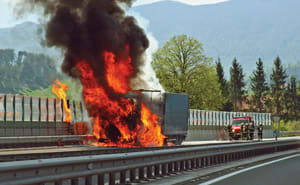
Truck fires have always been with us, but they have taken on a greater significance for their far more comprehensive and catastrophic nature.
"I don't know if there are more truck fires today or just that, now, they are catastrophic when they happen," says Bruce Purkey of Purkey's Fleet Electric. He's a major contributor to the efforts of the Technology & Maintenance Council of the American Trucking Associations when it comes to things electrical.
"It used to be that when a fire happened, you'd burn up some wires and paint, and some passing good Samaritan trucker would get out a fire extinguisher and that would be that," Purkey says. "But now with all the composite materials, glues, cab and sleeper trim, a driver is lucky to get out of a burning truck alive."
The damage on a truck that maybe cost $25,000 in the past was minor compared to a $100,000 truck burning down to the frame rails. "When it melts the tires, you know that it's a pretty hot fire," Purkey says.
This is why TMC has created a Task Force, led by industry electrical veteran Charlie Groeller, to look into the causes of truck fires and come up with some recommended practices. Groeller was on the electrical side at Mack Trucks for his entire career and recently retired to consult from his home. Groeller is still very active in both TMC and the Society of Automotive Engineers dealing with electrical issues. Another activity at TMC involves the spec'ing of wiring for heavy trucks, an issue that came out of the work done by the vehicle fire task force - or more correctly, the Vehicle Electrical Fires: Causes and Prevention Solutions Task Force.
In the start-up session for the Task Force, Groeller invited fleets to bring to the meetings examples of trucks damaged in "thermal events," as they were termed. The Task Force was created under the auspices of S1-Electrical Study Group because the perception was that vehicle fires are started by electrical problems - shorts that overheat locally but spread to flammable materials.
As it turns out, this is indeed the major cause of vehicle fires. But at subsequent meetings, issues with wheel ends have also been identified, such as dragging brakes and wheel bearing failures. Other events, such as turbo failures, also can ignite wiring and cab insulation. The Task Force has even identified such unlikely culprits under the hood as the windshield washer fluid. So the fleet members are now calling on other Study Groups to develop their own Task Forces to address potential fire risks.
And, of course, vehicle fires can be caused by what's in the back of the truck. Shifted and incompatible cargo is a potential cause for fire, and nowhere is there more incompatible cargo than in a trash truck, which can be a likely and frequent candidate for a fire.
The electrical problem
Electrical issues still dominate when a tractor is involved. Groeller's Task Force is concentrating on the routing, clipping and chafing of vehicle wiring, coming up with recommendations for the installation of wiring that will minimize the electrical short.
For the most part, the truck manufacturers do an excellent job, but over time things can change. That's why Groeller and his Task Force members are crafting not just guidelines for where the wiring goes, but how technicians need to be on guard for potential electrical problems that can lead to fires.
One of the issues identified is the changing out of one component for another, especially if it's a starter motor or alternator. The issue here is that a fleet might use a different component in service than those fitted by the OEM. In these cases, often the terminals are located in different positions on the component. This can lead to the wiring being stretched beyond its designed length and position. Putting additional stress on the cables can lead to chafing or terminal breakaway, either of which can lead to exposed wiring contacting grounded metal and subsequent arcing.
Starter motors have been identified as a potential cause of fires even when the terminals are not compromised. According to Groeller, there are conditions when the starter pre-engages before the pinion engages, and then a high current is drawn over a long enough period that the unfused starter cables start a fire. Another condition reported by Ron Szapacs, maintenance specialists at Air Products, was of a starter that remained in engagement after the engine had started; because of the noise from the engine, the driver was unaware and the cables again started a fire.
At the last Task Force meeting, the engineers from the various starter manufacturers were invited to comment and, Groeller says, went away very thoughtful. He anticipates further developments that could address some of the fleet concerns about starter motors.
Technicians can play an important role in the prevention of fires in ways beyond how they change out components. The Task Force plans to recommend that techs take a much more proactive role during preventive maintenance inspections in looking for potential electrical hazards by inspecting the routing and clipping of harnesses and wires to ensure that cannot chafe. They are encouraged to be especially vigilant in checking around the starter and alternator. Groeller says PM instructions should be modified to stress the importance of correctly attached wiring.
One area that has come up for discussion is the incidence of trucks burning to the ground after an accident. In a situation where the engine and transmission are displaced, this may result in starter terminals or cables tearing and contacting the frame. There would seem to be little that can be done to avoid this, other than to spec an inertia switch in the high-current circuit or a battery isolator switch within the driver's reach. However, it may be a lot to expect that a driver will have the presence of mind to shut off the electricals after an accident.
Add-on electricals
A recurring theme in the meetings has been the drivers' roles in vehicle fires. Purkey commented that inverters are an issue, especially if a driver is less than conscientious in keeping the cab tidy. A blanket or a jacket covering an inverter within the sleeper, especially when under load, can result in overheating and a potential fire. (Similarly, use of a space heater within a sleeper should be strongly discouraged.)
Purkey says he's no fan of inverters. If his clients want them for drivers' comfort, he's perfectly willing to supply them - but only with a wiring and fuse kit that makes them as safe as possible.
One of the big problems with inverters is that installation by a less-than-qualified technician (such as the driver himself) can lead to a fire risk. If the inverter is connected directly to the battery with wiring that has been run through a hole drilled in the sleeper floor, this is a fire just waiting to happen. It will not take long for the wiring to chafe through on the exposed metal edge. Even if a rubber grommet is used, it will become aged and crack and eventually fall out.
Purkey builds inverter kits that have grommets that don't do that, and each kit is unique to each truck model. He says he now uses a Fuse Cube that attaches to the terminal of a Group 31 battery with fuses sized to the power of the inverter. The wiring is also matched to the inverter's power requirements and made the correct length so it can be correctly routed and clipped, without great loops of wire that may be the case with the universal wiring kits that often come with the inverter.
On trucks Purkey does for one of his accounts, there is even a two-hour timer to restrict the amount of use a driver can have of the inverter in the period of a day. He says a driver should be able to manage his demands for 110-volt power.
More Maintenance

Color Match Smarter: Tools That Restore & Perform
For fleet managers and collision repair professionals keeping heavy-duty trucks on the road, getting the color right the first time isn't just about appearance — it's about efficiency, turnaround time, and bottom-line results. Discover how today's digital color tools are transforming the repair process from guesswork to precision.
Read More →
Wrong Repair Prompts Recall of Freightliner, Western Star 4x2 Trucks
DTNA is recalling more than 2,400 trucks that received an incompatible software fix instead of the hardware repair required to address brake valve corrosion.
Read More →
Truck Drivers Need More Than Another Alert
Fleets have more visibility into truck health, safety events, and driver activity than ever. The next challenge is turning all that information into useful guidance for the person who has to decide what to do next.
Read More →
The Maintenance Checks Trucking Fleets Should Prioritize Before Fall Freight Picks Up
Making it through August isn’t the same as being ready for the next several months of operation. Find out what systems may have suffered from summer heat and need to be checked out before fall.
Read More →
What Three Fleets Are Doing Differently When Buying Truck Parts in 2026
With freight improving but costs still climbing, fleet maintenance executives explain how they're balancing price, quality, and supplier relationships.
Read More →
Paccar Recalls 2027 Trucks Built This Summer for Possible Electrical Problem
The nearly 6,000 Kenworth and Peterbilt trucks in the recall could potentially lose engine power, among other things.
Read More →
Will API PC-12 Oil Change Trucking Fleet Maintenance?
The new API PC-12 heavy-duty engine oil category reflects the changing demands of modern diesel engines. But fleets like Foodliner are looking to getting their own data before making decisions on adopting the new oils and questions such as extending oil drain intervals.
Read More →
Brake Safety Week to Focus on Drums and Rotors
Commercial vehicle inspectors are focusing on truck brakes during CVSA's Brake Safety Week, August 23-29.
Read More →Possible Battery-Cable Fires Prompt Recall of 15,000+ International MV and HV Trucks
On the recalled vehicles, manufacturing variations can cause the battery interconnect cable to contact the auxiliary stud and hold down the bracket.
Read More →
Rush, MCT Team Up to Grow Refrigeration Service Network
The joint venture will operate MCT's network of Carrier Transicold dealerships and mobile service locations, with the companies promising greater service capacity and uptime for refrigerated fleets.
Read More →