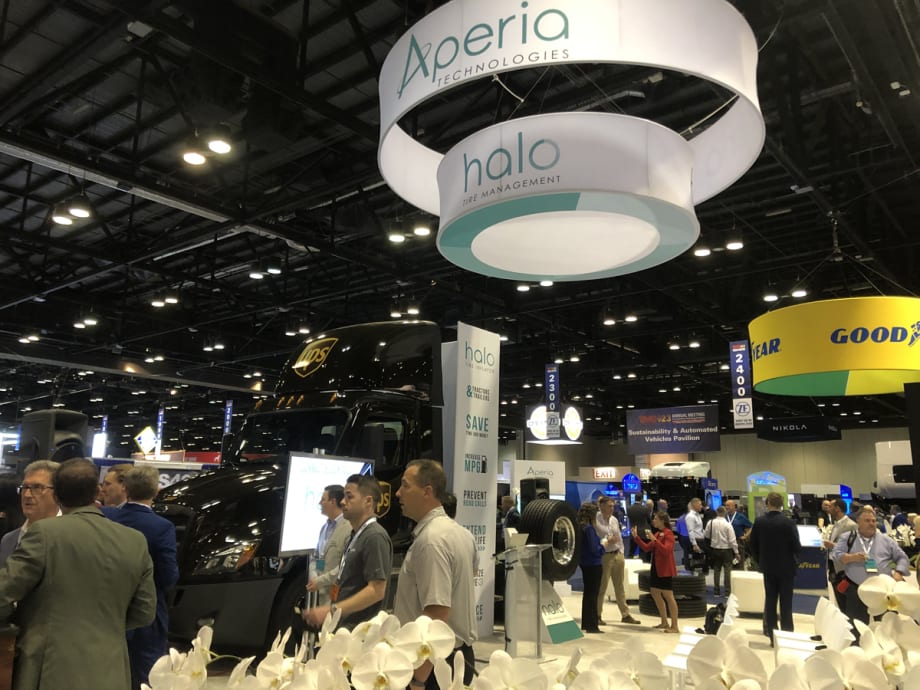
Aperia's TMC booth featured a UPS truck equipped with its Halo technology.
Photo: Jim Park
3 min to read
Building on its existing suite of Halo-branded tire management solutions, Aperia Technologies’ new Halo Tire Management platform brings predictive analytics to wheel-end maintenance.
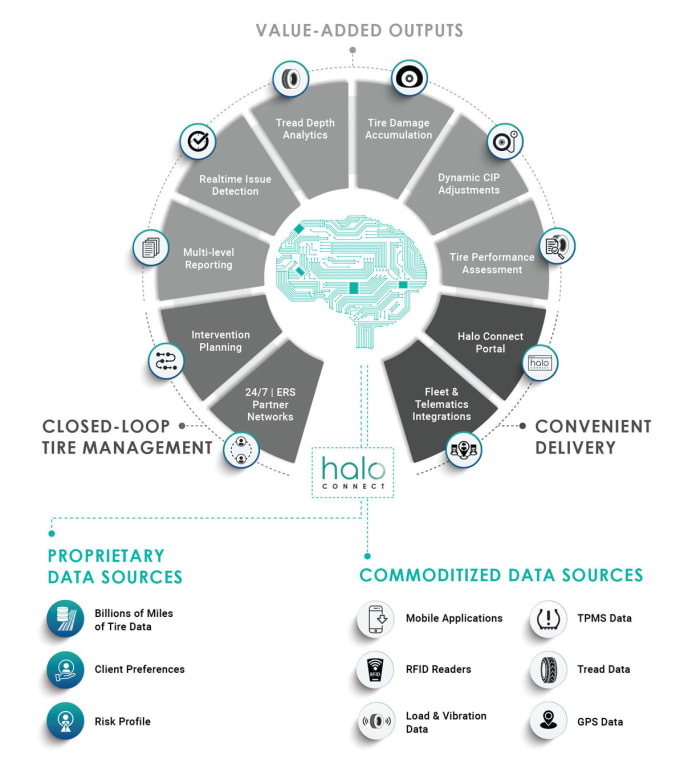
While other systems simply gather and report, bombarding fleets with more and more data from commodity sensors is not an effective way of managing tires. Instead, Halo Connect’s proprietary tire analytics engine receives data from several sources and decodes it, translating that data into meaningful maintenance recommendations for fleet users.
Ad Loading...
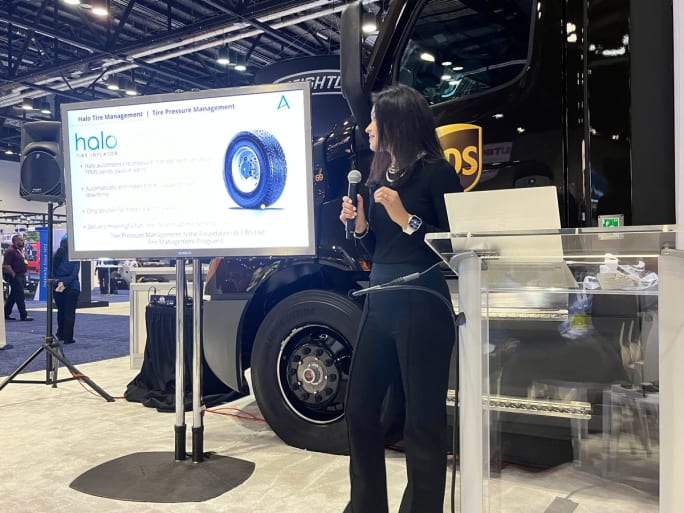
“Fleets spend millions of dollars every year manually managing tires, but under-inflated tires remain the leading cause of blowouts, and thus fleet downtime,” said Judith Monte, vice president of marketing and customer success at Aperia, introducing Halo Tire Management and Halo Trailer Connect at the ATA Technology & Maintenance Council annual meeting in Orlando in March.
Judith Monte, Aperia Technologies’ vice president of marketing and customer success, introduces the latest Halo tire management products at TMC.
Photo: Jim Park
“While commodity tire pressure monitoring pushes pressure alerts to fleets, they get lots of data but very little insight,” she said. “It requires an army of people just to figure out how to actually monitor tires. That means most problem tires never actually get addressed at all.”
Easier Tire Maintenance
According to Aperia, Halo Tire Management targets the three key aspects of tire maintenance:
Ad Loading...
Tire Pressure Management: The platform automates tire pressure adjustments for consistent, fleet-wide performance. With pressure automation by Halo, fleets can eliminate more than 70% of tire touches fleetwide, according to the company.
Tire Analytics: Halo Tire Management provides clear insight into tire health from cradle-to-grave, including uncovering tire leaks and their severity, determining how much safe drivetime is left before service is required, what tire damage accumulated before retreading, and more.
Seamless Integrations: With the ability to integrate into any number of platforms, the Halo Tire Management platform is customizable and integrates seamlessly into fleet workflows. The platform can tie into existing telematics or the vehicle CAN network.
Halo Connect can automate tire pressure, detect tire leaks, or assess tire tread, load, and vibration, and much more.
Source: Aperia
Halo Connect now Includes Trailers
Like its tractor counterpart, Halo Trailer Connect uses machine learning to assess overall tire and wheel-end health, detect potential issues by tire position, and classify them by severity. The system identifies tires reaching end-of-life, that are leaking, or that may benefit from an updated cold inflation pressure (CIP) target.
Halo Trailer Connect enables fleets to keep all tires under management with a single platform to optimize uptime, tire life, and maintenance costs.
Photo: Aperia
Halo Trailer Connect considers infinite interrelated and competing variables, such as user goals and risk profiles, to customize tire-related maintenance recommendations and drive strategic fleet decisions.
The system comes standard with the following features that the company said are not currently available with other tire management platforms:
Predictive tire health insights and customized user service recommendations
Trailer asset tracking
A single platform to manage both tractor and trailer tires
Can be used as a stand-alone product or with all brands of trailer inflation systems, including the Halo Tire Inflator for tractors and trailers
Ad Loading...
Aperia said it now has more than 1 million tires under management, which expands the learning capabilities of the platform’s algorithms, making it the smartest and more accurate tire management platform on the market, according to the company.
“With more tires under management than any other platform, the algorithms powering the solution will only get smarter, multiplying the value delivered to fleets with every rotation of the wheel,” said Monte.
For fleet managers and collision repair professionals keeping heavy-duty trucks on the road, getting the color right the first time isn't just about appearance — it's about efficiency, turnaround time, and bottom-line results. Discover how today's digital color tools are transforming the repair process from guesswork to precision.
DTNA is recalling more than 2,400 trucks that received an incompatible software fix instead of the hardware repair required to address brake valve corrosion.
Fleets have more visibility into truck health, safety events, and driver activity than ever. The next challenge is turning all that information into useful guidance for the person who has to decide what to do next.
Making it through August isn’t the same as being ready for the next several months of operation. Find out what systems may have suffered from summer heat and need to be checked out before fall.
With freight improving but costs still climbing, fleet maintenance executives explain how they're balancing price, quality, and supplier relationships.
The new API PC-12 heavy-duty engine oil category reflects the changing demands of modern diesel engines. But fleets like Foodliner are looking to getting their own data before making decisions on adopting the new oils and questions such as extending oil drain intervals.
The joint venture will operate MCT's network of Carrier Transicold dealerships and mobile service locations, with the companies promising greater service capacity and uptime for refrigerated fleets.