




Also of Interest:
Brake Defects Up in CVSA's September Inspection Blitz
Bad components and adjustment caused inspectors to place a higher percentage of trucks out of service during 2014's Brake Safety Week than during the '13 event, says the Commercial Vehicle Safety Alliance.
by Staff
January 5, 2015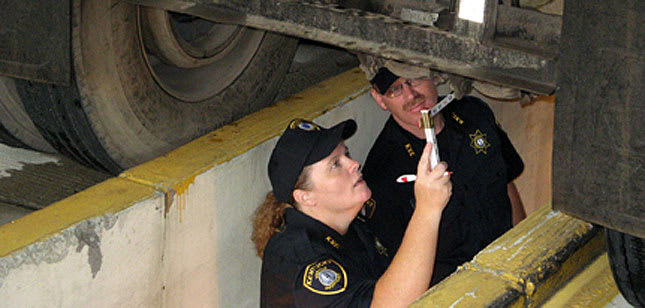
File photo courtesy Kentucky State Police.
2 min to read
File photo courtesy Kentucky State Police.
Last September’s Brake Safety Week inspections resulted in 16.2% of 13,305 commercial trucks examined in the U.S. being placed out of service, according to the Commercial Vehicle Safety Alliance. That’s several points higher than the activity in 2013, the organization said, though fewer trucks were inspected in 2014.
During the Sept. 7-13 campaign, local, state, provincial, territorial and federal motor carrier safety officials throughout the United States, Canada and Mexico conducted roadside inspections to identify out-of-adjustment brakes and brake-system violations.
Loose or missing parts, air or hydraulic fluid leaks, worn linings, pads, drums and rotors, excessive pushrod stroke, and malfunctioning warning lights for antilock braking systems were among items inspected.
The out-of-service rate for brake adjustment rose to 10.4% from 9% in 2013. The OOS rate for brake components was 9.3%, up from 7.1% in 2013. The 2013 OOS numbers hit a historic low.
Out-of-service rates for Canadian jurisdictions are historically lower than those in U.S. jurisdictions. This can be seen again this year with the OOS rates for brake adjustment violations (10.8% in the U.S. versus 4.6% in Canada; 10.4% combined), brake component violations (9.5% in the U.S. versus 6.8% in Canada; 9.3% combined), and total brake violations (16.6% in the U.S. versus 11.0% in Canada; 16.2% combined).
CVSA gave no statistics from inspections in Mexico.
“The ultimate goal of Brake Safety Week is to reduce the number of highway crashes caused by faulty braking systems on commercial vehicles,” said CVSA President Capt. William Reese of the Idaho State Police. “We strive to reach that goal by conducting roadside inspections and educating drivers, mechanics, motor carriers and others on the importance of proper brake inspection, maintenance and operation.”
Brake Safety Week is part of CVSA’s Operation Airbrake program sponsored by CVSA and in partnership with the U.S. Department of Transportation’s Federal Motor Carrier Safety Administration. More than 3.4 million brakes have been inspected during Operation Air Brake since the program’s inception in 1998.
CVSA members conduct approximately 4 million driver and vehicle roadside safety inspections each year throughout North America.
More Maintenance

Sponsored•September 16, 2026
Color Match Smarter: Tools That Restore & Perform
For fleet managers and collision repair professionals keeping heavy-duty trucks on the road, getting the color right the first time isn't just about appearance — it's about efficiency, turnaround time, and bottom-line results. Discover how today's digital color tools are transforming the repair process from guesswork to precision.
Read More →
Wrong Repair Prompts Recall of Freightliner, Western Star 4x2 Trucks
DTNA is recalling more than 2,400 trucks that received an incompatible software fix instead of the hardware repair required to address brake valve corrosion.
Read More →
Truck Drivers Need More Than Another Alert
Fleets have more visibility into truck health, safety events, and driver activity than ever. The next challenge is turning all that information into useful guidance for the person who has to decide what to do next.
Read More →
The Maintenance Checks Trucking Fleets Should Prioritize Before Fall Freight Picks Up
Making it through August isn’t the same as being ready for the next several months of operation. Find out what systems may have suffered from summer heat and need to be checked out before fall.
Read More →
What Three Fleets Are Doing Differently When Buying Truck Parts in 2026
With freight improving but costs still climbing, fleet maintenance executives explain how they're balancing price, quality, and supplier relationships.
Read More →
Paccar Recalls 2027 Trucks Built This Summer for Possible Electrical Problem
The nearly 6,000 Kenworth and Peterbilt trucks in the recall could potentially lose engine power, among other things.
Read More →
Will API PC-12 Oil Change Trucking Fleet Maintenance?
The new API PC-12 heavy-duty engine oil category reflects the changing demands of modern diesel engines. But fleets like Foodliner are looking to getting their own data before making decisions on adopting the new oils and questions such as extending oil drain intervals.
Read More →
Brake Safety Week to Focus on Drums and Rotors
Commercial vehicle inspectors are focusing on truck brakes during CVSA's Brake Safety Week, August 23-29.
Read More →Possible Battery-Cable Fires Prompt Recall of 15,000+ International MV and HV Trucks
On the recalled vehicles, manufacturing variations can cause the battery interconnect cable to contact the auxiliary stud and hold down the bracket.
Read More →
Rush, MCT Team Up to Grow Refrigeration Service Network
The joint venture will operate MCT's network of Carrier Transicold dealerships and mobile service locations, with the companies promising greater service capacity and uptime for refrigerated fleets.
Read More →