




The ABCs of DataQs Challenges
DataQs, the online system for correcting CSA scoring, has the reputation of being cumbersome and unpredictable, but there’s a way for safety managers to get what they need from it. Call it the ABCs of DataQs.

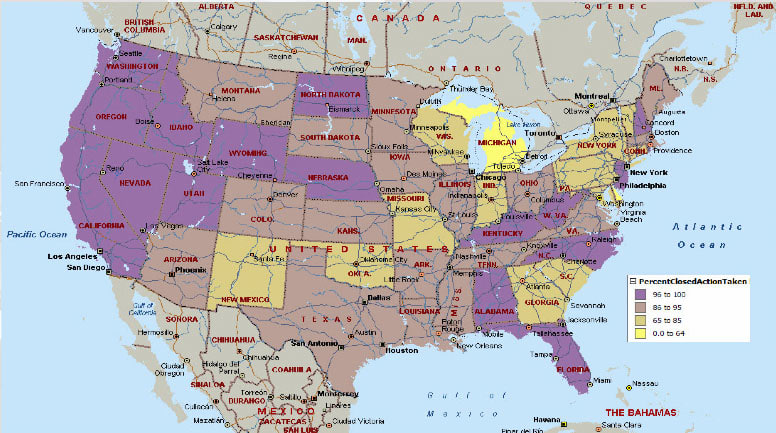
Data gathered by Vigillo shows a wide discrepancy in how states respond to DataQs challenges.

DataQs, the online system for correcting CSA scoring, has the reputation of being cumbersome and unpredictable, but there’s a way for safety managers to get what they need from it.
Call it the ABCs of DataQs.
Act quickly and consistently to fix incorrect information.
Be specific and factual when you present your case for the fix.
Contact the DataQs liaison in the states and establish a relationship.
A trio of experts laid out these fundamentals in a recent DataQs webinar hosted by the Truckload Carriers Association. On hand were Ron Cordova, a retired New Mexico Motor Transportation Police officer; Allan Hicks, vice president of safety, compliance and human resources for B.R. Williams Trucking, and Steve Bryan, CEO of Vigillo, the CSA service provider.
Act Quickly
Cordova and Hicks made the case for quick, consistent action to correct mistakes in CSA data.
Cordova counseled safety managers to move on a mistake within a week – “So it’s fresh on the mind of the inspector and he can move quickly.”
Hicks, providing the carrier perspective, said he reviews his company’s data every day. He goes to the Federal Motor Carrier Safety Administration’s Compass Portal, which with a single password and ID gives him access to a variety of federal truck safety databases, including DataQs.
A quick survey of the carriers attending the webinar indicated that close to 60% check their roadside inspection reports every day, and more than 30% do it at least once a week.
“It’s important that you get the process started as soon as possible,” Hicks said. If there are questions, he starts with the driver, and does not hesitate to call in his CSA service provider.
Be Specific and Factual
It is equally important that the request for a correction be factual and succinct.
“Homework is key,” said Cordova. Be sure to look up the applicable federal regulation, he said.
“Get the information from the regulations into the DataQs request to help the reviewer understand what the regulation says and what you are challenging.”
And don’t be distracted by unrelated information. “Do not attempt to provide a long dissertation concerning a violation.”
For example, if you are challenging a finding that the driver’s log is not current, explain exactly why the log was written the way it was, and why it is correct. It might help to have the driver photograph the log with his phone and email the photo so it can be part of the DataQs submission.
And think of the process in a strategic way. When state officials see that a particular officer is repeatedly being challenged on the same issue, it gives them a data trail that can guide improvements.
“You help us, we help you,” Cordova said.
It helps, for example, to understand how an inspector works. Suppose a driver is cited for having a cut in a brake service line, and for inoperative pushrods in the brakes.
It is normal for the inspector to flag the pushrods because they were not working, but clearly the cut line is the source of the problem.
“It’s worth a (DataQs) challenge,” Cordova said, “because if the line were not cut the brakes would be operative.”
Hicks said there’s an additional benefit from frequently checking your data through the Compass Portal: it gets your drivers’ attention when they realize you are keeping close tabs.
The flip side is that this can help with driver retention, he said. Fixing a CSA error through DataQs tells the driver that the company is paying attention on his behalf.
“It gives him a reason to stay,” he said. Plus, it gives the company feedback to improve training.
One frequent DataQs complaint is that it’s difficult to get the CSA record corrected after a court has dismissed a citation.
The problem arises, Cordova said, because of the disconnect between two different types of legal proceedings. The court action is criminal, while CSA and DataQs are administrative.
It’s a tough situation for the carrier because many jurisdictions are reluctant to overturn a violation that a court has dismissed. It’s best to take the same approach you take in a regular DataQs correction: be quick, specific, concise and factual.
Contact State Officials
Steve Bryan of Vigillo added the third fundamental: that while CSA is a federal program it is administered to some extent by 50 separate entities. Most people don’t look at DataQs as a state-specific system, but that’s what it is, Bryan said.
Vigillo’s data shows that the companies that are most successful in their DataQs challenges are the ones that know how each state handles the citations.
California, Kansas and Florida, for instance, are among those that often respond positively to DataQs challenges, while New Mexico, Missouri and Michigan are less responsive.
At the same time, some states have a tendency to make the same kind of mistake, such as assigning the inspection to the wrong carrier. Oddly, the same state may be better at assigning a crash to the right carrier.
In Bryan’s experience, the solution is to contact the state and get to know the people. From his customers he hears stories of two companies having completely opposite experiences in the same state.
“Getting a personal relationship developed with state people is key,” he said.
The best way to do that? Reach out to the Commercial Vehicle Safety Alliance, the enforcement-industry group that sets enforcement policy for North America, he said.
Cordova suggested joining CVSA as an associate member, but said in any event the group’s web site lists key state contacts.
Hicks added that he’s had success going directly to the source. His company was getting an unusual number of citations at a particular roadside inspection station, so he went there, met the personnel to learn how they were working, and got the situation turned around.
At the same time, it’s important not to waste energy where there’s little chance of success, Bryan said. If you fail to get a correction it makes sense to appeal if you have new information, but don’t pursue it just because it’s wrong.
“At the end of the day, the better strategy may be to look for other CSA points you can reduce,” he said.
More Safety & Compliance

How Waste Connections is Using Data, Telematics, and AI
How do you manage and maintain more than 18,000 connected trucks? Data. Lots of it.
Read More →
Fleet Advantage: Top Logistics Fleets Outperform National Safety Benchmarks
Fleet Advantage's latest TRUST Safety Index found leading logistics fleets maintained significantly lower out-of-service rates and stronger safety scores than national averages, while highlighting persistent challenges related to tires, brakes, and unsafe driving behaviors.
Read More →
Why Fleet Data Matters More Than Ever at Waste Connections [Watch]
Waste Connections' Chuck Palmer explains how telematics, predictive maintenance, safety analytics, and AI help keep vehicles on the road and drivers safe in this episode of HDT Talks Trucking.
Read More →
Short Takes: How K&B is Using AI
Fleets need to "get on board the train" with AI, says Lance Evans of K&B Transportation in this HDT Talks Trucking Short Takes episode.
Read More →
Short Takes: Inside K&B’s Truck Safety Tech
Listen to learn how K&B Transportation uses cellphone-blocking technology, speed management systems, weather geofencing, bridge avoidance tools, and more to improve driver safety.
Read More →
The Biggest Gap in Driverless Trucking Isn’t Tech. It’s Safety Validation
Nauto’s Stefan Heck says autonomous trucks are advancing quickly but proving they’re safe enough for large-scale deployment may be the industry’s hardest challenge.
Read More →
Truck Crash Rates Are Down. So Why Do Insurance Costs Keep Rising?
ATRI’s latest research points to litigation, social inflation, and soaring claims costs as key drivers behind record-high liability premiums for trucking fleets. But there are things motor carriers can do.
Read More →
FMCSA Removes More Than a Dozen ELDs from Registered List
The FMCSA continues its efforts to fight electronic logging devices that don't meet federal requirements, removing more than a dozen from the registered ELD list in May.
Read More →
How the Supreme Court Broker Liability Ruling Could Reshape Trucking’s Safety Landscape
The Supreme Court’s May 11 broker-liability ruling may not radically rewrite transportation law overnight. But industry experts say it will intensify pressure on brokers, carriers, and shippers to prove they are prioritizing safety.
Read More →
Recall of Fontaine Fusion Flatbeds Warns Owners Not to Use the Trailers
Some Fontaine Fusion flatbed trailer manufactured between February 2025, and March 2026 could have mainbeams weakened by hydrogen embrittlement because of a problem in the galvanizing process.
Read More →