




Related: ATA Urges Action from Congress on Infrastructure Plan
Analysis: Raising Federal Fuel Tax Makes Economic Sense
The way we pay for federally funded road and bridge projects hasn’t changed over the past 25 years and a fuel tax increase may provide the needed funding for our crumbling infrastructure. Analysis by Business Contributing Editor Evan Lockridge.

Evan Lockridge・Former Business Contributing Editor
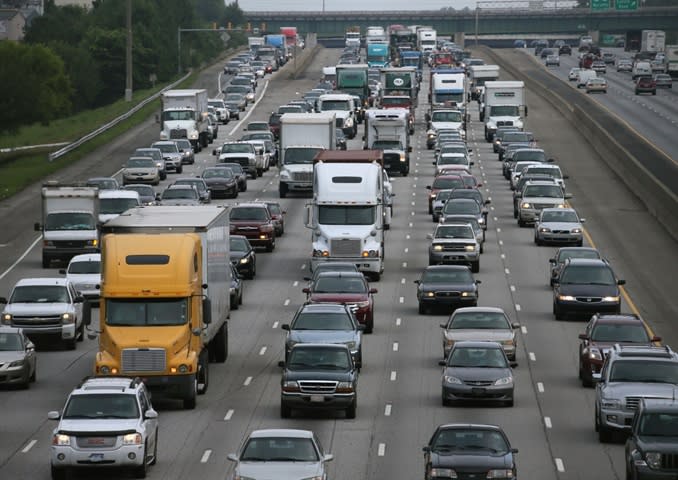
Infrastructure funding is one of the key legislative issues for the trucking industry in 2018. Photo: U.S. DOT
4 min to read
Infrastructure funding is one of the key legislative issues for the trucking industry in 2018. Photo: U.S. DOT
There is a lot of talk lately about increasing the amount of spending on the nation’s infrastructure, especially for roads and bridges. Report after report details why this needs to be done – because our roads and bridges are crumbling and too congested, and there is not enough money to pay for improvements.
How to pay for it, however, is another question. Some in trucking, such as the American Trucking Associations, are calling for an increase in the fuel tax. Of course, there are opponents to this, even in trucking, an industry that relies on roads and bridges like no other. However, the simple fact is that trucking can’t afford not to pay fuel taxes for road projects.
The Infrastructure Funding Plan
To begin with, a little background: More than $1.5 trillion in infrastructure funding has been called for by the Trump administration, while the American Society of Civil Engineers says $2 trillion is needed over the next 10 years just for roads – well short of current funding levels.
Also, the way we pay for federally funded road and bridge projects hasn’t changed over the past 25 years. Yep, the nation’s gas tax is still 18.4 cents per gallon and diesel is at 24.4 cents per gallon. And like everything else in this world, from healthcare and groceries to new vehicles, (whether four wheels or 18), the cost of building and repairing roads and bridges isn’t as cheap as it was in 1993.
The state of the nation’s roads also is costing trucking a lot in terms of traffic congestion. An American Transportation Research Institute study found traffic congestion added up to an increase of more than $22,000 in operational costs for each truck that travels 100,000 miles annually. For the entire trucking industry, that’s $63.4 billion in additional operational costs.
Funding Through Fuel Taxes
One plan that’s been floated is to gradually increase the fuel tax by 20 cents per gallon, to raise $340 billion over the next 10 years. Unfortunately, that’s not enough. Fifty cents per gallon, on the other hand, would take that figure to $850 billion over a decade, and that’s much closer to the amount of money that’s needed.
Opponents say trucking can’t afford such a hike. Yet diesel prices have increased by far greater amounts in just a matter of months and the wheels of the trucking industry kept turning. And no one’s calling to increase the fuel tax by that much all at once.
In fact, this might be a perfect time for fleets to absorb a fuel tax increase. Economists both inside and outside of the trucking industry are upbeat on the general condition of trucking and what’s expected to come the remainder of this year.
Many trucking operations had a stellar 2017. In addition to seeing healthy business levels, they got a hell of a holiday bonus in terms of tax reform, which pushed their profits much higher – and they will continue to enjoy its financial benefits.
Now is the Time to Invest
The bottom line is we have a healthy economy and good freight demand (some would argue the latter is among the best ever), so it’s not a bad time to deal with a fuel tax increase. At the same time, trucking is plagued by delays in terms of congested highways that’s costing billions of dollars and cutting into capacity to haul all that freight.
Economists are more mixed on the effects of infrastructure spending on the economy as a whole. But if we were to use a fuel tax to pay for it, rather than deficit spending, it could help avoid potential problems. Some economists are concerned that deficit spending, even if it spurs economic growth in the short run, may also cause an uptick in inflation, pushing the Federal Reserve to raise interest rates faster – potentially causing the economy to slow and making money more expensive to borrow.
You can’t tell me with a straight face that now isn’t a good time to invest in the nation’s roads and bridges, and that it doesn’t make economic sense. Unless of course you like paying for congestion and think a dollar today goes as far as it did more than two decades ago, which was the last time federal fuel taxes were increased.
Subscribe to Our Newsletter
More Fleet Management

Sponsored•September 16, 2026
Color Match Smarter: Tools That Restore & Perform
For fleet managers and collision repair professionals keeping heavy-duty trucks on the road, getting the color right the first time isn't just about appearance — it's about efficiency, turnaround time, and bottom-line results. Discover how today's digital color tools are transforming the repair process from guesswork to precision.
Read More →
FMCSA Pauses Biennial-Update Enforcement Amid Motus Transition
Carriers whose updates were due on or after June 1 have more time, while FMCSA works to stabilize its new registration system and warns of phishing sites impersonating its new carrier registration system, Motus.
Read More →
Sponsored•September 14, 2026
2026 Blueprint for Countering Smarter Supply Chain Theft
Cargo theft is no longer just the cost of doing business. It's a multi-billion-dollar criminal enterprise exploiting vulnerabilities across your fleet, drivers, and supply chain.
Read More →


Sponsored•September 1, 2026
How Telematics Improves Visibility, Control, and Performance in Refrigerated Fleets
Explore how telematics help refrigerated fleets improve visibility, uptime, efficiency, compliance, and cargo protection across connected cold chain operations.
Read More →
What the U.S.-Canada Trade War Means for Trucking
Escalating U.S.-Canada tariffs could disrupt cross-border freight, reduce truck volumes, raise costs, and create new uncertainty for carriers on both sides of the border.
Read More →
What Are Trucking’s Top Concerns for 2026?
The American Transportation Research Institute wants to know what's worrying trucking fleet managers, drivers, and other stakeholders in its annual Industry Issues survey.
Read More →
American Trucking Associations Looks for a New Leader
ATA President and CEO Chris Spear abruptly left his job at the association on August 21, at a pivotal time for the trucking industry.
Read More →
Public Wi-Fi Cybersecurity Risks: How Truck Drivers and Fleets Can Protect Their Data
Public Wi-Fi can expose truck drivers and fleets to credential theft, malware, and other cyber threats. Here’s how to reduce the risk on the road.
Read More →
For Nicky Cupp, Fleet Innovation Starts With Frustration
HDT Truck Fleet Innovator Nicky Cupp turns everyday pain points at Fraley & Schilling into opportunities for better technology and smarter processes.
Read More →
Adam Buttgenbach’s Approach to Electric Trucks: Start With Where They Fit
HDT Truck Fleet Innovator Adam Buttgenbach helped PepsiCo build one of North America’s largest EV fleets by focusing on where electric trucks make operational sense.
Read More →