




Lift Axle Considerations
State laws are the biggest factor governing use or non-use of auxiliary lift axles on trucks and trailers.
April 20, 2010

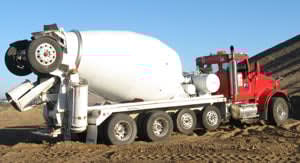
Pusher axles and the "flying tag" on this mixer truck are raised for crawling through deep sand in eastern Minnesota. While on the road, the lift axles are lowered to spread the truck's weight, protecting pavement and bridge spans.
Photo: Tom Berg
6 min to read
State laws are the biggest factor governing use or non-use of auxiliary lift axles on trucks and trailers. Many states have patterned their weight limits after the federal Formula B law, which encourages spreading truck poundage over multiple axles with certain minimum distances among them. This "bridge formula" concept, which protects bridge spans and road pavement, necessitates auxiliary lift axles; so do certain "axle-weight" laws still on the books in some states.
Because most of these trucks stay in their home states, operators adhere to those state laws in setting up their equipment. Truckers who regularly cross from one state to another must equip their vehicles for the higher limit but sometimes load for the lower limit. Owners and truck sales people know what works in their jurisdictions and spec trucks accordingly.
There might be new ways to meet a law and get even more payload capacity, but users and dealers tend to stick with the tried and true. If a few operators try a new idea and it works, giving them a competitive advantage, others in the area will also adopt it.
But there are a lot of technical considerations in choosing lift-axle types and models.
All about lift axles
By definition, lift axles are non-powered, and are installed ahead of or behind the driving tandem axles on a straight truck or tractor. If it's ahead of the tandem, a lift axle is called a "pusher." If it's behind, it's a "tag." Such axles can also be installed ahead of or behind a trailer's tandem. And a lift axle is occasionally applied to a single-rear-axle straight truck.
Lift axle suspensions use air bags to carry weight, and either air bags or steel springs to raise the axle when it's not needed. If two sets of air bags are used, one set is inflated while the other is deflated. If steel springs raise the axle, the weight-bearing air bags must first be deflated to allow the springs to retract the axle. All this is controlled by the driver, using electric switches or air valves close at hand.
Lift axles are also known as "cheater axles," because unscrupulous truckers raise them or reduce air pressure on them while running loaded. They think they're saving tire money, but weight that's supposed to be borne by the extra axles are now concentrated on those whose wheels are still on the ground, putting abnormal wear on both the components and pavement. States like Georgia discourage this by requiring controls to be mounted outside the cab, or avoid enforcement issues altogether by disregarding the liftables. Thus a truck could have a dozen lift axles, but its allowable gross weight is limited to what can legally be carried on its steer and drive axles, and those extra axles are useless.
A non-steerable lift axle needs to be raised prior to turning a tight corner, or its tires will plow asphalt and scrub concrete, and will scuff tire tread and impose high lateral stress on wheels and chassis components. In that case the controls must be in the cab. Authorities in some states allow this, even though the truck is technically overloaded on its remaining axles when the lift axle is up.
Authorities in an increasing number of states want the auxiliary axles to stay on the pavement during cornering. The solution is the steerable lift axle. This type caster steers only when moving forward, so raises automatically when the driver shifts the truck into reverse. Reverse-steering axles, whose geometry automatically shifts from forward to reverse and back again as the driver shifts gears, are also available, but they are more complex and expensive.
Bridge formula states are where we see the most auxiliary axles on trucks and sometimes trailers. On dump trucks, all the lift axles are usually pushers, but some dumpers have a tag axle. Tags sometimes increase the distance between a truck's steer axle and its rearmost axle - also called the "outer bridge" - whereas pusher axles don't. If all other things on the truck are equal, Formula B (or similar formulas) will always allow a truck with a tag axle to carry more than one with a pusher axle.
A truck's outer-bridge dimension and distance between certain axle groups are among the factors determining its allowable gross weight, and the longer the better. The Formula B Table (printed in every Rand McNally Motor Carrier's Road Atlas and available online) lists allowable weights by numbers of axles. Straight trucks have shorter outer-bridge dimensions than tractor-trailers, but using two, three or even four lift axles compensates. This is why it takes six or seven axles to carry what a semi can legally handle with only five axles.
A tag axle mounted under the rear of a truck body shortens a truck's wheelbase and makes it more maneuverable. But that tag must be down when a dump bed is raised to give the vehicle proper stability. Some tag axles are made for this but some are not.
Stingers and other options
Another type of rear lift axle is the "stinger" or Boost-A-Load (a trade name), which is common on concrete mixer trucks in many states. When deployed, it stretches the outer bridge by 15 or so feet, boosting the truck's legal payload by 5 tons or more in bridge-formula states. And it raises high and out of the way for offloading (inspiring another nickname, "flying tag"). The stinger can also work on dump trucks, and this concept has caught on in the West.
Early stingers had one supporting arm and later models have two, with one on either side of a truck, and these are what work best on dumpers. A stinger is used either alone (as in California, which gives no credit for pushers but allows stingers) or is combined with two or three pusher axles (as in Arizona, which has a liberal weight law based on the B Formula).
Truckers in Ohio tried stingers in the 1990s but rejected them for various reasons: outward off-tracking during tight turns, problems with an early product's reliability, and misuse (including using the axle's supporting arm as a tow hook for stuck trucks). Instead, dump truckers in the Buckeye State now use three and sometimes four pusher axles, making for a long-wheelbase truck that's awkward to turn around.
That's why some operators in Ohio and elsewhere prefer a more maneuverable tractor-trailer, though the short semitrailer will have two pusher axles to compensate for a resultingly short outer bridge dimension. In the Northwest and Great Plains, bridge-formula laws and operator preference result in long truck-trailer combinations. Usually both vehicles have one or two pusher axles; gross weights can exceed 100,000 pounds.
There are places with very liberal laws that make lift axles needless. Coal trucks in Kentucky and elsewhere in the Appalachian Mountains are legendary for their 100,000- to 120,000-pound gross weights on extra-heavy-duty 10-wheelers, though that's primarily off-road. On pavement, New York City winks at 90,000-pound-plus 10-wheel trucks. And Texas allows 40,000 pounds on a concrete mixer's tandem but only 34,000 on a dump truck's drives. Guess which industry did a better job of lobbying Lone Star lawmakers.
Subscribe to Our Newsletter
More Equipment
Engine Technology Forum Launches SCR, DEF Resource Center Amid Emissions Debate
The Engine Technology Forum’s new online hub aims to provide fleets, policymakers, and equipment owners with fact-based information about selective catalytic reduction technology, diesel exhaust fluid and emissions compliance.
Read More →
Prime Inc. to Open $7.9M Flagship Used-Truck Dealership
A new driver-focused facility to sell Prime Inc's used trucks and trailers will be the first purpose-built location in the company's history.
Read More →
Lessons Learned About Alternative Fuels: Start Small, Stay Flexible
Practical advice on adopting alternative fuels and ZEVs from HDT's 2026 Top Green Fleets, from renewable diesel and natural gas to electric trucks.
Read More →
Kenworth Names Peter Ahrens General Manager
Leadership changes at Kenworth take effect July 1 as the OEM promotes two longtime Paccar executives to key management roles.
Read More →
Hino Adds Electric Class 6/7 Truck
Hino says the Le Series is an important step in the company's efforts to reduce environmental impact and support its customers’ sustainability goals.
Read More →
ACT Expo 2026: Highlights in Photos
The 2026 Advanced Clean Transportation Expo featured a broad range of commercial vehicle technologies, from EVs to autonomous trucks to the latest diesel and alternative-fuel engines.
Read More →
Hendrickson Debuts Electraax E-Axle for Medium-Duty Trucks
Developed with Driventic, Hendrickson's new integrated e-axle is designed to improve efficiency, reduce weight, and extend range in Class 6-7 EV applications.
Read More →
Peterbilt Unveils Freedom 250 Special Edition Model 589
Peterbilt’s just-announced limited-run patriotic Model 579 tractor celebrates America’s 250th birthday with custom styling and premium features.
Read More →
Mack Unveils EPA 2027-Compliant MP13 Engine With More Power, Better Fuel Economy
Along with unveiling its EPA 2027-compliant MP13 engine, Mack outlined powertrain changes across its Class 6-8 lineup, including new Cummins-based X10 engines.
Read More →
Kodiak and Roehl Transport Launch Autonomous Route Between Dallas and Houston
Kodiak AI and Roehl Transport have begun autonomous freight operations on a regular Dallas-Houston route, marking another step toward Kodiak’s planned driverless launch by the end of 2026.
Read More →