




Canadian Judge Rules Against Speed Limiters
An Ontario trial judge recently tossed out a ticket under the province's speed limiter legislation, ruling that speed limiters are unsafe and violate a truck driver's right to personal safety. However, advocates for the devices say the ruling does not affect Ontario's speed limiter law
An Ontario trial judge recently tossed out a ticket under the province's speed limiter legislation, ruling that speed limiters are unsafe and violate a truck driver's right to personal safety. However, advocates for the devices say the ruling does not affect Ontario's speed limiter law.
The case comes as the U.S. National Highway Traffic Safety Administration NHTSA works on a proposal to require speed limiters in tractors.
The case involved owner-operator Gene Michaud from St. Catharines, Ontario. With funding support from the Owner-Operator Independent Drivers Association, he filed a constitutional challenge last year against the province over the law that requires heavy trucks 1995 and newer to have a working speed limiter set no higher than 105 kilometers per hour, or 65 mph. The court ruled in his favor, with Judge Brett A. Kelly also ruling that the speed limiter law violates the principles of fundamental justice because it does not make the roads safer as the province claimed but instead creates more danger.
OOIDA President Jim Johnston said the association took on the case because the precedent is important to owner-operators on both sides of the border.
"This case will impact our Canadian members and also our U.S. members, both those who travel in Canada and those who may be subject to similar types of regulations in the U.S.," Johnston says. "The real motivation of big-business proponents of speed limiter mandates is to drive up costs for small-business truckers and hurt their ability to compete."
Michaud testified that the speed-limiter law violated his right to security as a person under Canadian law because his vehicle speed was capped below the flow of traffic in many jurisdictions. He recalled numerous situations in which he felt "bound and unsafe."
Other testimony presented also included research showing that uniform speeds are safer than when vehicles travel at different speeds. A forced speed differential, therefore, creates increased danger of collisions.
The Ontario Trucking Association released a statement saying that the ruling "does not change the enforcement of the Highway Traffic Act law whatsoever." Contrary to some reports, the lower court ruling isn't binding and the law hasn't been struck down; nor does it require any amendments to the HTA legislation.
"People challenge traffic tickets every day and sometimes they win," says OTA President David Bradley says. "It means nothing; the law stands."
Related Stories:
3/29/2012 New Study Finds Safety Benefits of Limiting Truck Speeds
3/7/2012 Truckload Carriers to Support Mandatory Speed Limiters
5/17/2012 The Feds' Safety Wish List
More Safety & Compliance

How Waste Connections is Using Data, Telematics, and AI
How do you manage and maintain more than 18,000 connected trucks? Data. Lots of it.
Read More →
Fleet Advantage: Top Logistics Fleets Outperform National Safety Benchmarks
Fleet Advantage's latest TRUST Safety Index found leading logistics fleets maintained significantly lower out-of-service rates and stronger safety scores than national averages, while highlighting persistent challenges related to tires, brakes, and unsafe driving behaviors.
Read More →
Why Fleet Data Matters More Than Ever at Waste Connections [Watch]
Waste Connections' Chuck Palmer explains how telematics, predictive maintenance, safety analytics, and AI help keep vehicles on the road and drivers safe in this episode of HDT Talks Trucking.
Read More →
Short Takes: How K&B is Using AI
Fleets need to "get on board the train" with AI, says Lance Evans of K&B Transportation in this HDT Talks Trucking Short Takes episode.
Read More →
Short Takes: Inside K&B’s Truck Safety Tech
Listen to learn how K&B Transportation uses cellphone-blocking technology, speed management systems, weather geofencing, bridge avoidance tools, and more to improve driver safety.
Read More →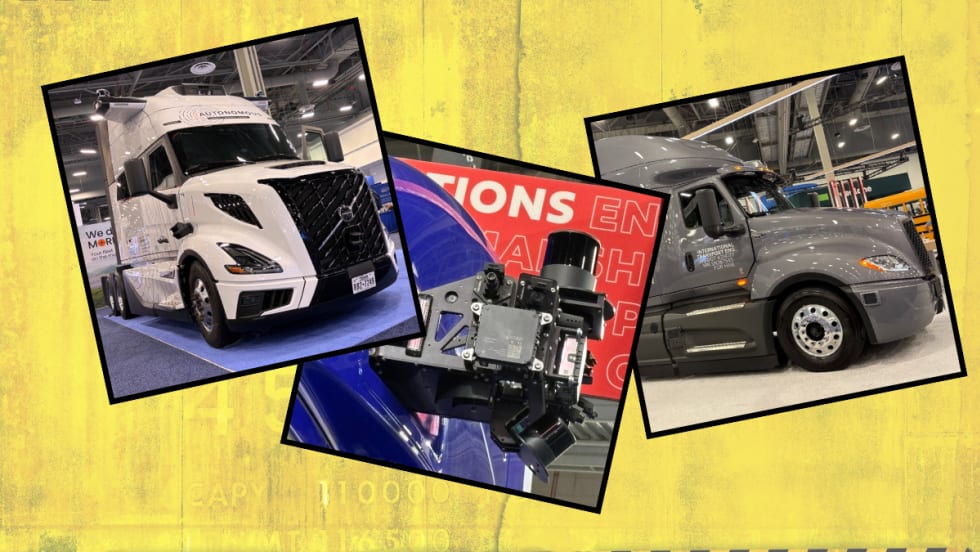
The Biggest Gap in Driverless Trucking Isn’t Tech. It’s Safety Validation
Nauto’s Stefan Heck says autonomous trucks are advancing quickly but proving they’re safe enough for large-scale deployment may be the industry’s hardest challenge.
Read More →
Truck Crash Rates Are Down. So Why Do Insurance Costs Keep Rising?
ATRI’s latest research points to litigation, social inflation, and soaring claims costs as key drivers behind record-high liability premiums for trucking fleets. But there are things motor carriers can do.
Read More →
FMCSA Removes More Than a Dozen ELDs from Registered List
The FMCSA continues its efforts to fight electronic logging devices that don't meet federal requirements, removing more than a dozen from the registered ELD list in May.
Read More →
How the Supreme Court Broker Liability Ruling Could Reshape Trucking’s Safety Landscape
The Supreme Court’s May 11 broker-liability ruling may not radically rewrite transportation law overnight. But industry experts say it will intensify pressure on brokers, carriers, and shippers to prove they are prioritizing safety.
Read More →
Recall of Fontaine Fusion Flatbeds Warns Owners Not to Use the Trailers
Some Fontaine Fusion flatbed trailer manufactured between February 2025, and March 2026 could have mainbeams weakened by hydrogen embrittlement because of a problem in the galvanizing process.
Read More →