





Related: ELD Mandate Leads ATRI's Top Trucking Issues List
ELD Mandate Enforcement Highlights ATA Educational Session
ORLANDO — In a sometimes-lively educational session at the American Trucking Associations 2017 Management Conference & Exhibition Saturday, a panel of regulatory, enforcement and fleet personnel fielded questions on enforcement and other aspects of the electronic logging device mandate that goes into effect Dec. 18.
October 21, 2017
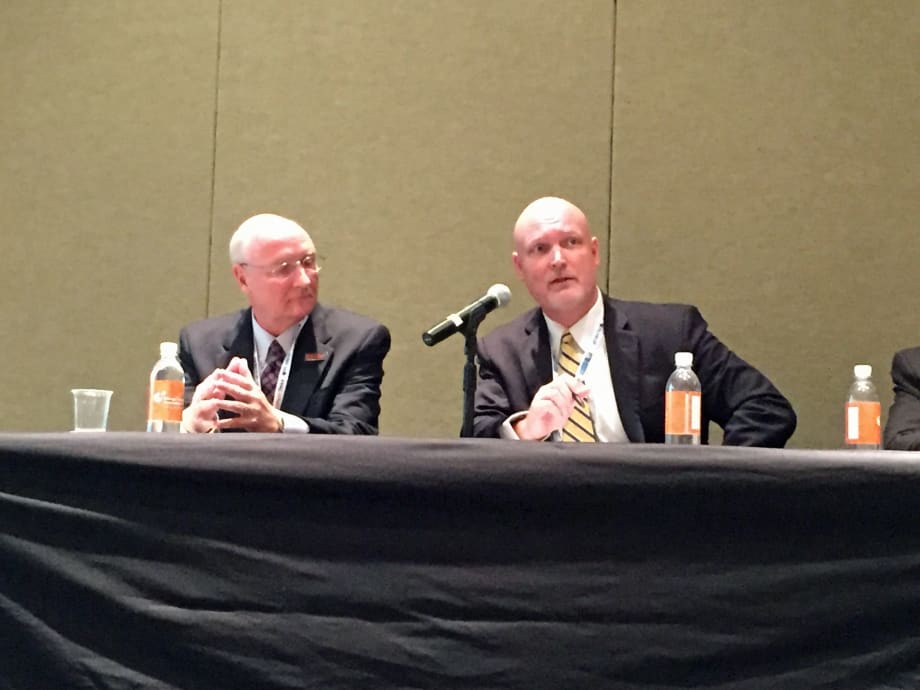
Jim Ward of D.M. Bowman and Collin Mooney of CVSA talk ELDs at ATA MC&E. Photo: Deborah Lockridge
7 min to read
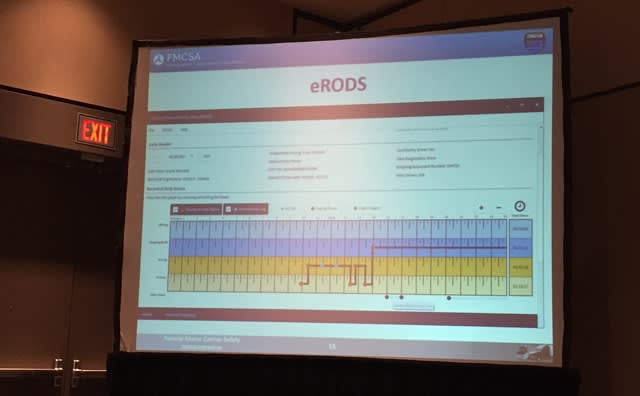
If you look at the lower right-hand corner of this display of the ERODS system that will be used to read ELD data files, you will see dots that indicate the truck was moving despite the driver logging the time as sleeper berth.
ORLANDO — In a sometimes-lively educational session at the American Trucking Associations 2017 Management Conference & Exhibition Saturday, a panel of regulatory, enforcement and fleet personnel fielded questions on enforcement and other aspects of the electronic logging device mandate that goes into effect Dec. 18.
“In today’s environment, you cannot pick up a periodical or go through 10 emails without someone offering a webinar about the ELD mandate,” said Jim Ward, president and CEO of D.M. Bowman Inc., a 400-truck fleet that has been on electronic logs since 2013. Pointing out that the overwhelming majority of the country’s trucking operations are small fleets, “it is a huge impact on a number of small businesses.”
Joe DeLorenzo, director of the Federal Motor Carrier Safety Administration’s Office of Compliance and Enforcement, went over some of the common questions, such as exemptions. But much of the discussion centered around what will happen at roadside come December.
Both DeLorenzo and Colin Mooney, executive director of the Commercial Vehicle Safety Alliance, stressed several times that the ELD rules do not change the underlying hours of service rules.
“A lot of folks are tying ELDs to the hours of service rules themselves,” Mooney observed. Many of the drivers and others objecting to the ELD mandate claim it will end the “flexibility” they currently have with paper logs. But in the eyes of the law, that “flexibility” is simply cheating.
“Enforcement’s ready to enforce the rules,” Mooney said. “All we're doing is moving from a paper to electronic format. However, for some it will be their first introduction to hours of compliance,” he noted, drawing a chuckle from the audience.
Enforcement issues
Mooney and DeLorenzo also wanted to clear up some confusion about the CVSA and FMCSA’s recent announcement that drivers will not be put out of service for violating the ELD rule until April 2018.
“A lot of people thought it meant ‘soft enforcement’” Mooney said. “We are not using that term at all. That is very subjective depending on who you’re talking to.” Come Dec. 18, he said, enforcement officials will be noting violations on inspection reports, which will go into the SMS database and affect carrier CSA (Compliance, Safety, Accountability) scores.
DeLorenzo explained that the points system for CSA is not changing. If a driver does not have an ELD or grandfathered AOBRD, points will be charged as if he did not have a paper logbook. If you’ve exceeded the allowable hours, it’s the same violation as before. If the ELD data file pulls up on an enforcement official’s system with a notification that the truck was moving when the driver had logged sleeper berth time, that’s falsifying logs. “Think about an ELD as an electronic form of keeping hours of service,” DeLorenzo said. “Everything is pretty much the same. Each violation cited on an inspection report has a certain weight associated with it; if it's out of service, it gets a little more weight.”
In addition to the inspection report, enforcement officials may also opt to issue a verbal or written warning, or write a citation/ticket.
Although the press release said jurisdictions would have discretion on the level of enforcement, Mooney told the audience, “From what I'm hearing it's going to be pretty consistent across the board. We’re training the trainers at all the jurisdictions at the same time. I’ve been given no indication it will be done any other way.”
Mooney also addressed a recent petition from the Owner-Operator Independent Drivers Association asking for a delay in the implementation of the rule, claiming that many states did not have the proper legislation in place to be able to legally enforce the federal rule. “We have canvassed all of our states and there’s only a couple that are still in the process of going though the legislative process, and both are on track to have that in place by Dec. 18.”
Data transfer
Mooney said the agency is embarking on a train-the-trailer program next week to educate state enforcement about the data transfer process — an area that has caused some confusion, especially since the agency did not have a process in place for vendors to test their data files until fairly recently.
On its website, the FMCSA has a data vile validator tool. Although it was designed for ELD vendors to check their data files, DeLorenzo noted that some fleets have been using it to test their ELD files as well.
He also said that while the ELD rules allow for several different options for that file transfer, including email, web transfer, Bluetooth and USB, “I will tell you that in the overwhelming majority of cases, we're going to be looking at web services as the way that data is transferred.” The web transfer system just went live a few days ago and live testing of the data transfer will be occurring in the coming weeks.
The enforcement official will give the driver his code, which the driver enters into the appropriate field on the ELD screen, and that data transfers to the officer’s device. It does not automatically note violations, but it does flag problem areas for the officer for further investigation.
If the inspection is taking place in an area with poor cellular coverage, the backup options are for the driver to print out the log, or more likely, show the enforcement officer the display. This has caused some concern about officers having to climb up into cabs or walking away with the ELD device, but DeLorenzo said, “i tell people all the time that there’s nothing that says you have to hand the display over to the officer and let them walk away with it. This is what we’re telling our folks — have the driver step out of the vehicle with their display, and hold the display for the law enforcement officer. That to me is the common sense approach.”
Ward added another bit of common-sense advice based on his fleet’s experience: “Make sure you have seven days of paper logs in the truck and the documents you're supposed to have in the truck, otherwise you're going to get zinged.”
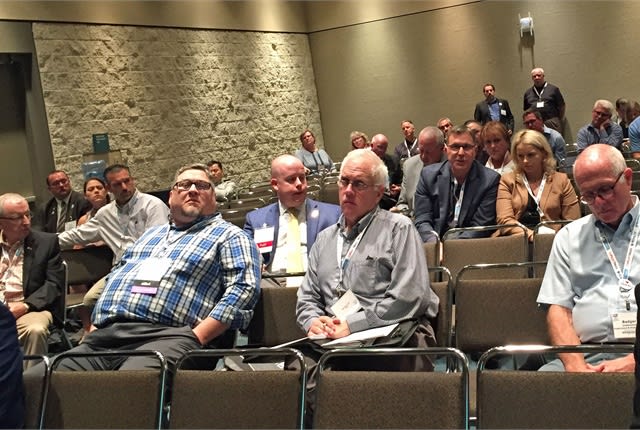
Turnout was good for the two-hour educational session Saturday afternoon.Photo: Deborah Lockridge
Annotate, annotate, annotate
DeLorenzo emphasized multiple times the importance of annotating the ELD hours of service record to indicate problems or extenuating circumstances.
“When something goes wrong on a paper log the driver makes a note on the paper log. The ELD has that exact same capability, and I really encourage you to make sure your drivers are trained on how to use it and they do use it. Because circumstances come up. Don't just make an edit; make an edit and an annotation so it's clear what happened. Those notes will be there for you and your company and for enforcement as well.”
For instance, DeLorenzo said, one way to handle yard moves is to do nothing at the time of the yard move. The driver will get in and be presented with this list of unassigned miles and asked are they are his. “The driver rejects these miles, and you address it by annotating on the back end.”
A fleet from Wyoming asked about what happens if you’re caught in an unexpected snowstorm. DeLorenzo pointed to the part of the 11-hour driving rule allowing an extra two hours for unforeseen adverse driving conditions. I empathize I the words unforeseen. Traffic in DC at 5:00, not unforeseen. A pop up snowstorm in Wyoming, unforeseen. But i would add, with ELDs, that's an opportune time when you would annotate.”
Non-compliant ELDs
There has been concern that with the large number of new entrants into the marketplace, and the fact that the process to become listed on the FMCSA’s ELD website is a matter of self-certification, that it’s possible some fleets might get stuck in a tough situation if they chose an ELD later found to not be compliant with the ELD required specifications.
According to the rules, carriers would only have eight days to replace a device that the agency had de-certified. But DeLorenzo and Mooney seemed to indicate that they are well aware of the situation and that their focus would not be on putting fleets into that type of situation.
When asked if roadside inspectors will be looking to find non compliant devices, Mooney said, “We are not encouraging that. We want to focus on hours of service compliance.” As DeLorenzo added, “If [the ELD is] on the registered devices list, then they kind of move on.”
If there is an issue with an ELD, DeLorenzo said, most of the time those are software issues and FMCSA works with the vendor to get it straightened out, often without customers even realizing it. “As long as we’re getting hours of service information, we’re probably not going to bother the motor farrier while we get things straightened out with the vendor.”
If there’s a worst case scenario where FMCSA is unable to get it straightened out, DeLorenzo indicated that the agency is aware that switching an entire fleet to a different ELD within the eight-day window would be a nightmare and that it would work with the carrier on a solution. If that comes up, he said, “we will do that on a case by case basis. Those we’ll handle as they come up.”
More Fleet Management
Geotab Links Fleet Card to Vehicle Data
The new card combines fuel discounts with telematics-based purchase controls. Geotab’s analysis also points to potential savings from choosing lower-priced fuel stops.
Read More →
How MFA Helps Protect Trucking Fleets
Multi-factor authentication adds protection when passwords are stolen. Here’s how it works and where fleets should start.
Read More →
How Better Freight Data Helps Trucking Teams Get Ahead of Disruption
Trucking and logistics teams have plenty of data. The problem is getting the right information in front of the right people soon enough to act. Better-connected data can help teams spot trouble earlier and make smarter decisions before small problems become big ones.
Read More →

Trimble: Taking Artificial Intelligence in Trucking Beyond Faster Tasks
At Insight 2026, Trimble executives argued that fleets may need to redesign workflows to get more from AI as it introduced new products and enhancements. AI’s value will depend on how fleets combine automation with their people's knowledge.
Read More →
Sponsored•September 28, 2026
Build a bulletproof fleet: Uniting ELDs and dash cams for total compliance
An ELD can prove compliance, but it cannot always prove what happened on the road. Discover how uniting accurate ELD data with AI-powered dash cam video can help your fleet strengthen compliance, defend against liability, protect drivers and reduce operational costs.
Read More →
Nominations Open for HDT Emerging Leaders
Heavy Duty Trucking is looking for accomplished trucking fleet professionals under 40 who are making an impact and helping lead the industry forward.
Read More →
Why Private Fleets Are Taking More Freight
Private fleets are putting their own trucks on demanding customers and high-cost lanes as companies seek greater control over service, costs, and capacity.
Read More →
Sponsored•September 16, 2026
Color Match Smarter: Tools That Restore & Perform
For fleet managers and collision repair professionals keeping heavy-duty trucks on the road, getting the color right the first time isn't just about appearance — it's about efficiency, turnaround time, and bottom-line results. Discover how today's digital color tools are transforming the repair process from guesswork to precision.
Read More →
FMCSA Pauses Biennial-Update Enforcement Amid Motus Transition
Carriers whose updates were due on or after June 1 have more time, while FMCSA works to stabilize its new registration system and warns of phishing sites impersonating its new carrier registration system, Motus.
Read More →
Sponsored•September 14, 2026
2026 Blueprint for Countering Smarter Supply Chain Theft
Cargo theft is no longer just the cost of doing business. It's a multi-billion-dollar criminal enterprise exploiting vulnerabilities across your fleet, drivers, and supply chain.
Read More →