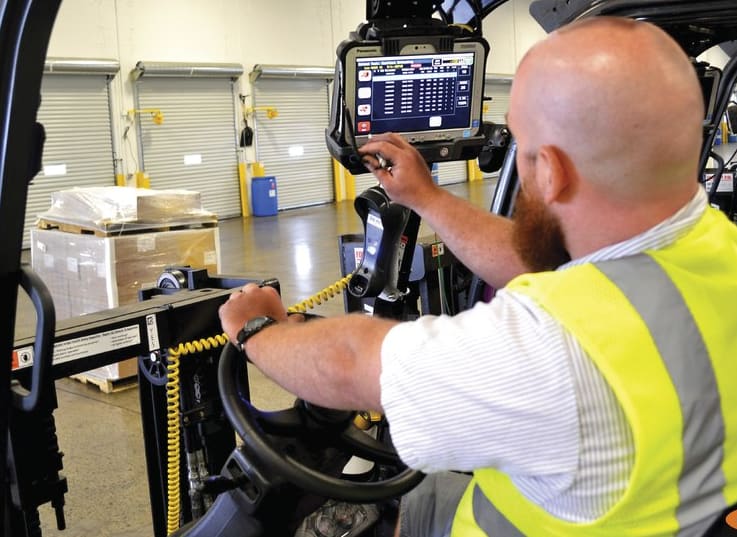
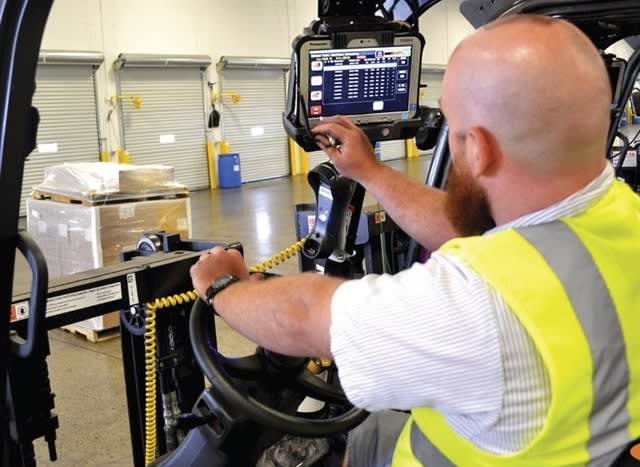
A. Duie Pyle’s dock management system, or DMS, in use. It works hand in hand with Route Planning Solutions to get freight where it needs to be faster.
2 min to read
A. Duie Pyle’s dock management system, or DMS, in use. It works hand in hand with Route Planning Solutions to get freight where it needs to be faster.
A. Duie Pyle created its own dock management system that shows every dock, every trailer, and every pallet position within each trailer, leading to fewer misplaced shipments and quicker movements across the dock.
Ad Loading...
Once a truck departs, mobile tracking technology offers real-time visibility of shipment status. Combined with new routing software, this improves distribution efficiency and reduces planning time, overhead, and wasted mileage, and gives the company a vast amount of information it can use.
“Most carriers, if not all, look at an eight-pallet shipment with one pro number,” explains Randy Swart, chief operating officer. “However, on a dock, those pallets get handled individually and can get set in different locations. Our system allows us to individually label each of those pallets at pickup. If we stage it in the warehouse we know where all eight pieces are. If somebody tries to put a piece in the wrong trailer, when they scan it, it will tell them it’s in the wrong trailer.”
Ad Loading...
With the traditional method of tracking by the shipment, he says, you wouldn’t know it went into the wrong trailer until it was too late — when only seven of the eight pieces were unloaded at the receiving dock.
The DMS also tracks which employee moves which piece, creating greater accountability. In addition, each piece is tracked by weight, which helps load the freight evenly.
The second piece of the system is Route Planning Solutions, or RPS. Routes are designed so they can be loaded in the exact order that the driver needs to deliver in. It allows the company to assign ETAs to every stop, so customers can plan better.
“We used to deliver about 48% of our freight prior to noon,” Swart says. “Now we’re closing in on 60%. The customers love it, and this puts us into position to make our pickups more timely.”
Drivers like it, too. “They know where they’re going; they don’t have to move their freight around,” Swart says. “Drivers can better plan their workday.” And because it allows drivers to get on the street with their loads earlier, there’s less congestion, and they tend to finish earlier in the day. The result is better work-life balance for drivers and better driver retention.
Ad Loading...
The whole system means it takes less time and fewer people to do the job, with better service to the customer.
Fleet Snapshot
Who: A. Duie Pyle
Where: West Chester, Pa.
Fleet: 21 transportation service centers, nine warehouses, 880-plus power units
Operations: LTL, TL, brokerage, dedicated and warehousing, primarily in the Northeast
Fun Fact: Family owned and operated since 1924
Challenge: Tracking freight by the pallet or piece instead of by the load
Explore how telematics help refrigerated fleets improve visibility, uptime, efficiency, compliance, and cargo protection across connected cold chain operations.
Escalating U.S.-Canada tariffs could disrupt cross-border freight, reduce truck volumes, raise costs, and create new uncertainty for carriers on both sides of the border.
The American Transportation Research Institute wants to know what's worrying trucking fleet managers, drivers, and other stakeholders in its annual Industry Issues survey.
HDT Truck Fleet Innovator Adam Buttgenbach helped PepsiCo build one of North America’s largest EV fleets by focusing on where electric trucks make operational sense.
HDT Truck Fleet Innovator Deen Albert makes sure people are still at the heart of operations at Grand Island Express, even while adopting artificial intelligence tools. AI-assisted dispatch helped boost revenue 25% with the same number of trucks.