




Why Kenworth’s T880 Won the ATD Truck of the Year
Senior Editor Tom Berg explains how he and the other judges picked Kenworth's T880 vocational truck as the ATD's 2015 Commercial Truck of the Year.

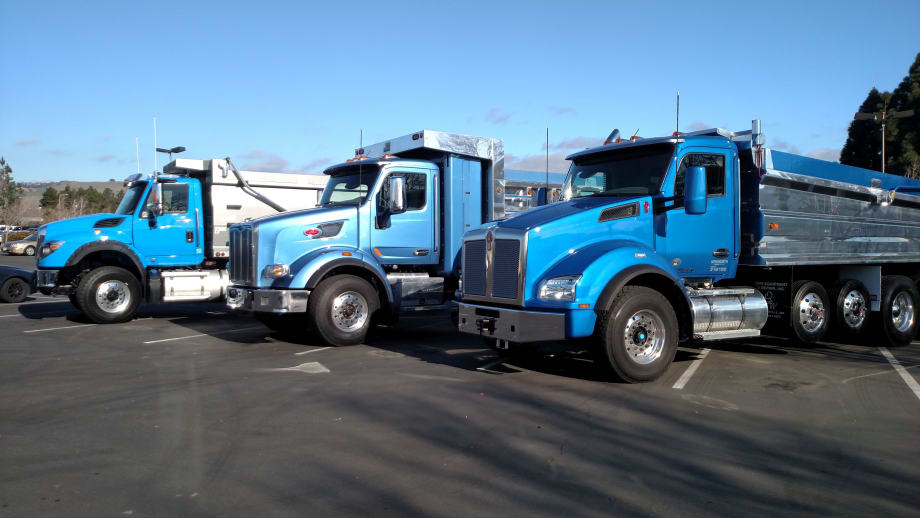
One thing for sure in the competition: A blue truck would win. Kenworth’s T880 (at far right) scored the highest vs. (from left) the International WorkStar 7600 and Peterbilt 567. Bottom line: The KW “was a nicer truck to drive.” Photo: Tom Berg
One thing for sure in the competition: A blue truck would win. Kenworth’s T880 (at far right) scored the highest vs. (from left) the International WorkStar 7600 and Peterbilt 567. Bottom line: The KW “was a nicer truck to drive.” Photo: Tom Berg
I was one of six judges that picked Kenworth’s T880 vocational vehicle as the 2015 Commercial Truck of the Year at the American Truck Dealers’ competition a week ago in Hayward, California.
The KW’s win verified what I was thinking and how I scored it and two competitors. I didn’t know the score tallies and still don’t – only the chief judge, Jack Roberts of CCJ (I had that job for the previous three years), and ATD’s executive director, Barbara Robinson – did. I learned the KW came out on top from an emailed announcement made by ATD on Saturday, during its convention across the bay in San Francisco.
The Kenworth’s win also jibed with what a few of us briefly discussed in the break room after we had driven all three trucks and finished our individual, and confidential, scoring: The Kenworth’s smooth, strong powertrain, good ride and functional, attractive trim package simply made it “a nicer truck to drive,” as one of the other guys remarked.
The other two trucks were a Peterbilt 567 and an International WorkStar 7600; all were vocational chassis fitted with dump bodies, because “heavy vocational” was the category judged this year. Those were both excellent trucks, but didn’t merit as many points as the KW. Here are my impressions:
The Kenworth had a 500-hp Paccar MX-13, Allison automatic transmission, and chassis equipment appropriate for the intended use: the carrying and delivering of construction-related materials on and off road. It had an upscale interior in its newish cab (introduced in 2013 on two KW models), which was nice to look at, and it carried a modest, 10-ton load which settled down its firm ride and garnered a few extra points on my score sheet. A load was suggested but not mandatory, and the other two were empty.
The Peterbilt 567 also had an Allison but under its hood was a 400-hp Cummins Westport ISX12 G, a gas engine fed by tanks in a cabinet behind the cab. My initial thought was that the gas engine is high-tech and might contribute to the Pete’s winning, but its lesser power output and more noise (surprising because gas engines are often quieter than diesels) made it less enjoyable to drive. The Pete’s interior (also in the modern aluminum cab shared with KW and also unveiled in ’13) was plainer and less pleasing to my eyes.
The International WorkStar had a 475-hp Navistar N13 and an Eaton UltraShift automated mechanical transmission, which was far easier to drive than a manual but not as smooth as the Allisons, especially at low speeds (though I preferred the UltraShift for its solid power-delivery feel at higher speeds). The International’s roomy steel cab (from the DuraStar medium-duty on-road series) was nicely trimmed and I liked its automotive design (an approach also used by the other two builders in its models, but to a lesser extent).
One of the scoring categories was ease of daily servicing, and here I gave high scores to the KW and Pete because, once their hoods were tilted, their engines were easy to get at. Their dipsticks and oil filler necks were low and close at hand, and other items – belts, hoses and fluid reservoirs – readily visible. The International’s diesel hid behind splash shields, and its dipstick and filler were mounted high and were a much longer reach, especially for short guys like me. And the reservoirs seemed likewise less accessible. I gave the WorkStar fewer points for that.
There were many other judging topics, but what I’ve listed were the main ones. I hasten to say that I liked all three trucks and would be happy to spend long days driving any of them. It’s just that compared side-by-side and driven on the same freeway segment and city streets, the Kenworth was the nicest.
More Equipment

How Volvo Updated Its D13 for EPA 2027 [Watch]
Volvo’s updated D13 promises lower emissions without sacrificing performance or fuel economy. Take a closer look at what changed inside the engine in this HDT Spotlight video.
Read More →
Michelin Tire Improves Efficiency and Durability for Regional Fleets
The Michelin X Multi Energy D2 is a regional haul drive tire engineered to help fleets improve fuel efficiency, durability and traction in demanding stop-and-go operations.
Read More →
ZF Expands Commercial Vehicle Push in North America
ZF is expanding its North American commercial-vehicle presence with new transmission applications, electrification, trailer technology and autonomous-driving systems.
Read More →
Tesla Wants a Self-Driving Semi. Are Cameras Enough?
Could Tesla’s camera-only autonomous driving technology work on an 80,000-pound Semi? In this commentary, HDT's Deborah Lockridge takes a look at Tesla, Cybercab, and how autonomous trucks see the road.
Read More →
Kodiak: Driverless Long-Haul Truck Launch on Track for 2026
Kodiak AI says its driverless long-haul safety case is 93% complete and it remains on track to begin commercial operations by year-end 2026.
Read More →
What DOT’s Automated Vehicle Strategy Means for Trucking
The U.S. Department of Transportation issued a new automated-vehicle strategy that outlines plans for driverless-truck regulations, cross-state freight corridors, and federal safety standards.
Read More →
East Coast Port Launches $45M Electric Truck Push
The Port Authority of New York and New Jersey announced millions in incentives for zero-emission drayage trucks, yard tractors, and new charging hubs near the port.
Read More →
PlusAI Going Public to Fund Autonomous Truck Launch
A SPAC deal could provide PlusAI with up to $300 million as it works toward a 2027 commercial launch of factory-built autonomous trucks.
Read More →
NHTSA Moves to Rewrite Truck Fuel-Economy Rules
The National Highway Traffic Safety Administration says it lacks authority to regulate medium- and heavy-duty truck engines separately from complete vehicles, but the existing standards have not yet been eliminated.
Read More →
Detroit Opens Orders for EPA 2027 Engines
Detroit isn’t starting from scratch to meet EPA 2027 diesel emissions standards. Its Gen 6 DD13 and DD15 engines keep much of today’s platform while updating the fuel and aftertreatment systems.
Read More →