




Delving Into the Cummins/Peterbilt SuperTruck: Part 1
By the time the Cummins/Peterbilt SuperTruck made its public debut in February boasting 10.7 mpg, some contemporary trucks were achieving better than 8 mpg, and some super-fuel-conscious fleets boast even higher. While that may make the SuperTruck accomplishment seem slightly diminished, that 10.7-mpg milestone is only a small part of the story.

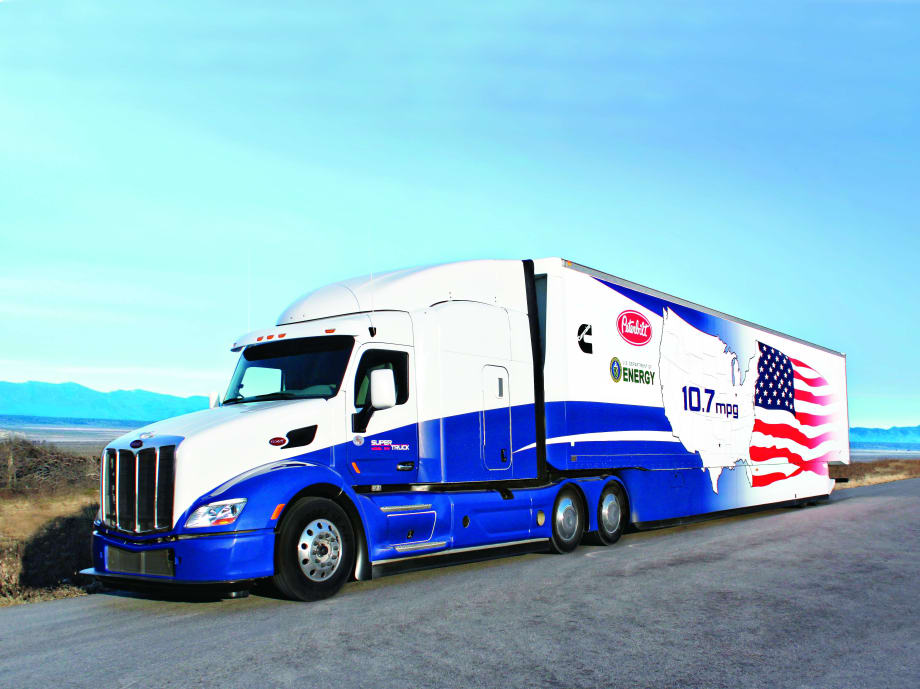
When the U.S. Department of Energy first announced funding for the development and demonstration of advanced technologies to improve the efficiency of long-haul Class 8 trucks, 10.7 mpg was almost unheard of. That was in 2010, when the industry was reeling from the fuel efficiency degradation of the U.S. Environmental Protection Agency’s 2007 emissions mandate.
By the time the Cummins/Peterbilt SuperTruck made its public debut this February boasting 10.7 mpg, some contemporary trucks were achieving better than 8 mpg, and some super-fuel-conscious fleets boast even higher. While that may make the SuperTruck accomplishment seem slightly diminished, that 10.7-mpg milestone is only a small part of the story.
The DOE put $115 million on the table, launching three projects aimed at improving fuel and freight efficiency. Cummins received a $39 million grant to develop and demonstrate an advanced waste heat recovery system, an aerodynamic Peterbilt tractor-trailer combination, and a solid oxide fuel cell auxiliary power unit to reduce engine idling. The SuperTruck is the result of those efforts.
Beyond 10.7 MPG
While the 10.7-mpg figure turned its share of heads, the truck as it stands today is not something any fleet will ever own. It’s a combination of technologies packaged together to demonstrate their effectiveness. While it meets all the design objectives set out by DOE, the sum of its parts is measurably greater than the whole.
“If you look at the goals of the project, they were really to achieve a 50% improvement in freight efficiency [measured in ton-miles per gallon] over a drive cycle as well as a 68% improvement in freight efficiency over a 24-hour duty cycle that includes no-idle technology — both of which we surpassed,” says Peterbilt Chief Engineer Landon Sproull. “We approached it in the areas of aerodynamics, lightweighting, reduced parasitic loads such as rolling resistance, driver assistance tools, and engine technology — the Cummins ISX 15-liter engine with the waste heat recovery system.”
Sproull says the engine contribution was 20% and the vehicle contribution was 30% toward the objective of a 50% improvement in fuel efficiency in the drive cycle.
Singled out, some of the efficiency improvements are quite spectacular.
David Koeberlein, Cummins’ principal investigator, says they improved the thermal efficiency of the engine (its ability to convert the chemical energy contained in a gallon of fuel to motive power at the driveshaft) from today’s typical 42% to 50%.
“The difference between 42% and 50% may seem small, but it’s a 20% gain,” he says. “The next goal is 55% – another 10% gain. And it’s all the more remarkable when you consider historic gains in thermal efficiency have been measured in single-digit steps.”
Saving Weight
The tare weight of the combination is about 31,000 pounds, which is a net improvement of 1,305 pounds from the baseline truck, a 2009 Peterbilt Model 386 tractor with an ISX 15 engine and a non-aero, standard dry van.
If that sounds less than remarkable, consider that engineers added about 1,500 pounds to the truck, including the auxiliary power unit, the cooling package, and the waste heat recovery system. The weight of the extensive aero treatment on the tractor and trailer is over and above that. So, a 1,305-pound net weight reduction from the baseline unit represents about 3,000 pounds of actual weight reduction.
“It was rather challenging because we added a lot of systems and aerodynamic features to the truck, which naturally added weight,” says Ken Damon, SuperTruck project manager at Peterbilt. “So we had to do extensive weight reduction throughout the truck in order to first break even and then actually end up with a benefit.”
Among the weight-reducing items:
variable gauge steel frame rails drilled for additional weight reduction
a number of aluminum parts, including the drive shaft, aluminum matrix brake drums, aluminum trailer frame and subfloor
6x2 drive axle
selective use of magnesium in some of the chassis cross members
wide-base single tires on aluminum wheels
lithium-ion hotel-load batteries
Smoothing Out the Flow
As Sproull noted, much of the drive-cycle efficiency came from the aerodynamic treatment, which focused on integrating the tractor and the trailer and reducing drag to the extent possible.
The biggest change, he says, was integrating the aerodynamic flow of the truck-and-trailer combination.
“To the truck we added front-wheel closeouts to tighten the gaps between the wheel and fender and lower bumper air dam, tandem wheel fairings, aero enhancements to the sleeper door housing, and a bridge fairing between the extenders.”
The trailer treatments include a nose fairing and full side skirting from just ahead of the landing gear to the DOT bumper. The fairings covering the wheels lift outward for easy access to the wheels for inspection, while the rest of the skirt tilts inward for better ground clearance at low speeds. The trailer also features an ATDynamics TrailerTails boat tail, and sculpted returns (shaped “fairings”) from the trailer bogey back to the bumper.
Using Waste Heat
The waste heat recovery system developed by Cummins is the most complex part of the truck, and indeed the most interesting. Its function is to capture heat energy that is usually given up to the truck’s cooling system and exhaust stack, and return it either to the powertrain directly, as is the case here, or redeploy the energy to serve some other function, like accessory drives.
And now for the $39 million question: How much does one of these things cost?
“SuperTruck is really a showcase of how to optimize fuel economy using technologies and components that are or can be available today,” says Damon. “We intend to bring to market the features that best meet customer needs and provide an ROI of one to two years.”
Each of the systems and components on the SuperTruck could be broken out and priced separately, but certain things, such as the aluminum matrix brake drums, have not yet been commercialized, and therefore can’t be priced.
“The waste heat recovery system, in its SuperTruck Gen 3 configuration, is still too costly, but design work is advancing to a Gen 4 solution whose key objective is to get the cost structure within an 18-month payback for the customer,” Cummins’ Koeberlein says.
With what they have learned from the SuperTruck, he says, Cummins engineers are systematically changing the system to improve its performance, reduce the complexity, reduce weight impacts, and eliminate troublesome refrigerant joints, all of which will significantly reduce the system cost. The waste heat recovery system has been operating on three Peterbilt trucks over the last three years.
“While [waste heat recovery] increases fuel economy, we’ve also tested advanced low greenhouse gas refrigerants which have performed at least equal to or better than the current system with a 10:1 reduction in GHG impact,” he notes.
For all we have mentioned here, we haven’t even touched on the improvements SuperTruck brings to the Freight Efficiency, or ton-mile, table. There’s more to tell. For a deeper dive into the project, go to www.truckinginfo.com/supertruck and check out our photo gallery.
More Fuel Smarts

Electric Yard Tractors Move Beyond Pilots
Operating-cost savings have overtaken sustainability goals as the leading reason surveyed fleets are adopting battery-electric terminal tractors, according to new NACFE research.
Read More →
Geotab Links Fleet Card to Vehicle Data
The new card combines fuel discounts with telematics-based purchase controls. Geotab’s analysis also points to potential savings from choosing lower-priced fuel stops.
Read More →
Fleet Economics Shape Electric Truck Outlook
ACT Research expects costs, charging infrastructure, and technology improvements to drive zero-emission commercial vehicle adoption as federal regulations and incentives retreat.
Read More →

Wex Adds Cardless Fuel Payments for Over-the-Road Customers
A new fuel card feature for Wex customers offers convenience and security.
Read More →
New California Law Could Shed Light on Electric Truck Prices
Why do battery-electric Class 8 trucks remain so expensive? A California bill signed by Gov. Gavin Newsom would give fleets and state agencies more visibility into what manufacturers charge.
Read More →
How Volvo Updated Its D13 for EPA 2027 [Watch]
Volvo’s updated D13 promises lower emissions without sacrificing performance or fuel economy. Take a closer look at what changed inside the engine in this HDT Spotlight video.
Read More →
Diesel Price Spike Shortens Payback for Natural Gas Trucks, Report Says
Energy Vision estimates fleets could recover the higher purchase price of an RNG-fueled Class 8 tractor in 1.3 to 2.8 years under current fuel-price scenarios.
Read More →
Calstart Becomes Catalyst Mobility, Reflecting Broader Focus
Calstart is now Catalyst Mobility, reflecting the nonprofit’s growing national role in clean transportation, including zero-emission trucks, infrastructure and incentive programs.
Read More →
Record Diesel Prices Squeeze Trucking Fleets
Average U.S. diesel prices have climbed to nearly $6 a gallon, surpassing the 2022 record as tight refinery capacity and Middle East disruptions keep fuel costs elevated.
Read More →
How Fuel Delivery Shapes Engine Performance
Fuel delivery depends on more than what happens at the injector. For fleet, maintenance and technical professionals, looking at the full path from pump to injector can provide useful context for understanding engine performance.
Read More →