




Using Analytics for Proactive Predictions
Technology allows fleets to take a much more proactive role in managing safety. In the past, addressing driver behavior was a reactive task, something you did after an event of some kind: an accident, a citation, a motorist's complaint

Technology allows fleets to take a much more proactive role in managing safety. In the past, addressing driver behavior was a reactive task, something you did after an event of some kind: an accident, a citation, a motorist's complaint.
The first onboard computers, GPS tracking systems and mobile communications systems presented fleets with more information to work with, such as engine speed, odometer readings, truck locations and idle time, but again, it was used in a post-hoc manner.
Advances in telematics have given fleet managers the ability to monitor driver and vehicle performance in real time, meaning corrective coaching can occur right away. Yet those still mean driver management is based on what has happened.
Fleets now have tools to manage driver behavior based not on what's happened, but on what is predicted to happen. Predictive analytics means taking data collected from past behavior and running that data through a model designed to predict future behavior.
Vikas Jain, vice president and general manager, FleetRisk Advisors, a business unit of Qualcomm Enterprise Services, says the models can predict which drivers are safety risks based on modeling their past behavior.
"We tell you who to talk to and what to talk about," he says. "We provide customers with predictions based on past behavior."
Jain explains that a driver is not a safe or unsafe, but rather safe and unsafe. The longtime safe driver who has an accident didn't forget how to be a safe driver. Something external may have caused that driver to lose focus.
"Driver behavior changes because of stresses," Jain says. Economic stress, for instance, may prompt a driver to speed or use unfamiliar routes to get more paying miles. "These behaviors reflect themselves in the data."
Early on in the program, the predictive analytics gave a warning that its star driver was at the highest risk in the company for an accident. Officials thought it must be a glitch and ignored the warning. A couple of weeks later, he was in a high-speed crash on I-10.
What no one at the company knew was that this driver's home had been severely damaged by Hurricane Katrina. His time in the FEMA trailer was running out. He was working on the house over the weekend when he hurt his ankle. So he was driving not only distracted by his problems, but he was also in pain.
The key data pointing to potential problems was a variation in the time he started his shifts. His commute from the FEMA trailer was longer than it had been from his house, and he also had stopped driving on weekends because he was trying to work on the house. There also was a slight increase in average speed. All those added up to trouble.
Once the model identifies a driver a company should talk with, driver managers can use a coaching script to try to identify what problems the driver may be having.
"In most cases, the driver opens up," Jain says. "Just talking to the driver can ease stress."
Predictive analytics allow fleets to take a proactive approach, said Al LaCombe, director of safety and safety training for Dupre Logistics, Lafayette, La., as part of a panel at a recent industry conference.
"Our industry has a lot of data points that can capture the kinds of problems that might cause stress in a driver," he said. It might be things out of the driver's control that impact his performance but that show up as over-speeding or rushing through their next task.
John Walton, director of safety and compliance, Averitt Express, Cookeville, Tenn., said at the same panel that he has found drivers receptive to the coaching. "Drivers at the end of the day are excited you are talking to them and that you care."
Thom Pronk, vice president recruiting, training and safety for C.R. England, Salt Lake City, said the model identified a driver as a potential risk. When they talked to him, they learned his son had recently been in a major accident, and he was concerned that he couldn't be there for him.
The company gave him the time off he needed. "These external forces that drivers are going through are the things that can affect safety, and the analytics helps identify these people," Pronk said.
Jain says according to customer data, drivers who received remediation based on the model's predictions show a marked reduction in accidents per driver when compared with the rest of the driver pool.
In addition to the safety model, FleetRisk Advisors also offers models designed to identify which drivers are most likely to leave or file a workers comp claim and which drivers to hire. Jain says the models generate predictions by identifying patterns from data based on previous behaviors and events. These patterns correlate to various stresses such as personal or financial issues. In all, the models look at 30 or more predictors - data elements that change to create the pattern.
The models look at three years of data and include the typical stuff (hard braking, speeding, etc.) but go beyond those data points to look at information such as how many messages were sent from the truck and when, how much money a driver is making, what time they start their shifts and what time they end their week.
Pronk said he was surprised by some of the data points included in the models and that they could determine whether or not a driver would have an accident.
Jain notes that "you have to work the models." The models are adjusted over time, and may differ between fleets, with only about 10% to 20% of the predictors the same.
In a separate panel on fleet safety, Dean Newell, vice president safety and driver training, Maverick TransportTransportationn using predictive analysis for three to four years. "It's not all about skills," he said. "Accidents happen before they hit a pole."
From the July 2012 issue od HDT
More Safety & Compliance

How Waste Connections is Using Data, Telematics, and AI
How do you manage and maintain more than 18,000 connected trucks? Data. Lots of it.
Read More →
Fleet Advantage: Top Logistics Fleets Outperform National Safety Benchmarks
Fleet Advantage's latest TRUST Safety Index found leading logistics fleets maintained significantly lower out-of-service rates and stronger safety scores than national averages, while highlighting persistent challenges related to tires, brakes, and unsafe driving behaviors.
Read More →
Why Fleet Data Matters More Than Ever at Waste Connections [Watch]
Waste Connections' Chuck Palmer explains how telematics, predictive maintenance, safety analytics, and AI help keep vehicles on the road and drivers safe in this episode of HDT Talks Trucking.
Read More →
Short Takes: How K&B is Using AI
Fleets need to "get on board the train" with AI, says Lance Evans of K&B Transportation in this HDT Talks Trucking Short Takes episode.
Read More →
Short Takes: Inside K&B’s Truck Safety Tech
Listen to learn how K&B Transportation uses cellphone-blocking technology, speed management systems, weather geofencing, bridge avoidance tools, and more to improve driver safety.
Read More →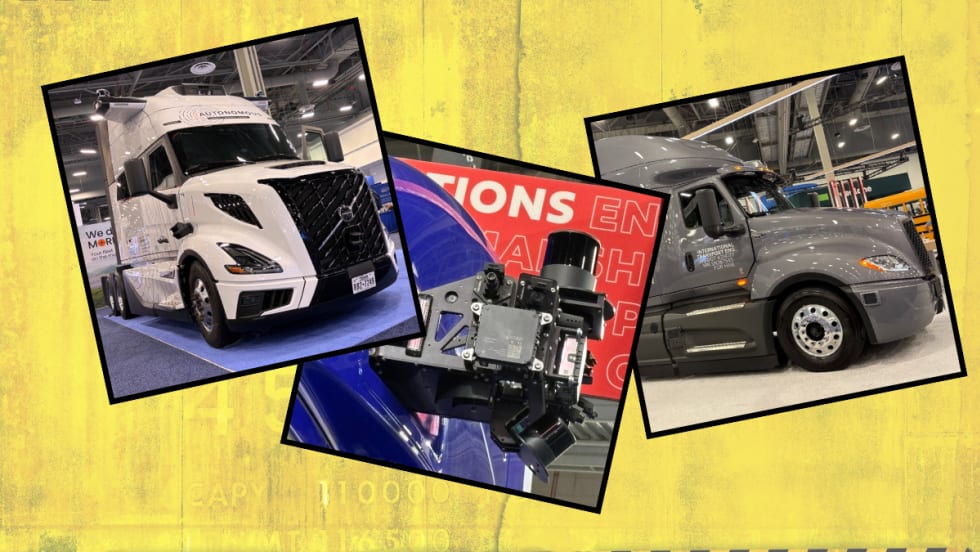
The Biggest Gap in Driverless Trucking Isn’t Tech. It’s Safety Validation
Nauto’s Stefan Heck says autonomous trucks are advancing quickly but proving they’re safe enough for large-scale deployment may be the industry’s hardest challenge.
Read More →
Truck Crash Rates Are Down. So Why Do Insurance Costs Keep Rising?
ATRI’s latest research points to litigation, social inflation, and soaring claims costs as key drivers behind record-high liability premiums for trucking fleets. But there are things motor carriers can do.
Read More →
FMCSA Removes More Than a Dozen ELDs from Registered List
The FMCSA continues its efforts to fight electronic logging devices that don't meet federal requirements, removing more than a dozen from the registered ELD list in May.
Read More →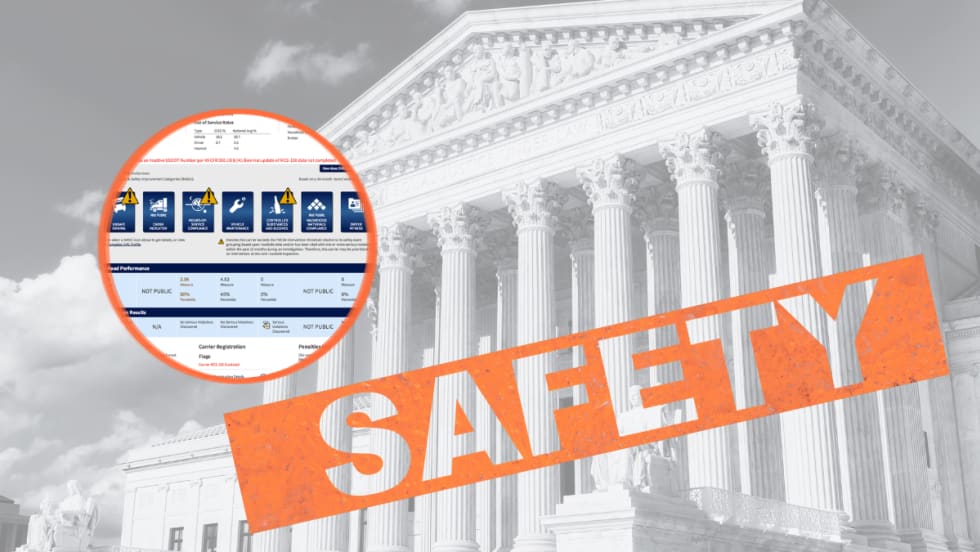
How the Supreme Court Broker Liability Ruling Could Reshape Trucking’s Safety Landscape
The Supreme Court’s May 11 broker-liability ruling may not radically rewrite transportation law overnight. But industry experts say it will intensify pressure on brokers, carriers, and shippers to prove they are prioritizing safety.
Read More →
Recall of Fontaine Fusion Flatbeds Warns Owners Not to Use the Trailers
Some Fontaine Fusion flatbed trailer manufactured between February 2025, and March 2026 could have mainbeams weakened by hydrogen embrittlement because of a problem in the galvanizing process.
Read More →