When Thurman Register went to work for Ferguson Enterprises, he discovered a fleet of more than 5,000 units, ranging from Class 1 through Class 8, where a lot of efficiencies could be gained with some needed centralization and standardization. And that's exactly what Ferguson had hired him to do.
Ad Loading...
Register is a seasoned fleet professional with 30-plus years of experience who specializes in taking decentralized fleets and centralizing them, making them more efficient.
At Ferguson, a Virginia-headquartered company that provides expertise and products ranging from plumbing and appliances to fabrication and infrastructure across North America, Register found that each district was focused on different fleet goals and objectives, which meant a lot of different truck specifications.
Ad Loading...
The Four Rs
One of the first things Register did was to look at whether the quantity and size of trucks were the best for their applications. He calls it the four R’s — the right vehicle, at the right place, at the right time, at the right value. In some cases that meant taking a driver out of a big high-horsepower Class 8 truck and putting them into a smaller vehicle.
“Fleet works backwards from the customer,” he explains. “What deliveries is the market requesting, what deliveries are we making, all the way back to where the product Is imported. Do I have the right transmission ratios, torque and horsepower ratings?”
Register also streamlined truck specifications to fewer than 40 and is working to make further reductions. Fewer different truck specs makes things easier for everyone, including body companies and upfitters, and provides greater economy of scale, saving Ferguson money.
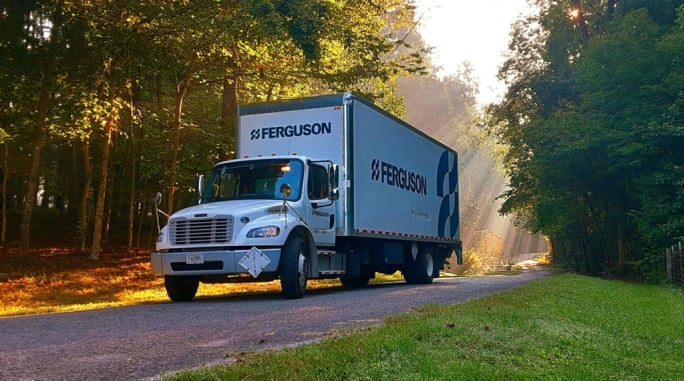
Photo: Ferguson Enterprises
“Those initial discoveries were kind of the easy wins,” he says. “We’re really turning the corner now, driving change from a fleet culture perspective.”
And that means making decisions based on data. “What we do a really good job of is taking data and turning it into action,” he says.
Ad Loading...
“If you’re trying to deploy electric vehicles into a fleet and force-fit them somewhere," without a robust strategy, "It's a recipe for disaster."
Developing an EV Strategy
Data analysis is also key in meeting Ferguson’s ESG goals (environmental, social, and corporate governance), evaluating how and where the company adopts alternative fuel and zero-emission vehicle strategies.
With an electric-truck pilot program just getting under way in California, the company plans to take the next year to 18 months to use data to evaluate where medium- and heavy-duty EVs are going to excel in its operations and where they will face challenges.
One challenge? The charging infrastructure. Will the power utilities be able to provide the service needed? What alternatives, such as microgrids, should be considered? What about solar or other renewables to generate power to charge the fleet's EVs?
"It's not as simple as just ordering an electric truck," Register says.
Instead of doing one-on-one replacement of its internal-combustion-engine trucks with battery-electric models, the pilot program is layering EVs on top of the existing fleet. The company will use EV trucks and ICE trucks on the same route and will look for efficiency gains on the EV side.
Ad Loading...
“How can we create more efficiencies with the EV trucks versus the ICE truck,” Register says, “so that eventually we can take the internal combustion trucks completely out of service?”
Again, the idea is to collect data that the company can use in expanding its EV fleet.
“Let’s take the learnings from the pilot, every data point from smart charging, when we charge, how much those kilowatt hours are going to cost us. What does charger maintenance look like on a go-forward? What is the true offset between EV versus ICE? And then we’ll build a fleet deployment strategy that replicates our success as we move forward.”
Just as when spec’ing regular trucks, Register says, it’s important to work backward from the customer. “If you’re trying to deploy electric vehicles into a fleet and force-fit them somewhere," without a robust strategy, "it’s a recipe for disaster.”
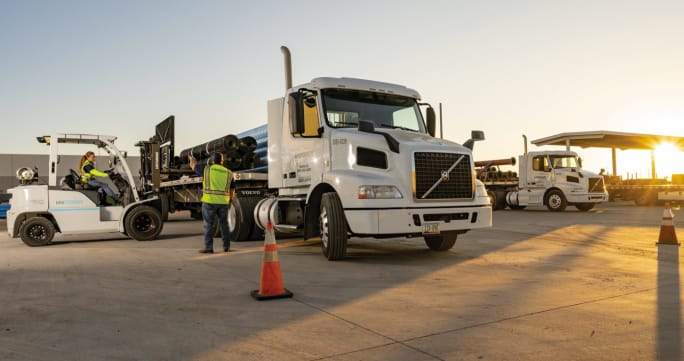
Photo: Ferguson Enterprises
The Importance of Drivers
Driver training is part of the electric-truck pilot, as well, including how and when to charge and how to drive most efficiently in order to extend battery range.
Ad Loading...
“This is where telematics is such an important tool,” Register says. “We are able to address behavior [in driving] the ICE engine, like hard accelerations that degrade batteries quickly. We want to address that before we move them into the EVs. We use real-time feedback and coaching sessions.”
Register also is addressing Ferguson’s ESG targets by reducing miles traveled through better fleet utilization. And the company is partnering with Ford on a medium-duty hydrogen-powered truck that will be launched on the East Coast.
But data alone is not enough. That’s why Register started a fleet management advisory council with members ranging from executives down to drivers.
“We bring them into a committee meeting and talk about truck specifications, what works and what doesn’t." Because they're using the trucks every day, he says, their feedback is invaluable. “We work together to redefine our truck specifications.”
Such an advisory council, Register explains, has many benefits, including diverse perspectives, increased employee engagement, improved communication, and better decision-making when reviewing the data. It allows the company to develop a well-rounded fleet management strategy that considers all aspects of the business.
The 2023 HDT Truck Fleet Innovators are:
James Adams, CEO and Founder, Revolution Trucking, Wadsworth, Ohio
Brad Bayne, Vice President of Strategic Initiatives, Duncan and Son Lines/4 Gen Logistics, Buckeye, Arizona
Brent Hickman, Senior Manager of Equipment Maintenance and Sales, Pilot Company, Knoxville, Tennessee
Thurman Register, Senior Fleet Manager, Ferguson Enterprises, Newport News, Virginia
Andrew Winkler, General Manager, Chief Carriers, Grand Island, Nebraska
The Innovators will be HDT’s guests at the Heavy Duty Trucking Exchange event in Scottsdale, Arizona, Sept. 6-8, where they will be presented with their awards and participate in a panel discussion.
The trucking industry has no shortage of cybersecurity reports and cargo crime statistics. What it lacks is timely, operational intelligence that fleets can actually use.
ATRI’s latest research points to litigation, social inflation, and soaring claims costs as key drivers behind record-high liability premiums for trucking fleets. But there are things motor carriers can do.
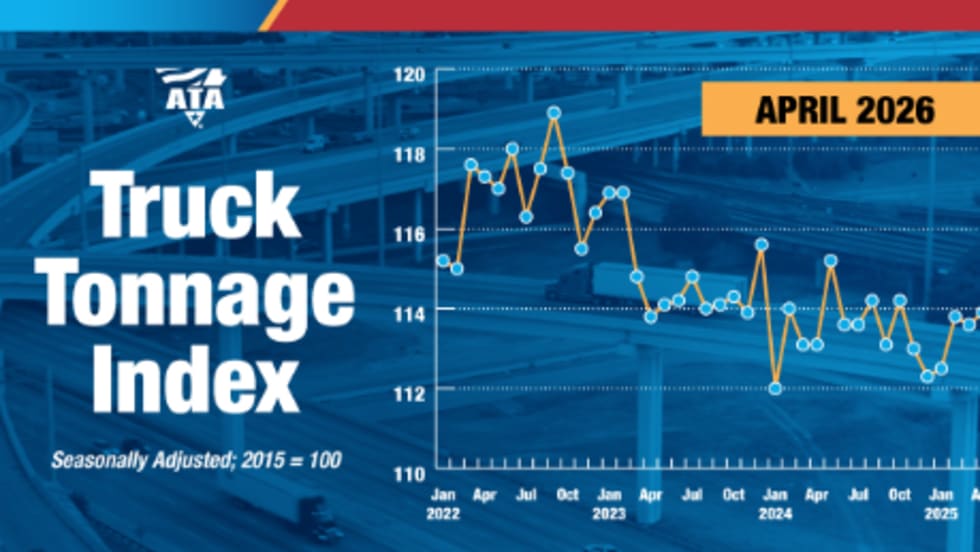
ATA’s For-Hire Truck Tonnage Index was unchanged in April after a strong March gain, with freight volumes remaining at their highest levels since late 2022.
Transportation attorney Greg Feary breaks down the recent Supreme Court decision that brokers can be held liable for damages in truck accidents and what it means for the trucking industry going forward.
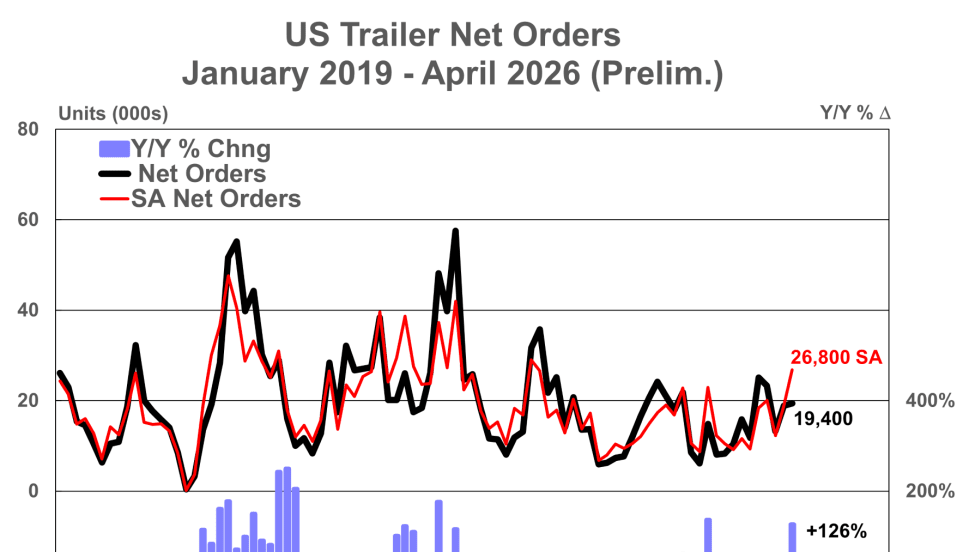
Preliminary net trailer orders rose 3% from March and jumped 126% year over year, signaling stronger-than-expected demand despite typical seasonal softness.
The unanimous SCOTUS ruling in the closely watched Montgomery v. Caribe case allows state negligence claims against freight brokers that hire unsafe motor carriers, raising new liability and vetting concerns among brokers.