




Daimler Takes the Next Step Toward Autonomous Trucks
In Germany Friday, Daimler Trucks is operating what it says is the first series-production truck to operate on an automated basis on the highway.
by Staff
October 2, 2015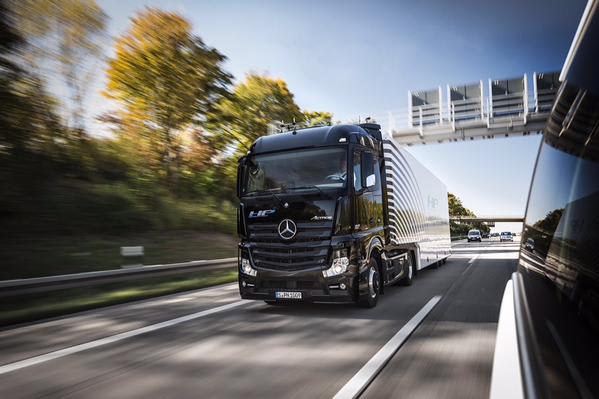
Daimler Trucks testing the first series-production autonomous truck on public roads. Photo: Daimler
5 min to read
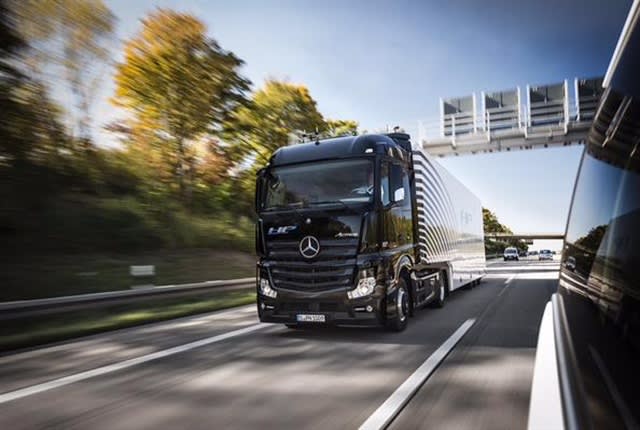
Daimler Trucks testing the first series-production autonomous truck on public roads.Photo: Daimler
In Germany Friday, Daimler Trucks ran a real-world test of what it says is the first series-production truck to operate on an automated basis on the highway.
The truck used for the premiere is a standard Mercedes-Benz Actros equipped with the intelligent Highway Pilot system for this test of autonomous driving on public roads. A special permit from the state of Baden-Württemberg allows the truck to drive on motorways on an automated basis.
"Today's premiere is a further important step towards the market maturity of autonomously driving trucks – and towards the safe, sustainable road freight transport of the future," said Wolfgang Bernhard, the Daimler AG board member responsible for trucks and buses.
The "multi-sensor fusion," the combination of proven new-generation assistance and safety systems and sensors, enables the truck with the Highway Pilot system to continually observe the entire area in front of the vehicle and to take control itself in certain situations.
The test scenario goes like this:
Bernhard drives the Mercedes-Benz Actros from the service station onto the motorway towards Karlsruhe. As soon as the truck has entered the flowing traffic in the right-hand lane, it's "Highway Pilot On," and the system offers to take over vehicle operation. The driver can confirm at the press of a button. The Actros keeps to its lane and maintains the optimum distance to the vehicle in front of it. Should the distance become too small or if a vehicle cuts in front of it, the truck brakes. Both vehicle occupants are sitting comfortably in the functional and modern cab and are chatting in a relaxed fashion.
At the airport/trade fair exit the system asks Bernhard to take control and the truck reverts from automated driving mode to manual control – "Highway Pilot Off." He steers the Actros off the motorway and then drives directly back onto the A8 again, this time in the opposite direction. The scenario is exactly the same: the Actros steers and brakes independently in the flowing motorway traffic.
If it approaches an obstacle, such as roadworks on the A8, the system asks the driver to take over the vehicle. If the roadworks are behind the truck, the Highway Pilot can once again take over control of the vehicle. The system safely assists both occupants up to the Wendlingen exit. Here Wolfgang Bernhard again takes over the driving and steers the truck off the motorway.
Daimler emphasized that the Highway Pilot does not replace the driver, but supports and relieves the strain on him or her by dealing with monotonous stretches and taking care of annoying stop-and-go driving in a traffic jam. In automated mode the driver has control over the truck at all times and in tricky situations can take over driving of the vehicle again.
If the minimum prerequisites for the system are not present due to bad weather or missing road markings, the Highway Pilot issues acoustic and visual impulses to ask the driver to take over. If there is no reaction from the driver, the truck brings itself to a standstill independently and safely.
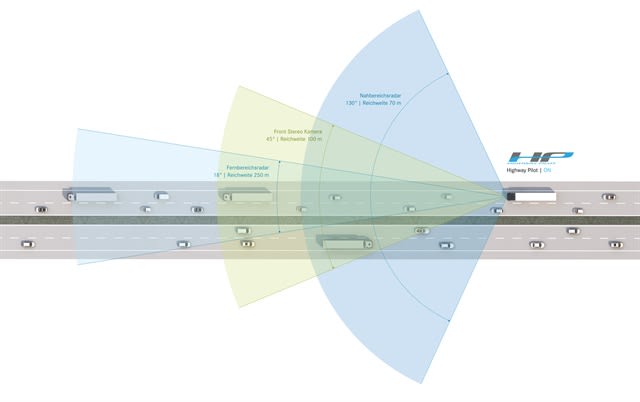
Overview of the functions of the Mercedes-Benz Actros with Highway Pilot.Photo: Daimler
Connectivity down the road
While the Highway Pilot does not need the Internet to work, Daimler says connectivity will increase in importance in the traffic of the future. Connectivity means not only the combination of all assistance, safety and telematics systems with the new sensor systems; it also encompasses intelligent networking between vehicles themselves and with the transport infrastructure.
For instance, if a truck is informed at an early stage about traffic incidents occurring far in front of or behind it, appropriate action can be taken. This means that in autonomous driving mode the handling adapts to the characteristics of the route ahead. Through the more homogeneous flow of traffic, fuel consumption and emissions fall. At the same time the transport times will become more calculable and the major assemblies of the trucks concerned will also be subjected to less wear thanks to a consistent driving style. This also reduces the truck's downtimes due to maintenance and repairs.
Step-by-step toward the autonomous truck
Daimler says it's taking a step-by-step approach to vehicle automation. In July 2014, Mercedes-Benz had its Future Truck 2025 driven on a an unopened highway near Magdeburg, Germany. In May this year, the world premiere of the Freightliner Inspiration Truck in Las Vegas featured a permit for operation on public roads to drive in a highly automated fashion.
Both the Future Truck 2025 and the Inspiration Truck are concept vehicles which are equipped with further functions. For instance, the mirror cam, swivelling seat and integral tablet of the Future Truck 2025 are not present in the Actros with Highway Pilot used today. The reason for this is that the vehicle is approved according to automation level 2 (partially automated driving). This means that the Highway Pilot can assist the driver in certain situations both for longitudinal and lateral guidance. However, the driver must constantly monitor the vehicle and the road and traffic conditions and at all times be in a position to take control of the truck again. For this reason, activities such as the use of a tablet during the automated journey are not currently allowed, Daimler explains.
On the test track in Magdeburg, the Future Truck 2015 was demonstrating automation stage 3 (highly automated driving). This means that the system independently detects the system limits and accordingly asks the driver to take over the task of driving. And at this automation level the driver no longer has to monitor the system on a permanent basis and could also carry on with other activities during the journey.
More Equipment

Kodiak Targets Dallas–Houston for Driverless Trucks
The company says its autonomous trucks are completing the I-45 run without a safety observer taking control. It plans to remove the observer by the end of 2026.
Read More →
Kodiak Hauls Produce in California Autonomous Truck Pilot
Kodiak AI and DTL Transport have begun hauling produce between Fresno and Los Angeles under California’s new rules for testing heavy-duty autonomous trucks. A safety driver remains behind the wheel.
Read More →
Used-Truck Remarketing Math Is Changing
Used-truck value is no longer just a concern at trade-in. Decisions made throughout a truck’s first life can influence what it’s worth years later.
Read More →
How Volvo Updated Its D13 for EPA 2027 [Watch]
Volvo’s updated D13 promises lower emissions without sacrificing performance or fuel economy. Take a closer look at what changed inside the engine in this HDT Spotlight video.
Read More →
Michelin Tire Improves Efficiency and Durability for Regional Fleets
The Michelin X Multi Energy D2 is a regional haul drive tire engineered to help fleets improve fuel efficiency, durability and traction in demanding stop-and-go operations.
Read More →
ZF Expands Commercial Vehicle Push in North America
ZF is expanding its North American commercial-vehicle presence with new transmission applications, electrification, trailer technology and autonomous-driving systems.
Read More →
Tesla Wants a Self-Driving Semi. Are Cameras Enough?
Could Tesla’s camera-only autonomous driving technology work on an 80,000-pound Semi? In this commentary, HDT's Deborah Lockridge takes a look at Tesla, Cybercab, and how autonomous trucks see the road.
Read More →Kodiak: Driverless Long-Haul Truck Launch on Track for 2026
Kodiak AI says its driverless long-haul safety case is 93% complete and it remains on track to begin commercial operations by year-end 2026.
Read More →
What DOT’s Automated Vehicle Strategy Means for Trucking
The U.S. Department of Transportation issued a new automated-vehicle strategy that outlines plans for driverless-truck regulations, cross-state freight corridors, and federal safety standards.
Read More →
East Coast Port Launches $45M Electric Truck Push
The Port Authority of New York and New Jersey announced millions in incentives for zero-emission drayage trucks, yard tractors, and new charging hubs near the port.
Read More →