


Related: What Phase 2 GHG Regs Mean to Fleets
Related: Court Battle Erupts over Truck Trailers and GHG/MPG Rule
 MENU
MENU SEARCH
A three-judge panel Friday granted the Truck Trailer Manufacturer’s Association request to provisionally stay the trailer provisions of the greenhouse gas/fuel economy standards that were slated to go into effect in January.

TTMA contends that the fleets that can benefit from aerodyamic technology on trailers are already using it voluntarily. Photo: Utility Trailer
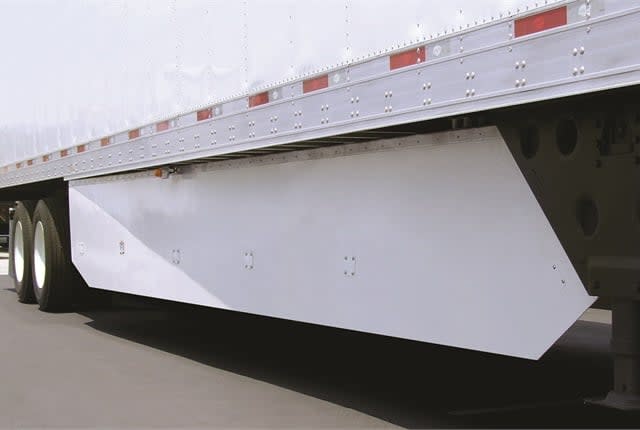
TTMA contends that the fleets that can benefit from aerodyamic technology on trailers are already using it voluntarily. Photo: Utility Trailer
A three-judge panel On Oct. 27 granted the Truck Trailer Manufacturers' Association request to provisionally stay the trailer provisions of the greenhouse gas/fuel economy standards that were slated to go into effect in January.
Late last year, TTMA asked the court to review the trailer provisions of the Phase 2 Greenhouse Gas Emissions and Fuel Efficiency Standards, written by the Environmental Protection Agency and the National Highway Traffic Safety Administration.
In August, EPA announced it would revisit the trailer provisions (as well as new rules regarding glider kits) following concerns raised by stakeholders in those industries.
In September, TTMA petitioned the court, this time for a stay of the rules while the litigation ran its course and the agencies decided what to do. EPA responded that it did not have any problems with such a stay, but noted that didn’t mean it agreed with TTMA’s arguments.
Among the trailer makers’ arguments is that the Clean Air Act only allows the government to regulate motor vehicles, and that trailers are not self-propelled and therefore not motor vehicles subject to EPA rules.
The court filing also held that trailer makers will suffer “irreparable harm” without a stay. And, TTMA argued, a stay will not cause public harm, because even if implemented, the rules will have little positive effect on climate change. The types of fleet operations that would benefit from these technologies are already using them, TTMA claimed, and the rules would force trailer makers to put fuel-saving aerodynamic equipment on trailers that would not benefit.
TTMA President Jeff Sims told HDT, “We are pleased with the court's decision and looking forward to EPA's final decision.”
The Environmental Defense Fund criticized the efforts to derail the trailer provisions of the rule and said a stay will “delay these critical health and environmental protections for the duration of the litigation, which could last for years.”
“In a highly unusual action that emerged publicly at the 11th hour, EPA declined to defend the standards against TTMA’s stay motion,” the advocacy group said in a news release.
But Acting Assistant Attorney General Jeffrey Wood noted that EPA’s plan to revisit the trailer provisions through a notice-and-comment rulemaking could extend into next year –after the rule was supposed to go into effect.
EDF and numerous allies filed court documents opposing TTMA’s request, as did the California Air Resources Board and seven states – Connecticut, Iowa, Massachusetts, Oregon, Rhode Island, Vermont, and Washington.
EDF Attorney Alice Henderson pointed out that this stay has no impact on another provision of the Phase 2 GHG standards that is under review by the EPA that could affect glider kits. “The glider industry never brought a challenge to the glider provisions and in fact, though the rule was published in October 2016, did not even ask the agency to reconsider the glider provisions until July of this year,” she stated.

Volvo’s updated D13 promises lower emissions without sacrificing performance or fuel economy. Take a closer look at what changed inside the engine in this HDT Spotlight video.
Read More →
Energy Vision estimates fleets could recover the higher purchase price of an RNG-fueled Class 8 tractor in 1.3 to 2.8 years under current fuel-price scenarios.
Read More →
Calstart is now Catalyst Mobility, reflecting the nonprofit’s growing national role in clean transportation, including zero-emission trucks, infrastructure and incentive programs.
Read More →
Average U.S. diesel prices have climbed to nearly $6 a gallon, surpassing the 2022 record as tight refinery capacity and Middle East disruptions keep fuel costs elevated.
Read More →
Fuel delivery depends on more than what happens at the injector. For fleet, maintenance and technical professionals, looking at the full path from pump to injector can provide useful context for understanding engine performance.
Read More →
The Port Authority of New York and New Jersey announced millions in incentives for zero-emission drayage trucks, yard tractors, and new charging hubs near the port.
Read More →
Why do battery-electric Class 8 trucks remain so expensive? A California bill headed to Gov. Gavin Newsom would give fleets and state agencies more visibility into what manufacturers charge.
Read More →
Detroit isn’t starting from scratch to meet EPA 2027 diesel emissions standards. Its Gen 6 DD13 and DD15 engines keep much of today’s platform while updating the fuel and aftertreatment systems.
Read More →
California, Oregon, Washington, British Columbia and Baja California are coordinating plans for truck charging and hydrogen fueling from Canada to Mexico.
Read More →
Learn more about Kenworth's T880E battery-electric vocational truck at the Paccar Technical Center, including its range, applications, upfitting considerations, and PTO options, in this HDT Spotlight video.
Read More →