




Last Legs for Long-Haul Trucking?
A move away from long-haul to regional and super-regional routes has been predicted for years. Volvo's Magnus Koeck says that shift may already be underway.

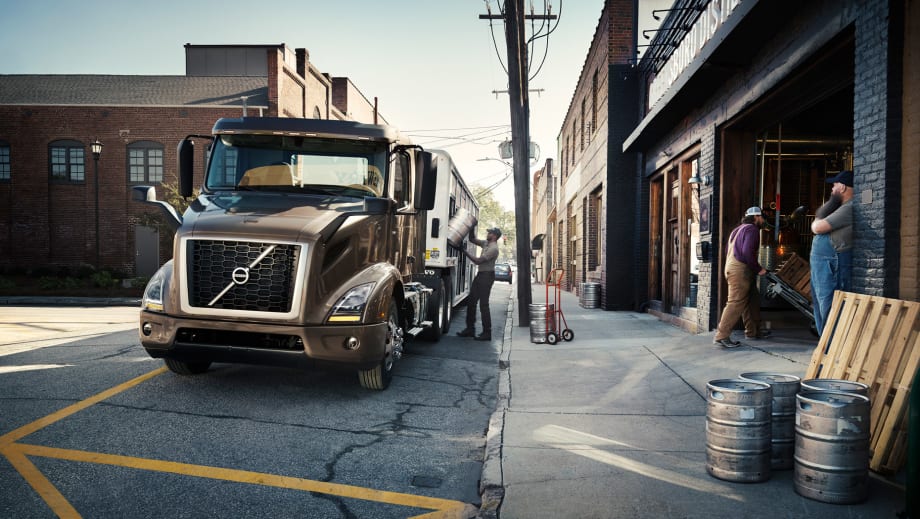
Volvo's Magnus Koeck says a new industry emphasis on regional haul routes was a prime design driver for the OEM's new VNR tractor. Photo: Volvo
Volvo's Magnus Koeck says a new industry emphasis on regional haul routes was a prime design driver for the OEM's new VNR tractor.Photo: Volvo
The long-haul model has been the dominant model for moving freight in North America for decades, but there are signs that could be changing, according to Magnus Koeck, vice president, marketing, and brand management for Volvo Trucks North America.
The long-haul model for freight distribution developed organically after the Second World War in an age of cheap diesel fuel, a large driver pool, and infrastructure limitations at the time: The Panama Canal was not able to accommodate larger freighters and a new class of container ships. This placed an emphasis on East and West Coast ports, with corresponding long-haul truck routes becoming the norm.
A lot of the pieces that set the long-haul freight model in place have changed dramatically over the past several years, however. The size of the driver pool has not kept pace with the rise in freight volumes. Moreover, a new generation of potential drivers sees the isolation and long periods away from home associated with long-haul routes as a distinct negative.
At the same time, the widening of the Panama Canal (with a new, Chinese-funded canal across Nicaragua under construction now) has made it easier for larger container vessels to reach Gulf Coast ports.
Industry experts tracking these trends have predicted they could lead many truck fleets to adopt short-haul, regional, or super-regional routes, leveraging port expansions on the Gulf Coast to get drivers home sooner, while still maintaining increasingly important efficient freight deliveries.
While there is still some ways to go before trucking sees a full-blown shift away from long-haul routes, Koeck sees signs the shift is underway. “We actually don’t see that happening yet in a larger scale as there are still some work to do (renovations, dredging, blasting and bridge raising) in some of the Eastern seaboard ports to be able to accommodate the largest container ships,” Koeck said. “The Panama Canal is ready, but some of the ports are not. The Panama Canal did open up in the end of June last year for larger ships. We’re monitoring the development closely and we’re confident that there eventually will be changes in the freight patterns because of this.”
Volvo reported last week at a press event unveiling its new VNR tractor that its Class 8 build number for 2017 is beginning to indicate a move toward more regional delivery routes by fleets, with production of long-haul spec’d trucks falling off by 5%, compared to 2016, while regional-spec’d truck production has remained steady.
“It’s hard to tell if this is a long-term trend or simply a market correction,” Koeck said. “We do see a declining trend for long haul and a steady, slight upward trend for regional haul, although we’re also positive that the long-haul segment will recover in the years to come and the construction segment will decline sometime after 2019.
"The regional haul segment stands for close to 30% today of the total market and that’s a strong number," he continued. "We truly believe that we are extremely competitive now with our new lineup of VNR tractors, reflecting that we have seen a higher demand for daycabs and smaller sleepers in the last few years.”
Another driver that could push growth in regional and super-regional markets is the increasing pressure for faster delivery times, including a new emphasis on efficient “last mile” delivery, although Koeck said it is again too soon to say for sure if those forces are fueling a significant shift in freight delivery patterns.
“The future will tell if this is happening now,” he said. “But our customers certainly have demands on them for quicker, on-time deliveries, and that trend will continue. We will see different business models for the future. Just see what has happened thanks to companies like Uber and Airbnb. Connectivity and digitalization are enablers for all this. Nevertheless, I believe that we will see long-haul trucks also in the future and it will be the dominant segment in the foreseeable future, but maybe in the context of different business models among our customers.”
For the time being, Koeck said the driver shortage, in his opinion, remains the main driver for shorter transport distances. “Younger drivers also have somewhat different values than older drivers,” he noted. “And they highly value time off with family and friends, meaning it will be harder and harder to recruit drivers just for long-haul operations. That’s also why we at Volvo put a lot of effort into making the best possible driving and living environments in our trucks, both for our long-haul and regional-haul products. We truly believe that our customers have a competitive advantage when they have Volvos in their fleets when it comes to recruiting drivers.”
More Drivers

FMCSA Removes 110 Truck Driver Training Schools from Certified ELDT List
Federal regulators also are targeting more than 160 additional training providers and launching a nationwide audit of third-party CDL skills testers as part of a broader crackdown on trucking fraud.
Read More →
Hours of Service Pilot Programs: FMCSA Readies for 2027 Rollout
Two pilot programs could eventually reshape hours-of-service rules, giving truck drivers options to pause their 14-hour clock or use longer split sleeper rest periods.
Read More →
Medical Cards, English Proficiency Reshape Roadcheck Violations
Medical-card violations jumped to the top of the driver out-of-service list during CVSA’s 2026 International Roadcheck, while English-language proficiency violations appeared among the leading violations for the first time.
Read More →
Driver Trust Can Make or Break the Success of Fleet Safety Technology
New Teletrac Navman research suggests that onboarding, transparency about driver data, and positive feedback can play a significant role in how commercial drivers respond to safety and coaching technology.
Read More →
EEOC Sues KLLM Over Alleged Sex Discrimination in Driver Training
KLLM is facing a federal sex-discrimination lawsuit over policies the EEOC alleges put female truck driver trainees at a disadvantage.
Read More →
FMCSA Moves to Codify English Language Requirements for Commercial Drivers
By changing regulations on English-language proficiency requirements for commercial drivers, rather than relying on a guidance memo, the FMCSA said future administrations won't be able to walk back the Trump administration's stricter enforcement with just a memo.
Read More →
Drivers Put Western Star Trucks to the Test at Star Nation Experience
Watch to get an inside look at the Western Star trucks, technology, and community behind the Star Nation Experience 2026!
Read More →
Trump Administration Looks to Put More Veterans Behind the Wheel
The Freedom Haulers program pulls together existing and expanded programs at several federal agencies to recruit veterans to drive commercial heavy-duty trucks and cut the red tape for them to get a CDL, training, and employment.
Read More →
Putting Mack’s Command Steer to the Test
A test drive of Mack’s Command Steer active steering system evaluates how it can make truck driving easier and less tiring.
Read More →
Competition Heating Up for Truck Drivers
New report reveals rising driver hiring costs, the return of sign-on bonuses, growing AI advantages, and the operational factors shaping driver retention.
Read More →