




Senate Panel Hears Pros and Cons of Autonomous Trucks
While the House has already passed a bill that could help bring self-driving cars to market faster, a Senate panel is taking a more deliberative approach by considering whether such legislation should also help foster the development of autonomous truck technologies.

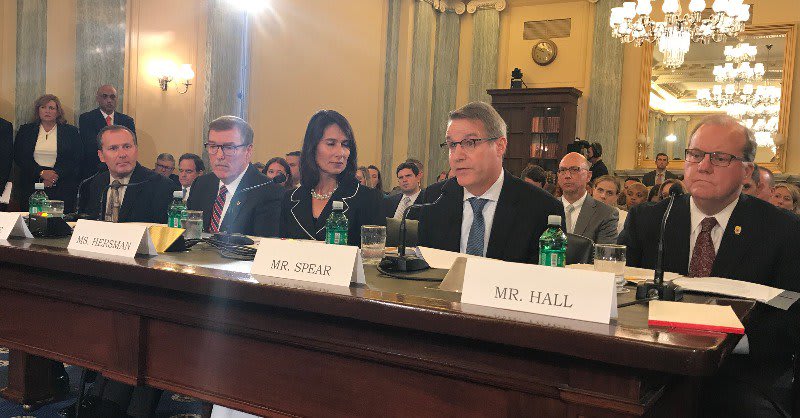
ATA chief Chris Spear testifying on autonomous truck technology to Senate panel on Sept. 13. Photo: ATA, via Twitter
ATA chief Chris Spear testifying on autonomous truck technology to Senate panel on Sept. 13. Photo: ATA, via Twitter
While the House has already passed a bill that could help bring self-driving cars to market faster, a Senate panel is taking a more deliberative approach by considering whether such legislation should also help foster the development of autonomous truck technologies.
To that end, Sen. John Thune (R-SD), Chairman of the Senate Committee on Commerce, Science, and Transportation, held a hearing on Sept. 13 with the specific intention of examining the potential benefits of automated truck safety technology.
“Trucks share our roads, deliver our goods, and keep our economy moving,” Thune said in his opening statement. “Including trucks in the conversation about automated vehicles is important as we seek to improve safety; it also puts our economy on a level playing field as other countries around the world deploy automated freight trucks.”
In his minority statement, Sen. Gary Peters (D-MI), substituting for absent Ranking Member Sen. Bill Nelson (D-FL), pointed out that a bipartisan effort has gone into crafting a draft Senate bill on self-driving vehicles. But he is not yet sold on including commercial vehicles in the legislation, stating noting that “… we have not gotten as clear of an understanding on issues related to self-driving trucks as we have during our countless discussions on self-driving cars. As a result, I am of the mind that highly automated trucks are not ripe for inclusion in this bill.”
On the other hand, Peters said that he “recognize that in the long-term, self-driving trucks and buses are also intended to improve safety on our highways. That is certainly clear.” However, he questioned “assertions that excluding self-driving trucks from this particular bill will result in less safe roads and that they don’t merit special considerations going forward. We cannot allow such premature conclusions to stand in this Committee’s way of talking specifics – and getting the answers we need to have a more complete understanding of the safety, workforce, and policy implications of highly automated trucks.”
Referencing a successful and highly publicized 2016 demonstration of an autonomously controlled tractor-trailer that made an intrastate delivery in Colorado, Scott Hernandez, Colonel of the Colorado State Patrol and a member of the Commercial Vehicle Safety Alliance, testified that the “proof of concept in Colorado indicates that self-driving vehicles will play a critical role in improving traffic safety and may reduce congestion in the future... Technological advances in the past have saved lives and, clearly, technology will continue to save lives in the future as the Colorado State Patrol, the Commercial Vehicle Safety Alliance and the law enforcement community moves toward zero deaths on our roadways.”
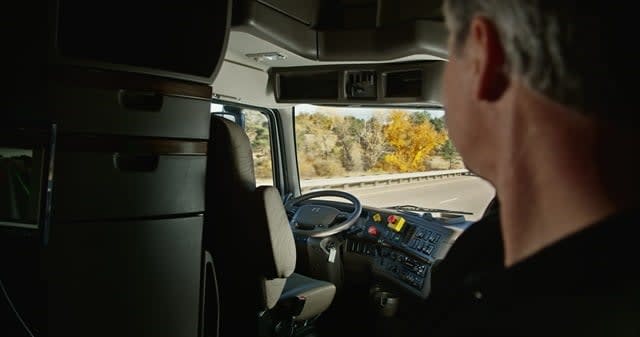
Truck driver monitoring a 120-mile autonomous truck demo trip run in Colorado last year. Photo: Uber (Otto)
Hernandez added that as the committee “moves forward with legislation setting a national framework to guide the deployment of autonomous vehicles, we believe that consideration must be given to the commercial motor vehicle industry.”
Navistar International Chairman, President and CEO Troy Clarke testified that with trucking daily moving the nation's freight across multiple state lines, “having a predictable legislative and regulatory environment for vehicle manufacturers to design, test and validate autonomous technology will help ensure that the technology is safe when it is deployed for larger market consumption."
In urging the Senate to include trucks in legislation that would establish federal regulatory standards for autonomous vehicles, Clarke said that “greater levels of self-driving technology will help reduce human error, which today accounts for 94% of all motor vehicle accidents. This technology can help support the driver to create a better driving experience and make our roads safer."
Clarke also pointed out that rather than being displaced by autonomous technology, truck drivers in the future will be more highly skilled and trained to manage multiple vehicle assets safely and efficiently. "As we develop technologies that could lead to completely autonomous vehicles, we will make many of them available to provide today's drivers with greater ease of use, comfort, safety, productivity and efficiency -- factors that, we believe, will attract more people to this important and noble profession," he explained.
"The commercial vehicle industry has proven that regulations and technology have worked together to advance the interests of all stakeholders," Clarke added. "As federal regulations are being drafted and implemented, we want to ensure that passenger and commercial vehicles are following similar safety and design standards for optimal compatibility."
In the very first sentence of her testimony, National Safety Council President and CEO Deborah Hersman, who is a former chair of the National Transportation Safety Board, said that NSC believes that “for our nation to receive the biggest benefit from this technology, all motor vehicles – both personal and commercial – must be included in this legislative proposal.”
She bolstered her argument by commenting that “there are more vehicles on the road today traveling more miles, and yet the most dangerous factors in roadway travel continue to be human factors… The top four reasons for crashes are caused by human behavior or choices: alcohol, speed, fatigue and distraction, giving ADAS [advanced driver assistance systems] systems and automated vehicles the potential to reduce preventable crashes and deaths in an unprecedented way.”
Hersman also contended that the proposed Senate bill is “intended to set the framework to aid the inevitable transition to ADAS technologies and fully automated vehicles,” yet said that “roadways were not made for passenger and commercial vehicles to operate independently of each other, and both types of vehicles are being tested at this time. Therefore, the policies outlined in this legislation should apply to all vehicles.”
American Trucking Associations President and CEO Chris Spear opened his testimony by stating that he hoped to “unwind some of the myths about automation and our industry” and “demonstrate why trucking needs to be at the table as the roadmap for automated vehicles is being written.”
Spear waded right into the debate about whether automation will kill jobs for truck drivers-- which is the political hot potato that led the House to drop all mention of commercial vehicles from its just passed self-driving bill.
He argued that increased automation is not likely to change the overall demand for truck drivers, noting that the U.S. depends on more than 3.5 million truckers to move more than 70% of goods that are delivered by truck annually.
"While some people use the terms 'autonomous' and 'driverless' interchangeably, ATA believes the world of automated vehicles will still have an important role for drivers," Spear said. "Just as pilots play a key role in our airline industry, truck drivers will do the same on the ground by leveraging the benefits of automated technology while navigating the cityscapes and handling the customer pickups and deliveries."
Because of trucking's key role in the supply chain, Spear said that commercial vehicles must be included along with passenger vehicles within any framework for regulating them. "We are at a critical moment in the development of autonomous technology," he said. "There are many questions to be answered-- including those about cybersecurity, about the impact on trucking operations and how vehicles will interact with one another, and about infrastructure. What is clear is that those questions should be answered for commercial and passenger vehicles at the same time."
Spear also said the government should set uniform national “rules of the road” for automated vehicles, but at the same time not to suppress innovation. "Federal agencies and state governments must commit to supporting innovation for both commercial and passenger vehicles, using existing regulatory exemptions to allow manufacturers and technology companies to test and develop new systems.”
But one witness took a different stance. General Secretary Treasurer of the International Brotherhood of Teamsters Ken Hall testified that the “issues facing autonomous commercial trucks are fundamentally different, and potentially more calamitous than those facing passenger cars, and warrant their own careful consideration. The consequences for getting this wrong could be deadly both for workers and other drivers on the roads.”
He argued that Congress has “tended to focus on the impact of small personal cars on our daily lives-- increasing mobility for the disabled, and alleviating congestion in our cities. These are all important topics. But taking a cookie cutter approach in dealing with those issues and applying it to heavy vehicles is reckless.”
Hall stated that he has “yet to hear a serious discussion about how we will make sure an 80,000 pound automated truck will be able to maneuver around a warehouse or drop yard and not injure the countless workers also occupying that same space. Or how we would make sure that the rules governing a driver’s training requirements would be updated the moment one of these new vehicles is put on the road. And we haven’t gotten to the largest issue of them all, the potential impact on the livelihoods and wages of millions of your constituents.
“These issues,” he added, “should be considered carefully and deliberately at the outset of this discussion, not after the fact.”
Related: Self-Driving Trucks Need to Gain Traction on Capitol Hill
More Drivers

Truck Drivers Need More Than Another Alert
Fleets have more visibility into truck health, safety events, and driver activity than ever. The next challenge is turning all that information into useful guidance for the person who has to decide what to do next.
Read More →
FMCSA Removes 110 Truck Driver Training Schools from Certified ELDT List
Federal regulators also are targeting more than 160 additional training providers and launching a nationwide audit of third-party CDL skills testers as part of a broader crackdown on trucking fraud.
Read More →
Hours of Service Pilot Programs: FMCSA Readies for 2027 Rollout
Two pilot programs could eventually reshape hours-of-service rules, giving truck drivers options to pause their 14-hour clock or use longer split sleeper rest periods.
Read More →
Medical Cards, English Proficiency Reshape Roadcheck Violations
Medical-card violations jumped to the top of the driver out-of-service list during CVSA’s 2026 International Roadcheck, while English-language proficiency violations appeared among the leading violations for the first time.
Read More →
Driver Trust Can Make or Break the Success of Fleet Safety Technology
New Teletrac Navman research suggests that onboarding, transparency about driver data, and positive feedback can play a significant role in how commercial drivers respond to safety and coaching technology.
Read More →
EEOC Sues KLLM Over Alleged Sex Discrimination in Driver Training
KLLM is facing a federal sex-discrimination lawsuit over policies the EEOC alleges put female truck driver trainees at a disadvantage.
Read More →
FMCSA Moves to Codify English Language Requirements for Commercial Drivers
By changing regulations on English-language proficiency requirements for commercial drivers, rather than relying on a guidance memo, the FMCSA said future administrations won't be able to walk back the Trump administration's stricter enforcement with just a memo.
Read More →
Drivers Put Western Star Trucks to the Test at Star Nation Experience
Watch to get an inside look at the Western Star trucks, technology, and community behind the Star Nation Experience 2026!
Read More →
Trump Administration Looks to Put More Veterans Behind the Wheel
The Freedom Haulers program pulls together existing and expanded programs at several federal agencies to recruit veterans to drive commercial heavy-duty trucks and cut the red tape for them to get a CDL, training, and employment.
Read More →
Putting Mack’s Command Steer to the Test
A test drive of Mack’s Command Steer active steering system evaluates how it can make truck driving easier and less tiring.
Read More →