




Economic Watch: Employment, Manufacturing Remain Strong
Employers continued adding a high-number of non-farm jobs in March while U.S. factory orders increased broadly in February, but the rebound was less than expected, according to two new reports.

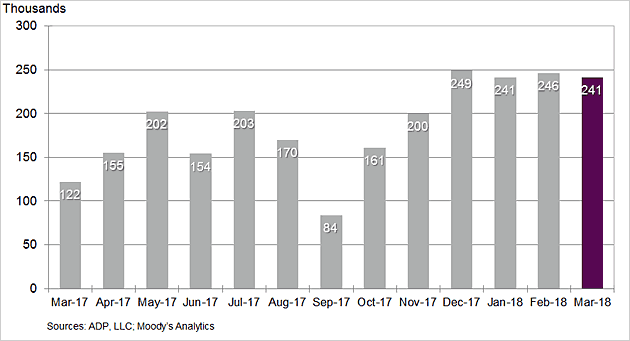
Change in nonfarm private employment by month. Graphic: ADP
Employers continued adding a high-number of non-farm jobs in March while U.S. factory orders increased broadly in February, but the rebound was less than expected, according to two new reports.
There were 241,000 private sector jobs additions during the month, according to the latest figures from ADP, the fifth straight month the level was at 200,000 or better. The February total of jobs added was revised up from 235,000 to 246,000 by the payroll processor.
“We saw impressive momentum in the first quarter of 2018, with more jobs added per month on average than in 2017,” said Ahu Yildirmaz, vice president and co-head of the ADP Research Institute. “Midsized businesses added nearly half of all jobs this month, the best growth this segment has seen since the fall of 2014. The manufacturing industry also performed well, with its strongest increase in more than three years.”
The report came two days before the Labor Department releases unemployment figures for March.
Story continues below graphic.
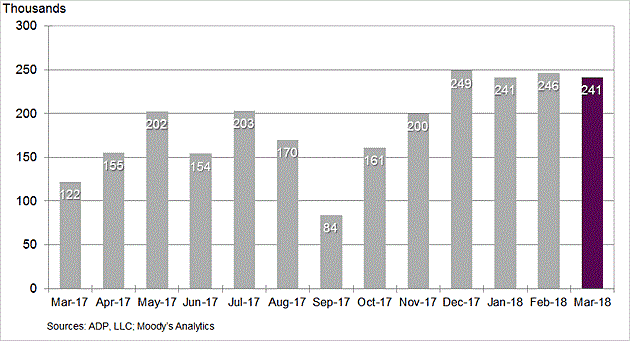
Change in nonfarm private employment by month.Graphic: ADP
Commerce Department factory report
Meantime, a Commerce Department report showed new orders for U.S. factory-made goods in February increased nearly 1.2% from the month before, nearly erasing January’s 1.3% decline. Despite the improvement, it was below a consensus estimate from Wall Street analysts, who expected a 1.7% gain.
When compared to the same time a year earlier, February’s gain was still impressive, rising 7.9%, boosted in large part to a spike in civilian aircraft orders. There were solid gains in orders for electrical equipment, machinery and primary metals, which offset a slip in computer-related electronics.
Shipments of factory orders recorded their 14th gain in the past 15 months, rising 0.2% in February following January’s 0.7% increase.
Both new orders and shipments of long-lasting manufactured durable goods also moved higher, as new orders also rebounded from a decline in January. Nondurable goods orders declined 0.5% after rising 1% in January
The Commerce Department also revised downward orders for nondefense capital goods excluding aircraft, an indicator of business investment, to show a 1.4% rise, down from a first reported 1.8% improvement. Shipments of these core-capital good increased 1.4% in February, the same as reported a month earlier.
Wells Fargo Securities said the rise in both new orders and shipments of core capital goods “bodes well for equipment spending” when it comes to upcoming first quarter U.S. gross domestic product numbers, but believes it will be less of a boost than the double-digit gains seen in the last half of 2017.
Econoday said “the overall order rise and especially the order rise for capital goods point to manufacturing momentum."
Will tariffs slow growth?
It’s worth noting this report was for the final full month before new tariffs were imposed by the Trump administration on $50 billion worth of Chinese made goods, with China responding with a similar move against U.S. produced items.
Some analysts are concerned this could lead to an escalating trade war between the world’s largest two economies and could also slow down worldwide economic growth.
“Ultimately, this tit-for-tat strategy is to the detriment of both economies. The hope is that tariffs are being used as a tactical approach to force a dialogue regarding the continuous violation of intellectual property rights of U.S. firms that operate in China,” said Beata Caranci, senior vice president and chief economist at TD Economics. “The conciliatory tone of Chinese authorities and the willingness of the U.S. administration to continue with dialogue are positive signs that a further escalation of a trade war can be averted.”
The positive news about manufacturing in February follows reports released a few days earlier that showed March was another good month for the sector.
More Fleet Management

Color Match Smarter: Tools That Restore & Perform
For fleet managers and collision repair professionals keeping heavy-duty trucks on the road, getting the color right the first time isn't just about appearance — it's about efficiency, turnaround time, and bottom-line results. Discover how today's digital color tools are transforming the repair process from guesswork to precision.
Read More →
FMCSA Pauses Biennial-Update Enforcement Amid Motus Transition
Carriers whose updates were due on or after June 1 have more time, while FMCSA works to stabilize its new registration system and warns of phishing sites impersonating its new carrier registration system, Motus.
Read More →
2026 Blueprint for Countering Smarter Supply Chain Theft
Cargo theft is no longer just the cost of doing business. It's a multi-billion-dollar criminal enterprise exploiting vulnerabilities across your fleet, drivers, and supply chain.
Read More →


How Telematics Improves Visibility, Control, and Performance in Refrigerated Fleets
Explore how telematics help refrigerated fleets improve visibility, uptime, efficiency, compliance, and cargo protection across connected cold chain operations.
Read More →
What the U.S.-Canada Trade War Means for Trucking
Escalating U.S.-Canada tariffs could disrupt cross-border freight, reduce truck volumes, raise costs, and create new uncertainty for carriers on both sides of the border.
Read More →
What Are Trucking’s Top Concerns for 2026?
The American Transportation Research Institute wants to know what's worrying trucking fleet managers, drivers, and other stakeholders in its annual Industry Issues survey.
Read More →
American Trucking Associations Looks for a New Leader
ATA President and CEO Chris Spear abruptly left his job at the association on August 21, at a pivotal time for the trucking industry.
Read More →
Public Wi-Fi Cybersecurity Risks: How Truck Drivers and Fleets Can Protect Their Data
Public Wi-Fi can expose truck drivers and fleets to credential theft, malware, and other cyber threats. Here’s how to reduce the risk on the road.
Read More →
For Nicky Cupp, Fleet Innovation Starts With Frustration
HDT Truck Fleet Innovator Nicky Cupp turns everyday pain points at Fraley & Schilling into opportunities for better technology and smarter processes.
Read More →
Adam Buttgenbach’s Approach to Electric Trucks: Start With Where They Fit
HDT Truck Fleet Innovator Adam Buttgenbach helped PepsiCo build one of North America’s largest EV fleets by focusing on where electric trucks make operational sense.
Read More →