





Related: Look Deeper Into GDP Numbers for Better Trucking Insight
Trucking Economy Forecast Looks Good for 2018
Truckable Economic Activity is expected to continue at its current pace, according to Dr. Bob Dieli, president and founder of RDLB Inc., speaking at Heavy Duty Aftermarket Dialogue in Las Vegas.
January 24, 2018
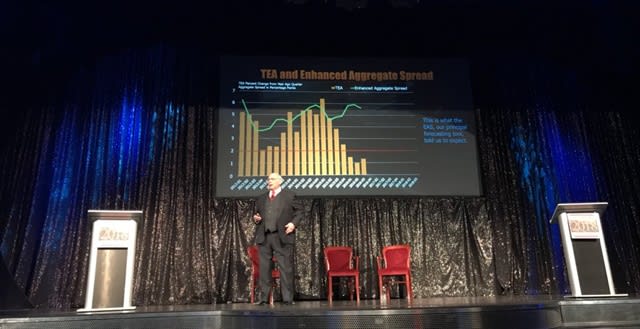
MacKay & Co.'s proprietary measure, Truckable Economic Activity, reflects the portion of the GDP that spends its time in trucks. Photo courtesy Today's Trucking via Twitter.
2 min to read
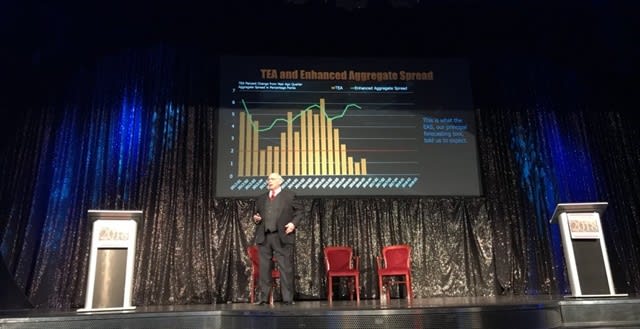
MacKay & Co.'s proprietary measure, Truckable Economic Activity, reflects the portion of the GDP that spends its time in trucks.Photo courtesy Today's Trucking via Twitter.
LAS VEGAS – Truckable Economic Activity is expected to continue at its current pace, according to Dr. Bob Dieli, president and founder of RDLB Inc., speaking at Heavy Duty Aftermarket Dialogue in Las Vegas.
TEA is a measure developed by MacKay and Co. to measure the part of the Gross Domestic Product that spends time in trucks.
Before looking ahead to what the trucking industry can expect for 2018, Dieli took a look back to what he had forecast for trucking at last year’s meeting.
His three keys takeaways from the 2017 meeting were:
The expansion phase was likely to continue through 2017
Domestic events, mainly fiscal policy, would have the biggest effect on TEA in 2017
The composition of TEA growth would continue to change
He was cautious a year ago about investment, exports and government — three of the five elements that make up TEA, the other two being consumption and imports — but by the end of the year, government spending was the only area of caution.
Dieli uses a tool called the Enhanced Aggregate Spread to help him forecast market conditions. At the end of the third quarter of 2017 (the latest period for which figures are available), all areas of TEA have shown growth, aided by truckable investment and truckable exports, but truckable consumption was the true driver of the growth. He expects this to continue with employment continuing to rise.
Looking forward, Dieli said TEA is continuing to follow the path normally associated with the expansion phases of the economic cycle.
Dieli’s forecast model shows that for 2018, expansion will continue and TEA growth will remain positive. The pace of recent capital spending has accelerated and businesses are placing orders and making purchases.
Demand for exports should continue and imports likely will continue to expand as a result of consumption and investment.
As for government, he says, “Considerable uncertainty remains at all levels of governments. The drag on TEA seems likely to persist this year.”
Concluding his remarks, Dieli made these predictions:
2018 looks to be another good year for TEA
The effects of the changes to the tax law will take a while to be seen, but the net impact is expected to be favorable.
More Fleet Management

Sponsored•September 1, 2026
How Telematics Improves Visibility, Control, and Performance in Refrigerated Fleets
Explore how telematics help refrigerated fleets improve visibility, uptime, efficiency, compliance, and cargo protection across connected cold chain operations.
Read More →
What the U.S.-Canada Trade War Means for Trucking
Escalating U.S.-Canada tariffs could disrupt cross-border freight, reduce truck volumes, raise costs, and create new uncertainty for carriers on both sides of the border.
Read More →
What Are Trucking’s Top Concerns for 2026?
The American Transportation Research Institute wants to know what's worrying trucking fleet managers, drivers, and other stakeholders in its annual Industry Issues survey.
Read More →

American Trucking Associations Looks for a New Leader
ATA President and CEO Chris Spear abruptly left his job at the association on August 21, at a pivotal time for the trucking industry.
Read More →
Public Wi-Fi Cybersecurity Risks: How Truck Drivers and Fleets Can Protect Their Data
Public Wi-Fi can expose truck drivers and fleets to credential theft, malware, and other cyber threats. Here’s how to reduce the risk on the road.
Read More →
For Nicky Cupp, Fleet Innovation Starts With Frustration
HDT Truck Fleet Innovator Nicky Cupp turns everyday pain points at Fraley & Schilling into opportunities for better technology and smarter processes.
Read More →
Adam Buttgenbach’s Approach to Electric Trucks: Start With Where They Fit
HDT Truck Fleet Innovator Adam Buttgenbach helped PepsiCo build one of North America’s largest EV fleets by focusing on where electric trucks make operational sense.
Read More →
Deen Albert: Let Automation Do the Math, People Make the Decisions
HDT Truck Fleet Innovator Deen Albert makes sure people are still at the heart of operations at Grand Island Express, even while adopting artificial intelligence tools. AI-assisted dispatch helped boost revenue 25% with the same number of trucks.
Read More →
Trimble’s New AI Agent Takes Aim at Fleet Back-Office Busywork
Arc Agent works across Trimble TMS products to automate repetitive tasks such as freight orders, maintenance, invoices, fuel costs and more.
Read More →
How HDT’s 2026 Truck Fleet Innovators Are Rethinking Fleet Operations
Meet five trucking leaders who are challenging assumptions, solving operational problems, and putting innovative ideas to work.
Read More →