




Related – Ray of Hope: Richard Branson on Trucking's Beacon of Fuel Efficiency
Run On Less Drivers Average 10.1 mpg, Surpassing Goals
Despite the challenges of two hurricanes, on top of the normal trucking challenges of high elevations, heavy loads, and crosswinds, seven drivers over 17 days and 50,000 miles managed to average 10.1 mpg overall in the Run on Less fuel-economy road show that concluded this weekend in Atlanta.
by Staff
September 24, 2017
PepsiCo was one of the title sponsors and also one of the participating fleets. Photo: Evan Lockridge
4 min to read
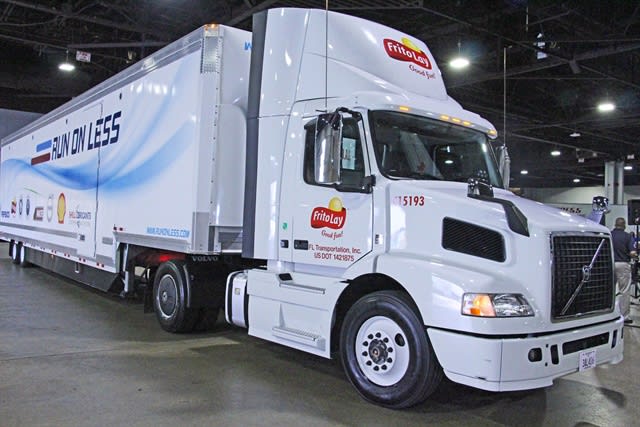
PepsiCo was one of the title sponsors and also one of the participating fleets.Photo: Evan Lockridge
ATLANTA – Despite the challenges of two hurricanes, on top of the normal trucking challenges of high elevations, heavy loads, and crosswinds, seven drivers over 17 days and 50,000 miles managed to average 10.1 mpg overall in the Run on Less fuel-economy road show that concluded this weekend in Atlanta at the North American Commercial Vehicle Show.
Run on Less, put on by the Carbon War Room and the North American Council for Freight Efficiency, proved that 10 mpg is possible using efficiency technologies that are available on the market today. The results exceeded the original 9 mpg goal set by CWR and NACFE.
Using a variety of commercially available technologies, including 6x2 axles, trailer and tractor aerodynamics, engine accessories, tire pressure systems, automated transmissions, low viscosity oils and others, they demonstrated that it is possible to save fuel in real world operations.
If the 1.7 million trucks on North American highways today achieved the same level of efficiency as the trucks in the Run, they would save 9.7 billion gallons of diesel fuel, $24.3 billion and 98 million tons of CO2 each year.
The 17-day event kicked off on Sept. 6. The trucks—from fleets Albert Transport, PepsiCo’s Frito-Lay Division, Hirschbach, Mesilla Valley Transportation, Nussbaum Transportation, Ploger Transportation, and U.S. Xpress— saved 2,877 gallons of fuel and $7,193 compared to the national average of 6.4 mpg. The highest mpg achieved in a single day was 12.8, and three different trucks had days over 12.5 mpg. The lowest mpg from a truck was 7.1 on one of the days, and the average for all lowest mpgs throughout the Run was 8.8. The average gross combination weight over the Run was 55,498 pounds, with 31 of the 99 days over 65,000 pounds.
The trucks were monitored over the three-week period with telematics devices from GeoTab.
Wind was monitored along each truck’s route using OpenWeatherMap.org, and it varied from a 6.8 mph average headwind to a 7.6 tailwind. All truckers dealt with hurricanes Harvey or Irma. Average vehicle speed was 54 mph and elevation gain was tracked for each route. One day, a truck travelled 3,270 ft. of elevation gain with 72,960 gross combination weight and experienced an average 2.7 mph headwind – and still achieved 9.7 mpg. The seven trucks have some similar specifications, but all have differences, demonstrating there are many different combinations of technologies that can achieve high levels of mpg.
The seven trucks—three Freightliners, two Internationals, and two Volvos, were piloted by experienced drivers—Henry Albert, Bradley Long, Tommy Revell, Roberto Sandoval, Joel Morrow, Clark Reed, and Mark Risien.
Shell and PepsiCo were the title sponsors; sustainability are core values for both of these companies. For instance, Shell’s Eco-marathon challenges students to design, build and drive the most energy-efficient cars. And Shell is sponsoring a Starship concept truck that will demonstrate freight efficiency.
Annie Peter, fleet sector marketing manager for Shell Lubricants, noted, “It will take collaboration among energy suppliers, lubricants producers and fuel retailers like Shell, vehicle manufacturers, fleet owners, businesses and other organizations to work together to consistently achieve the impressive fuel economy and CO2 reduction results these seven drivers accomplished during the Run. We are continually striving for more advanced technology, such as our low viscosity lubricants, to help reduce the loss of energy through friction, improve overall engine efficiency, and actively reduce emissions from combustion.”
Nearly a year ago, PepsiCo announced an ambitious global sustainability agenda, including reducing absolute greenhouse gas emissions across the company's value chain by at least 20% by 2030.
“We are so proud of Tommy Revell who drove on behalf of Frito-Lay, and all of the participating fleets and drivers for their contributions to this effort,” said Mike O’Connell, senior director, supply chain, PepsiCo, a former HDT Truck Fleet Innovator. “Run on Less demonstrated what can be accomplished when our industry comes together and combines readily available technologies with experienced drivers who leverage smart driving skills regardless of road and weather conditions. Now more than ever, it's so critical that we improve the fuel economy of our fleets as a way to meet sustainability goals and ultimately improve the bottom line for our respective organizations.”
Watch Truckinginfo.com for more details on how these drivers and fleets achieved this success.
More Fuel Smarts

California Bill Could Shed Light on Electric Truck Prices
Why do battery-electric Class 8 trucks remain so expensive? A California bill headed to Gov. Gavin Newsom would give fleets and state agencies more visibility into what manufacturers charge.
Read More →
Detroit Opens Orders for EPA 2027 Engines
Detroit isn’t starting from scratch to meet EPA 2027 diesel emissions standards. Its Gen 6 DD13 and DD15 engines keep much of today’s platform while updating the fuel and aftertreatment systems.
Read More →
Zero-Emission Truck Corridor Planned for West Coast
California, Oregon, Washington, British Columbia and Baja California are coordinating plans for truck charging and hydrogen fueling from Canada to Mexico.
Read More →
A Closer Look at Kenworth’s Electric T880E Vocational Truck [Video]
Learn more about Kenworth's T880E battery-electric vocational truck at the Paccar Technical Center, including its range, applications, upfitting considerations, and PTO options, in this HDT Spotlight video.
Read More →
Kenworth T880E Brings EV Power to Vocational Trucks
A closer look at the Kenworth T880E’s range, charging, powertrain and upfit options — and where fleets are showing the most interest.
Read More →
Jennie Abarca Is Proving Electric Trucks Can Do the Job
HDT Truck Fleet Innovator Jennie Abarca is building confidence in fleet electrification one load at a time while openly sharing the challenges she encounters along the way as a small-fleet owner.
Read More →
Cummins Adjusts 2027 Engine Rollout After EPA Proposal
The engine maker will gradually introduce its new Model Year 2027 diesel engines while continuing to offer current models during the transition, citing the EPA's proposed emissions rule changes.
Read More →
EPA Proposal Could Ease 2027 Truck Costs and Buying Uncertainty
The proposal doesn't change the tougher NOx standard, but it would revise key implementation requirements that manufacturers say have driven up costs and complicated fleet purchasing decisions.
Read More →
Cummins, Paccar Ease DEF Derates After EPA Guidance
Updated diesel engine software gives truck operators more time to address emissions-system issues while staying compliant with EPA emissions standards.
Read More →
Maintenance in the Messy Middle Part 3: Biodiesel
Biodiesel can reduce emissions, improve fuel-system lubricity and use existing diesel infrastructure. But NACFE’s Messy Middle maintenance report says fleets must actively manage storage, cold-weather operation, filters and oil drain intervals to avoid problems.
Read More →